
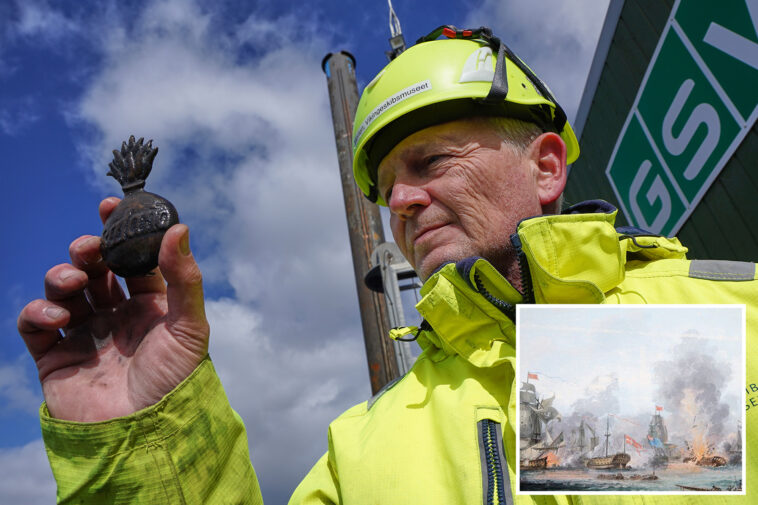
Danish archaeologists recently uncovered a ship that was battered by the forces of Vice Admiral Horatio Nelson, one of the most renowned naval commanders of his time.
The Viking Ship Museum in Roskilde, Denmark, announced in a release this month that its researchers uncovered the remains of the Dannebroge, a blockship destroyed during the Battle of Copenhagen on April 2, 1801.
The ship’s remnants were found ahead of the construction of the Lynetteholm project, and its discovery was announced on the 225th anniversary of the battle.
The vessel, representing Danish-Norwegian forces, attempted to protect the city of Copenhagen before it was “heavily hit, caught fire and ultimately exploded,” during the attack by the British, the museum said.
The battle was fought during the Napoleonic Wars, as Britain attacked Denmark to break a neutral alliance with other European powers that threatened British naval supremacy.
Some 700 people — the majority of them Danish — were killed in the battle, including at least 56 men aboard the Dannebroge, with 19 more listed as missing.

Pictures from the excavation reveal a haunting array of artifacts. The items include worn shoes, personal belongings, and various everyday items left behind — plus a human lower jawbone.
Otto Uldum, maritime archaeologist at the Danish Viking Ship Museum, said in a release he was positive the remains matched the description of the Dannebroge.
“The dimensions of the timbers correspond exactly to the drawings of the ship that survive, and the dendrochronological dating matches the vessel’s year of construction in 1772,” said Uldum.

“So we are stating this with a degree of certainty that borders on absolute. … We have found Dannebroge and the remains of those who never made it ashore after the battle.”
Uldum noted that the seabed is filled with cannonballs and shot, and excavators even found two cannons.
“We have found a number of personal belongings,” he said. “Shoes and fragments of clothing, and various small items the sailors would have carried with them — clay pipes, uniform insignia and weapons.”

Uldum added that, in addition to the jawbone, his team also discovered “several other bones, including ribs, which could very well be human.”
The remains belonged to at least one of the 19 men who were reported missing — something that officials realized was a possibility before they began diving.
“Even before the excavation began, the archaeologists knew they might encounter human remains in the wreck,” the release noted.

The Battle of Copenhagen is a defining moment in Danish history, and played a part in shaping the nation’s identity — making the excavation especially significant for the country.
“Although the battle is a central event in Danish history, no one, to my knowledge, has examined it archaeologically until now,” said Uldum. “That is actually quite remarkable.”
The reason is Denmark’s long-standing policy of leaving historic shipwrecks undisturbed unless they are threatened, said Morten Johansen, the head of maritime archaeology at the Viking Ship Museum.

The archaeologist told Fox News Digital on April 23 that it is illegal to “disturb, touch or remove material from these wrecks without permission.”
“The current archaeological work is taking place solely because the wreck lies within an area affected by planned construction,” he noted. “When development threatens protected cultural heritage, Danish legislation requires archaeological investigations to be carried out.”
“In other words, it is not a lack of interest or awareness that explains why this is the first archaeological excavation of a shipwreck from the Battle of Copenhagen.”