
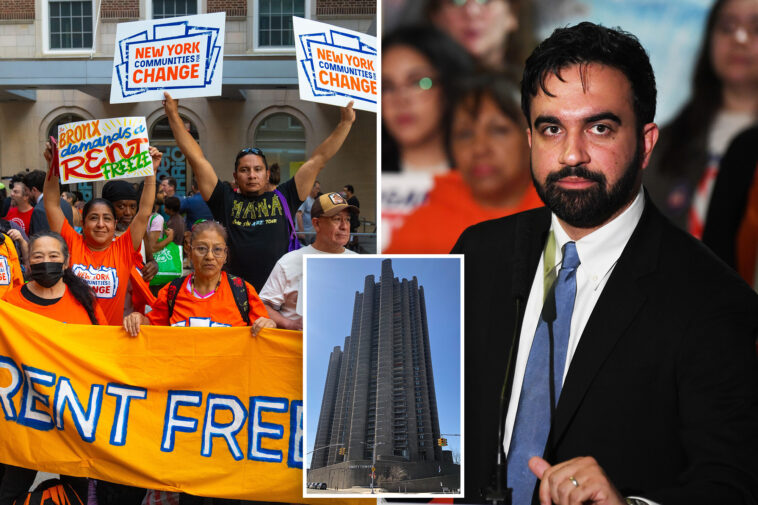
Mayor Zohran Mamdani’s rent-freeze is set to face serious legal challenges — with critics already slamming the newly-passed policy as a “political sham” that could cause huge rent hikes for market-rate tenants.
Landlords have been gearing up for the legal battle for months in anticipation of Thursday’s Rent Guidelines Board vote, insiders told The Post, with lawsuits expected to be filed in the coming weeks.
“Landlords might successfully argue that the freeze does not properly account for rising operating costs,” real estate lawyer Massimo D’Angelo said Friday. “They would need to show that the economic impact of a freeze and its interference with investment expectations is severe.”
Another “potentially stronger” argument that building-owners could take to court would be that their due process rights were violated, with the RGB accused of ignoring evidence on landlords’ rising costs before enacting the pause.
“Landlords would, in that case, argue that data on operating expenses weren’t properly considered,” D’Angelo said.
If legal challenges are unsuccessful, D’Angelo predicted landlords will either sell their properties or begin neglecting them — none of which would benefit tenants Mamdani professes to help.
“I think a lot of these buildings are going to be sold at a discounted rate,” he said. “A freeze that fails to account for these rising operating costs really strengthens the argument.

“Landlords are just not going to make repairs to stabilizer units,” he said. “There’s no incentive to update the units, leading to these tenants living in these subpar apartments. It helps no one.”
The 7-1 vote was cheered by watching crowds, with the passage ushering into action one of core tenets of Mamdani’s campaign — where the phrase “freeze the rent” was often plastered on signs, pushed on social media and chanted by supporters.
It came after hours one member of the nine-person RGB, a landlord advocate appointed by former Mayor Eric Adams, publicly resigned while claiming the panel’s decision might have crossed a legal line.
Christina Smyth argued the RGB ignored its own data about rising landlord costs and “stopped being a fact-finding body, instead becoming dedicated to delivering one of Mamdani’s key promises.
The decision had really been made “last year on the campaign trail,” she wrote in a scathing resignation letter.
Mamdani — who appointed six of the current RGB members — has argued the board was independent.
The decision will block rent increases on one and two-year leases for the 1 million stabilized units across New York City, beginning between Oct. 1, 2026 and Sept. 30, 2027. A later vote would be held to determine whether the freeze continues into 2028.
Critics claimed that the vote was hardly an impartial examination of renter and landlord needs, as the RGB is intended to be — while arguing the millions of New Yorkers who don’t live in stabilized units will just end up paying more.

D’Angelo agreed with Smyth, calling the vote a farce and questioning who the freeze will actually help.
“It’s irrational. It’s a sham. It was clearly politically motivated. The outcome was preordained,” he said. “If you go to the Upper West Side, it’s all these rich white people who have passed these down.”

Indeed, about 41% of stabilized units are occupied by single adults without children, while about 30% make more than $100,000 year, according to city housing data from 2023, the most recent year publicly available.
And one group is certain they will gain nothing from the freeze — landlords.
“They are going to take my f–king buildings. I’m desperate,” said Violet Zharku, who owns three rent-stabilized buildings in Queens and told The Post she’s spent years doing everything possible to update apartments between tenants — work which included recently pouring money into a new roof.
“We still wanted to invest in it and provide good quality housing. We did nice renovations in there because we want nice apartments, so we put a significant amount of money in there,” she said.
“We were in financial distress before even this rent freeze,” Zharku said. “Now this rent freeze is just like, OK, we’re putting up these freaking buildings up for sale.”
Frank Velovic, a Midtown doorman who also owns two Astoria properties, called rent freezes a “very bad idea” and a “disaster.”
“It’s nuts,” the 67-year-old said. “If a landlord doesn’t have income how is he going to maintenance the property?
“If you want to freeze some people’s income then freeze everything else,” he said. “Freeze the taxes, for one. Freeze the maintenance bills!”
Lincoln Eccles, owner of a 14-unit Crown Heights, Brooklyn building, found himself unexpectedly happy after the rent freeze passed — but only because he hopes the feds might intervene to block Mamdani’s power.
“I was upbeat,” Eccles said. “Honestly I’d say to the mayor, ‘Thank you.’ You have provided a pathway to freedom for people like me and my tenants, because the whole country can see what is being done to us. That this is an unjust assault. Abuse. Intentional harm.
“Doing the two-year lease and the one-year lease looks like it’s an attempt to do intentional harm to property owners,” Eccles added — referring to the fact that the RGB passed the freeze for two-year leases for the first time in its history.
Rent-freezes for one-year leases were previously passed three times, all under then-Mayor Bill de Blasio, in 2015, 2016 and 2020.
“I need to be able to rent my apartment at a reasonable price so that I could cover my bills,” Eccles said. “And the government is not allowing that.”
“I’m hopeful that the federal government can now see this, step in and vacate this unnecessary abusive law where the mob is running private property.”