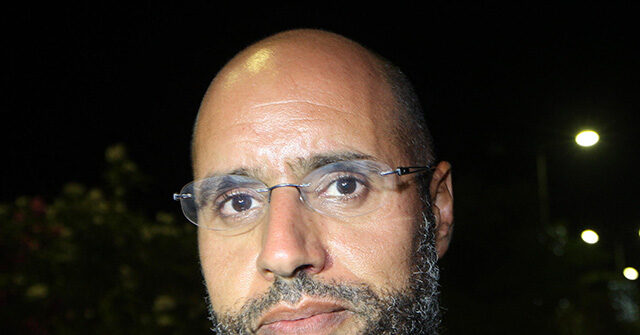
Saif al-Islam Qaddafi, the 53-year-old son and onetime heir apparent to former Libyan dictator Muammar Qaddafi, was reportedly murdered by a squad of masked gunmen in his hometown of Zintan, according to statements from his office, his political allies, and local media on Tuesday.
Qaddafi’s lawyer and chief political adviser both announced his death at the hands of “armed men” in Facebook posts on Tuesday. Qaddafi’s office later released a statement that said “four masked men” broke into his house in Zintan, which is about 85 miles from Tripoli, and murdered him in a “cowardly and treacherous assassination.”
According to Qaddafi’s office, the attackers neutralized security cameras at the victim’s home “in a desperate attempt to conceal traces of their heinous crimes.”
Libyan prosecutors on Wednesday confirmed “the victim died from wounds by gunfire,” and promised to conduct a thorough investigation. Libyan officials offered no theories as to the identity of the gunmen, or the reason Qaddafi was killed.
Saif al-Islam Qaddafi had a long and complex political history in Libya, even though he never formally held any office, either during his father’s four-decade reign or after he was overthrown and killed in 2011.
The urbane, London-educated Saif was long seen as the heir apparent to Moammar Qaddafi’s empire and, before 2011, he was viewed as something of a pro-Western moderate influence by the outside world, having participated in talks over Libya’s nuclear weapons program and compensation for the victims of the Lockerbie airplane bombing.
Saif dropped his moderate posture when the uprising against his father’s rule began in 2011, becoming a brutal enforcer for the regime. He became one of the most feared figures in Libya during the revolution, telling foreign reporters that the regime was prepared to unleash a “river of blood” to drown the uprising.
“All of Libya will be destroyed. We will need 40 years to reach an agreement on how to run the country, because today, everyone will want to be president, or emir, and everybody will want to run the country,” he railed in one televised speech.
After the fall of the regime, Saif was captured by a militia group in Zintan while he was attempting to flee into Niger, and held prisoner for almost six years. He was charged with crimes against humanity by the International Criminal Court (ICC), which issued a warrant for his arrest in June 2011, but was never able to bring him to trial.
In 2015, he was tried for war crimes by a court in Tripoli and sentenced to death by firing squad. The militia let him go in 2017, and he spent the next four years in hiding, fearing he would either be assassinated or dragged to Tripoli for execution.
Saif launched an improbable political comeback in 2021, popping up in the southern Libyan city of Sabha clad in traditional garb and running for the presidency in one of Libya’s spasmodic and doomed elections. He billed his candidacy as a return to the relative stability of his father’s reign, which was understandably a tough sell to Libyans who did not have fond memories of Moammar Qaddafi’s erratic rule, although it would be hard to argue that Libya became more stable after he was gone.
The election never happened, in part because of bitter arguments about whether Saif should be allowed to participate. He was ultimately disqualified on the basis of his 2015 war crimes conviction in Tripoli, and when he sought to file an appeal to that ruling, a group of armed men prevented him from getting into the courthouse.