
in

Melting point: Extreme heat threatens Italy’s parmesan heartland

melting-point:-extreme-heat-threatens-italy’s-parmesan-heartland
Melting point: Extreme heat threatens Italy’s parmesan heartland

MONTECAVOLO/MEDESANO, ITALY – Fifty years ago, farmers in Italy’s Emilia-Romagna region used to open the windows in their ​barns at night during the summer to keep their cattle cool.

Today, as heatwaves send temperatures soaring to record highs, ‌those windows stay open round the clock to protect the cows, and ultimately their milk, the foundation of the area’s centuries-old Parmigiano Reggiano cheese industry.

“Extreme heat impacts milk’s quality and quantity,” said Nicola Bertinelli, president of the Parmigiano Reggiano Consortium, who also runs the dairy farm that his family founded in 1895 on ​the outskirts of Parma.

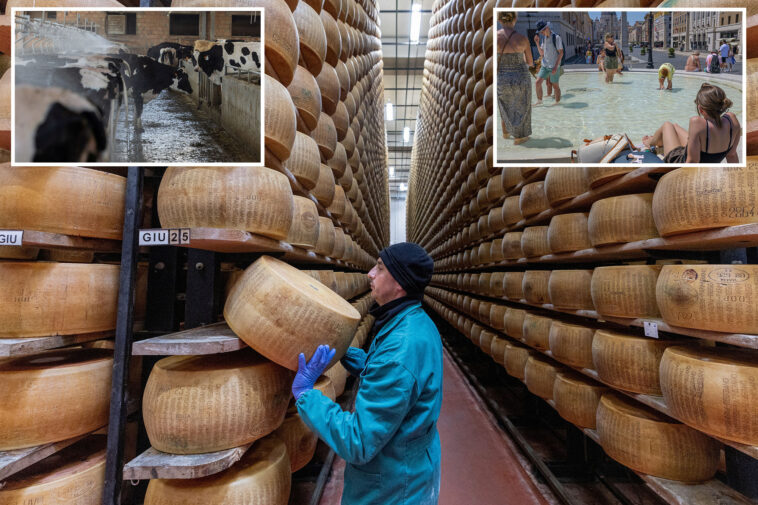
Nicola Bertinelli, President of the Parmigiano Reggiano Consortium, stands in a dairy barn with cows behind him.

Nicola Bertinelli, President of the Parmigiano Reggiano Consortium, in his family’s dairy barn in Medesano, Italy, on July 7, 2026. REUTERS

Tourists standing and sitting with their feet in the water of a fountain in Piazza Pia, Rome, Italy, during a heatwave.

Tourists seek relief in the fountain water in Piazza Pia during the hottest hours of the day, while Rome is trapped in the grip of July heat on July 11, 2026. ZUMAPRESS.com

A barn manager walks past open-sided sheds during a heatwave at a dairy farm.

A barn manager walks past the open-sided sheds of the Bertinelli dairy farm during the heatwave, in Medesano, Italy, on July 7, 2026. REUTERS

COSTS MOUNT AS CHEESE AGES

With temperatures topping 104 degrees Fahrenheit (40 degrees Celsius), cows spend more time lying ​down, eat less and produce up to 10% less milk, one of the Parmigiano’s only three ingredients alongside ⁠salt and rennet.

Production of authentic Parmigiano Reggiano is only allowed in five provinces, mostly in the Emilia-Romagna region, and cows must be ​fed exclusively with grass and hay grown there.

“If it doesn’t rain, grass doesn’t grow, hay cannot be produced and it’s impossible to obtain ​the milk needed to make the cheese,” Bertinelli, 54, told Reuters.

He and others have also installed fans and water-mist systems, but those extra cooling measures have sent their energy costs soaring.

A field of dry wheat stubble with hay bales and a farm building in the distance under a hazy sky, with white birds on the green foreground.

Wheat fields dotted with straw bales surround the Bertinelli dairy farm in Medesano, Italy, on July 7, 2026. REUTERS

Cows in a feed alley being cooled by sprinklers during a heatwave.

Cows wait in the feed alley as sprinklers spray to cool them off at the Bertinelli dairy farm. REUTERS

A farm manager watering fodder for cows in a dairy barn.

The barn manager wets freshly delivered fodder to keep it palatable for cows during the extreme heat. REUTERS

Rising bills are also hitting managers of the warehouses where cheese wheels are stored during the aging process for at least 12 ​months, sometimes three years or even longer.

More than 500,000 wheels of Parmigiano Reggiano, together worth more than $342 million (€300 million), are stored in the two warehouses operated ​by Credito Emiliano unit Magazzini Generali delle Tagliate (MGT) in the provinces of Reggio Emilia and Modena.

“During this year’s peak heatwaves, our daily energy consumption rose ‌by about ⁠30%,” MGT director Giancarlo Ravanetti said.

An employee turns a wheel of Parmigiano Reggiano cheese inside a cheese vault.

An employee turns a wheel of Parmigiano Reggiano cheese inside Credito Emiliano’s Magazzini Generali delle Tagliate cheese vault, amid a 30% surge in daily power use during the peak of the recent heatwaves, at the facility, which stores the aging wheels of cheese as collateral for low-interest loans to dairies, in Montecavolo di Quattro Castella, Italy, on July 6, 2026. REUTERS

Cows eating forage from headlocks with cooling spray pipes overhead.

Cows stretch through headlocks to eat a forage mix while overhead pipes deliver a cooling spray. REUTERS

“To make our facilities as energy-efficient as possible, we have improved our cooling systems and boilers, upgraded building insulation and increased renewable energy production,” he added.

‘WE DON’T WANT TO BE THE LAST GENERATION TO EAT IT’

The region’s climate-controlled warehouses have become institutions, collectively known as the Bank of Parmigiano. Behind their walls, technology and tradition go hand in hand.

Climate-controlled storage racks at Credito Emiliano's cheese bank.

New climate-controlled racks stand ready for additional stock at Credito Emiliano’s cheese bank, which secures credit for Parmigiano Reggiano cheese makers, in Montecavolo di Quattro Castella, Italy, on July 6, 2026. REUTERS

Rows of large Parmigiano Reggiano cheese wheels on wooden shelves.

Long-aged wheels of Parmigiano Reggiano cheese darkened by time line the shelves of a high-security cheese vault operated by Credito Emiliano. REUTERS

Each wheel of Parmigiano Reggiano undergoes strict ​quality inspections — including X-ray scans — to ​rule out defects. The cheese ⁠is checked weekly by experts who tap each wheel with small hammers, listening for signs of flaws that may have developed during the aging process.

“The human factor remains key and is the real strength ​of the entire process,” Ravanetti said.

Paolo Ganzerli, international sales director at food group GranTerre, which posted ​consolidated revenue of $2.14 billion (€1.87 billion) ⁠in 2025, echoed Ravanetti’s concerns about rising bills.

A grader checks a wheel of Parmigiano Reggiano cheese in a large cheese vault.

A grader listens for internal cracks during quality checks in the cheese vault as part of efforts to safeguard both product and collateral. REUTERS

A worker checks sealed portions of Parmigiano Reggiano cheese at a factory.

A worker checks sealed portions of Parmigiano Reggiano cheese at the end of the automated line at Caseifici GranTerre, where management says extended heatwaves are adding to production costs, in Montecavolo di Quattro Castella, Italy, on July 6, 2026. REUTERS

“If extreme events become longer-lasting and more intense, they will certainly have an impact on both the quantity and quality of milk, but above all they will lead to higher costs,” he said.

There is a lot at stake.

A person wearing blue gloves places Parmesan cheese wedges into plastic trays on a packing line.

A person places wedges of Parmigiano Reggiano cheese into plastic trays on the GranTerre packing line, a process that requires extra climate control during the summer. REUTERS

The Parmigiano Reggiano industry ⁠generates an ​estimated $5.15 billion (€4.5 billion) in revenue a year, employing thousands and powering the local economy.

In ​2025, exports of the cheese accounted for more than 50% of Parmigiano Reggiano’s global sales, with the United States as its largest foreign market.

Parmigiano Reggiano “has existed for more than ​800 years,” Ganzerli said.

“We don’t want to be the last generation to eat it.”

Leave a Reply

south-korean-court-sentences-ousted-president-yoon-to-2-years-over-manipulated-opinion-polls

South Korean court sentences ousted President Yoon to 2 years over manipulated opinion polls

rookie-russian-soldier-wildly-flung-from-machine-gun-turret,-nearly-kills-instructor-in-viral-training-video

Rookie Russian soldier wildly flung from machine gun turret, nearly kills instructor in viral training video