
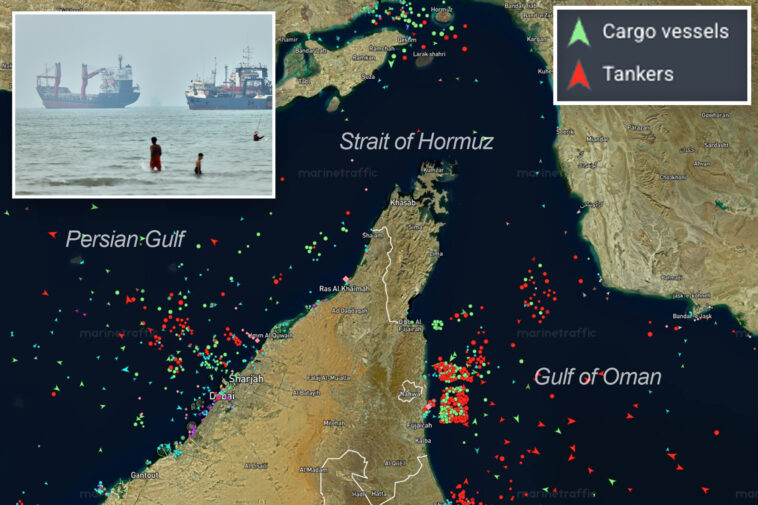

Oman is championing a new plan for the Strait of Hormuz that would permit Iran to receive “voluntary” fees from ships traveling through the critical oil chokepoint.
The plan, Reuters reported, takes inspiration from the Strait of Malacca in Asia, where Malaysia, Indonesia, and Singapore collect optional fees from ships to cover environmental, search-and-rescue, and other expenses that come with managing the waterway.
Oman, which sits on the opposite side of the southern entrance of the strait from Iran, previously alluded to its interest in working with Tehran on some sort of fee structure.

Iran Foreign Minister Abbas Araqchi discussed the proposal Monday with his counterparts in Oman and Saudi Arabia, per the wire service.
It was not immediately clear how Iran would be prevented from pursuing ships that did not wish to pay.

Last month, Oman and Iran said in a joint statement that they had established a working group to study the future of “navigation in the Strait of Hormuz and the services that will be provided in this regard and the costs associated with them in accordance with international standards.”
The US has long opposed the idea of mandatory fees for travel through the Strait of Hormuz, through which roughly one-fifth of the world’s seaborne oil flowed in peactime.
After President Trump ordered the launch of Operation Epic Fury, which commenced on Feb. 28, Tehran began carrying out sporadic attacks on the Strait of Hormuz to scare off ships from traveling through it.
Last month, the US and Iran reached a preliminary memorandum of understanding (MOU) as a framework for negotiations for a peace deal.

Under the MOU, Iran committed to ensuring “safe passage of commercial vessels with no charge for 60 days.”
But after the MOU was signed, Iran carried out additional attacks on ships in the Strait of Hormuz, which prompted Trump to order 13 consecutive days of strikes on the Islamic Republic in response.
The Pentagon halted those strikes late Friday after Trump claimed that talks with Iran had picked up momentum.
“I think there’s a good chance that something could happen,” Trump said Monday, “and if it does, good, if it doesn’t, we go back to doing what we were doing two days ago.”