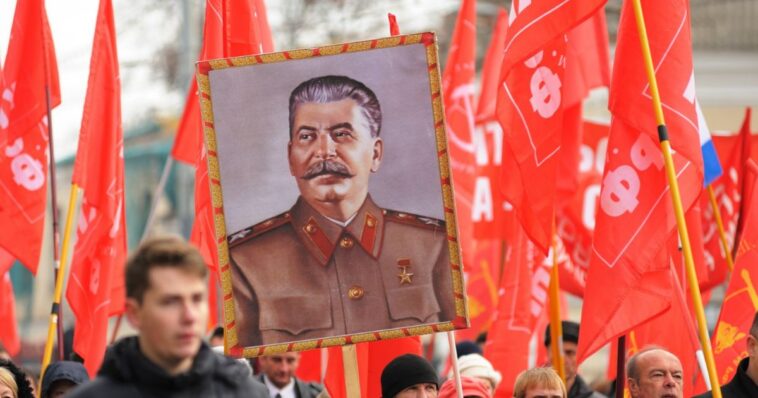
Joseph Stalin believed in predestination. Just not the Calvinist kind.
Both Stalinism and Calvinism can sound, at least superficially, as though history is moving toward an inevitable conclusion.
John Calvin taught that God is sovereign over creation, that nothing ultimately escapes His providence, and that salvation rests upon divine election rather than human merit.
Stalin likewise spoke the language of historical inevitability. Marxism-Leninism taught that history moved according to discernible laws, that capitalism would eventually collapse, and that socialism would triumph.
But there the similarity ends. Indeed, the differences reveal two radically opposed understandings of man, history, power, and God.
For Calvin, God controls history and man does not. For Stalin, there was no God, and therefore men like Stalin would have to take His place.
That difference may help explain why Calvin’s doctrine of election was intended to produce assurance and humility, while Stalin’s doctrine of historical inevitability produced terror.
Calvin is frequently caricatured as a grim theologian obsessed with predestination. Yet election was never intended merely as an abstract theory about who goes to heaven. It rested within a much larger doctrine of divine sovereignty.
The world, in Calvin’s understanding, was neither accidental nor autonomous. God did not create the universe and then abandon it to chance. He continually governed His creation.
That conviction had enormous practical significance.
If God governs history, the believer does not have to.
Wars may come. Governments may collapse. Disease may spread. Fortunes may disappear. Good men may suffer and wicked men may prosper. Yet none of these events means that history has escaped God’s control.
The Heidelberg Catechism, written within the broader Reformed tradition shortly after Calvin’s Institutes, expressed the idea beautifully. Providence means that “all things” come to us not by chance but through God’s fatherly hand.
But the Christian was not passive. He was commanded to work, pray, raise children, assist his neighbor, obey lawful authority, oppose injustice, and exercise whatever responsibilities Providence had placed before him. Yet the ultimate outcome of history did not depend upon him.
Stalin inhabited an entirely different intellectual universe.
Marxism rejected the Christian understanding of Providence and replaced it with historical materialism. History supposedly moved through conflicts between economic classes toward an eventual communist society.
Capitalism contained within itself the forces that would destroy it. The proletariat triumphed as class distinctions disappeared.
History had a destination, but no divine Author.
That created a problem. If history’s promised future did not arrive on schedule, somebody had to fix that.
Under Stalin, the Communist Party increasingly assumed that responsibility. And Stalin increasingly assumed responsibility for the Party.
The result was an extraordinary paradox. Marxism claimed that history was governed by impersonal forces, yet Stalin behaved as though the future of civilization depended upon his personal decisions.
Agriculture would be collectivized. Industry would be transformed. The kulaks would disappear as a class. Political opposition would be eliminated. Religion would be suppressed.
Millions of people would be relocated, imprisoned, starved, or killed if they stood between the present and the promised future.
Stalin therefore became something much more consequential than an ordinary dictator. He became, in practice, a substitute for Providence.
The Christian says: God governs history. The Stalinist effectively said: history has revealed its laws to the Party. And Stalin increasingly said: I speak for the Party.
The distance between those propositions is smaller than it first appears.
There is another curious parallel.
Calvinism teaches election. But election necessarily requires an Elector.
Stalinism produced something resembling election while eliminating God entirely.
Certain classes had been “chosen” by history. The proletariat represented the future. The bourgeoisie represented the past. Some people stood on the correct side of history. Others stood against it.
But “history” cannot choose anyone. History has no mind.
It cannot speak, judge, love, condemn, forgive, or elect.
Someone therefore had to interpret history’s supposed verdict. That responsibility fell to the Communist Party. And because the Party required leadership, enormous authority eventually accumulated in Stalin.
The transformation was remarkable.
God had been abolished, but judgment remained. Providence had been abolished, but predestination remained. Sin had been abolished, but heresy remained. The Church had been abolished, but orthodoxy remained. Hell had been abolished, but the Gulag remained.
And salvation itself became political: mankind would eventually be redeemed through the creation of a classless society.
The great difference was that the Christian doctrine placed judgment in the hands of God. Stalinism placed it in the hands of men.
This is where the doctrine of election is easily misunderstood.
Predestination can initially sound like an enormous assertion of theological power. Properly understood, however, it is an enormous denial of human power.
Man does not save himself. Man does not choose the circumstances into which he is born. Man does not control Providence. Man does not determine the final meaning of history.
And man certainly does not become God.
Calvin’s sovereign God therefore leaves very little room for the sovereign ego. Even the greatest king remains a creature. He will die. His kingdom will disappear. His accomplishments will be judged according to standards he did not create.
That is a profoundly inconvenient doctrine for dictators.
Stalin recognized no such authority above himself. Officially, of course, he remained subject to Marxism-Leninism and the Communist Party. But as his dictatorship matured, Stalin became the authoritative interpreter of both.
Political disagreement could therefore become something approaching theological heresy. And heretics must be eliminated.
The difference between Calvin and Stalin consequently becomes clearest when each confronts the uncertainty of history.
Calvin could say: God knows. Stalin had to say: I must decide.
There is something psychologically liberating about believing that history ultimately belongs to God.
It does not produce passivity. Calvin himself was hardly passive, nor were generations of Reformed Christians who founded churches, schools, businesses, charities, political institutions, and eventually entire communities.
But their theology contained an important boundary: Do what Providence requires of you and leave the future to God.
Stalin had no such luxury.
If there is no God, and if history nevertheless has a predetermined destination, then somebody must ensure that mankind reaches it.
The dictator becomes engineer, prophet, judge, and executioner. Failure becomes intolerable because failure is no longer merely a political setback. It threatens the entire theory of history.
When collectivization produced catastrophe, the ideology could not be wrong. Someone must have sabotaged it.
When industrial targets were missed, the economic theory could not be defective. Someone must have betrayed the revolution.
When political opposition appeared, perhaps history itself was being obstructed.
Enemies therefore had to be discovered. Confessions had to be obtained. Purges had to be conducted. People had to disappear.
Do you think history is governed by divine providence or human decisions?
Terror became not merely a technique for maintaining Stalin’s power but a logical consequence of a political system claiming certainty about history while denying any authority beyond itself.
The contrast ultimately involves two profoundly different understandings of history.
For Calvin, history has meaning because God exists outside history. God created time, governs it, and will ultimately judge what occurs within it.
For Stalin, history had to generate its own meaning.
That made political power enormously important.
If there is no transcendent Judge, the judgment of history becomes the highest conceivable tribunal. If there is no divine Providence, political action becomes the instrument through which history advances. And if mankind possesses knowledge of history’s inevitable destination, enormous cruelty can be justified as merely accelerating the inevitable.
Calvinism’s doctrine of human depravity warns against entrusting unlimited power to human beings. The same fallen nature exists in the prince as in the peasant. No political leader escapes it.
Stalin’s worldview effectively reversed that proposition.
Ordinary human beings could not be trusted to understand their own interests. They might cling to private property, religion, family loyalties, traditional customs, or political independence. Because the Party understood history better, it had to re-educate and re-orient the people.
Eventually Stalin understood the Party better than almost anyone else. The servant of history became its master.
Placing Calvin and Stalin beside one another creates an important contrast.
Both confronted the ancient human question of whether history has meaning and direction. Calvin answered that it does because history belongs to God. Stalin answered that it does because history operates according to material laws discoverable by man.
From those starting points came dramatically different conclusions.
Calvin’s believer could look upon a chaotic world and say: I do not understand what God is doing, but I will do my duty and trust in Providence.
Stalin could look upon a chaotic world and conclude that chaos demonstrated the necessity for greater control.
One worldview provides the comfort of confidence. The other demands the insecurity of constant management.
One places the outcome beyond man’s control. The other tempts man to seize control of the outcome.
And therein lies perhaps the greatest difference between Providence and ideology.
The doctrine of Providence tells man that history has a Master and that he is not Him. Stalinism abolished the Master but retained the plan.
Eventually someone had to take His chair. Stalin volunteered.
Millions died and continue to suffer under Stalin’s ideology.
By contrast, Calvinism liberates people to freely pursue their vocation and ministry, confident that the result of their labors rests in divine Providence.
Will Sellers is a graduate of Hillsdale College and an Associate Justice on the Supreme Court of Alabama. He is best reached at jws@willsellers.com.
The views expressed in this opinion article are those of their author and are not necessarily either shared or endorsed by the owners of this website. If you are interested in contributing an Op-Ed to The Western Journal, you can learn about our submission guidelines and process here.
Advertise with The Western Journal and reach millions of highly engaged readers, while supporting our work. Advertise Today.

Will Sellers was appointed to the Supreme Court of Alabama by Governor Kay Ivey in 2017. He was elected to a 6-year term in 2018 and re-elected in 2024. A life-long resident of Montgomery, he graduated from Hillsdale College, magna cum laude, The University of Alabama School of Law, and in 1989 received an LL.M. in Taxation from New York University. Before joining the Court, Justice Sellers was in private practice for 28 years in the areas of taxation, business organizations and corporate and campaign finance. He was a member of Electoral College in 2004, 2008, 2012, and 2016. Currently he is the community liaison for the International Officers School at Maxwell Air Force Base. Justice Sellers has written over 200 opinions. He and his wife Lee have three adult children and 4 grandchildren.