
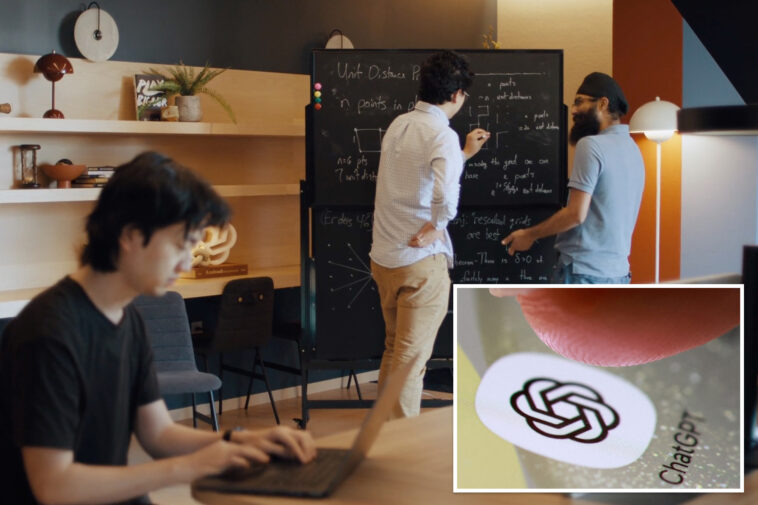
OpenAI claims its model solved a famous geometry problem that has eluded the world’s greatest mathematicians for 80 years — a breakthrough hailed as evidence of the bot’s creativity and “intuition.”
The company published its findings on Wednesday, demonstrating that one of its models cracked the planar unit distance problem, first posed by legendary Hungarian mathematician Paul Erdős in 1946.
The puzzle poses a deceptively simple question that boils down to: How many pairs of dots on a piece of paper can be the same distance apart?

The prevailing theory suggested that a “square grid” was the key to creating the maximum number of pairs listed in the problem, and Erdős himself proposed that the number of pairs could increase only slightly faster than the number of dots as more points were added.
OpenAI’s work, however, disproved the idea and proposed its own layout.
University of Toronto mathematician Arul Shankar, one of the experts who reviewed OpenAI’s work, went as far as to suggest the model used its own “intuition” to arrive at the surprising solution.
“In my opinion, this paper demonstrates that current AI models go beyond just helpers to human mathematicians – they are capable of having original, ingenious ideas, and then carrying them out to fruition,” he said in a statement.
Fellow Toronto professor Jacob Tsimerman said he was wowed by the results, noting that he had once tried to disprove the distance problem himself to no avail.

“It is definitely an intimidating construction to see through, even if you know what is going on, and even harder to go play for yourself,” he noted.
OpenAI has repeatedly touted its model’s use to help solve math problems and prove or disprove decades-old conjectures that were previously deemed too complicated to approach.
The breakthrough came just days after it was revealed that OpenAI’s ChatGPT was used to help solve another decades-old problem, allowing the mathematician who first thought up the solution to see his “sensational” idea proven right.

In 1995, renowned French mathematician Michel Talagrand, 74, made a sweeping statement, claiming that in a seemingly endless and scattered plane littered with points across innumerable dimensions, simple, orderly shapes will appear.
But what Talagrand believed would be a herculean task to prove or disprove his so-called “convexity conjecture” came to an abrupt end last week after mathematicians at the California Institute of Technology used OpenAI’s ChatGPT to play out his theory.
“This is the most extraordinary result of my entire life,” Talagrand told Scientific America about seeing the answer. “The proper word is ‘sensational.’”

At the heart of Talagrand’s conjecture was the idea that even when facing a billion dimensions, one could draw a simple shape that manages to encircle an enumerable number of points scattered throughout them.
The French mathematician himself was the first to pour cold water on his own theory, describing it as a “shot in the dark” and saying that, if true, it would amount to nothing less than a “total miracle.”
Talagrand had even put up a $2,000 reward for years for anyone who could take on the challenge, but a collector never came.
That is, until Antoine Song and his student, Dongming (Merrick) Hu, used ChatGPT to translate Talagrand’s problem and demonstrate that he was right.
The duo eventually worked with Stefan Tudose, a Princeton mathematician, on the final proof, choosing to exclude ChatGPT due to uncertainties in the language models’ “thought process.”