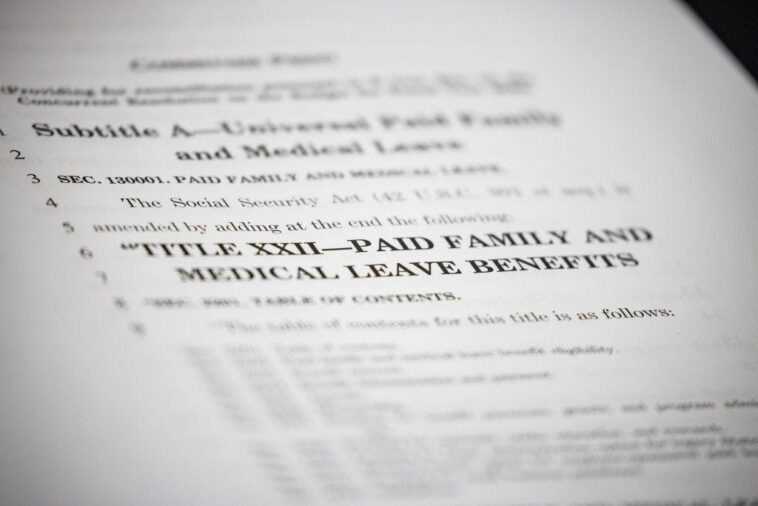
Last week, Virginia Democrats shepherded into law a paid family and medical leave program whose own fiscal impact statement projects an annual shortfall of more than $500 million, every year, beginning in the second year of operation. The math does not math. And the governor championed it.
The Department of Planning and Budget’s March 17 fiscal impact statement on HB 1207 lays out the program’s economics in plain numbers. In FY2030, the second year benefits are paid, the program is projected to collect $1.51 billion in payroll taxes while spending $2.04 billion on benefits and administration. That is a $528 million annual shortfall, on the program’s own numbers, before it ever reaches steady state. By FY2031, the gap widens to roughly $600 million. The General Fund is also lending $116.5 million up front to stand the program up before a single premium is collected, repayable from future payroll taxes by 2034.
The initial 0.72% payroll tax in the bill is based on utilization assumptions drawn from a Weldon Cooper Center study, which other states have already exceeded in practice. Worse, the bill itself acknowledges that the rate is insufficient. It requires the trust fund to maintain a reserve of at least 40% of expenditures, and authorizes the Virginia Employment Commission Commissioner to set the actual contribution rate annually beginning October 1, 2027. That is not a fixed tax. It is a floor, with the real number to be set by an unelected commissioner one month after the next legislative elections.
Virginians do not have to guess where this leads. Washington State’s paid leave program has been operational since 2020, and the trajectory is documented. In 2023, Washington legislators were forced to inject $200 million from the general fund into the trust fund because premium revenue could not keep up with claims. The program’s own actuary now projects a $350 million deficit by 2029. The state is on track to hit its statutory premium cap of 1.2% in 2027 and stay there, with no remaining headroom to raise rates. Virginia is worse: there is no cap on rates needed to “self-fund” the payroll tax.
This is the part that the governor’s celebration omitted. Virginia workers will not pay once. They will pay twice. First through the new payroll tax. Then again through general fund appropriations as the trust fund runs dry, drawing on the same income taxes that fund schools, roads, and public safety. A program that pays people not to work, supplemented by income taxes the rest of us pay, with the new line item on your checks hitting after the next election, is not landmark legislation. It is a structural deficit dressed up as affordability, with every incentive in place for fraudulent claims and every guarantee that taxes will rise to chase them.
Governor Abigail Spanberger calls this a competitive benefit that helps Virginia’s small businesses recruit. A benefit is not competitive when every employer with more than 10 people is mandated to offer it. That is not competition. That is a payroll tax. In Patrick County and across Southwest Virginia, the businesses that absorb it are the ones with the least margin to do so.
When voters go to the polls in November, they should remember the half-billion-dollar annual hole Virginia Democrats just signed every Virginian up for, whether they utilize the subsidy or not.
***
Del. Wren Williams represents Virginia’s 47th House District (Patrick County and the surrounding area). He is an attorney and a member of the House Republican Caucus.