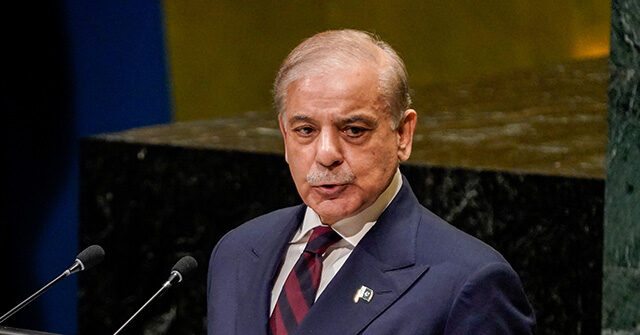
Pakistani Prime Minister Muhammad Shehbaz Sharif used much of his address to the U.N. General Assembly (UNGA) on Friday to criticize Pakistan’s regional rival India while touting his own government’s efforts at diplomacy, including mediation of the conflict between the United States and Iran.
“Unfortunately, in February this year, conflict engulfed the Gulf, along with the wider Middle East. Precious lives were lost. Economies suffered. Critical maritime routes, particularly the Strait of Hormuz, came under severe pressure,” he recalled.
“At this critical moment, Pakistan chose to act swiftly,” he said. “Through concerted efforts, Pakistan successfully brought Washington and Tehran under one roof in Islamabad. From Islamabad talks to the Islamabad Memorandum of Understanding, many historic steps were taken to bring an end to this serious conflict.”
Sharif said the region has “regrettably” seen a “dangerous surge of hostilities,” and recommended more “diplomacy” as the solution. He mentioned the two “arteries of the global economy” that have been menaced by terrorism from Iran and its Houthi proxies in Yemen: the Strait of Hormuz and Bab el Mandeb Strait.
“They must remain open, connecting nations, not becoming choke points of confrontation,” he said. “These waters must carry the promise of prosperity, not the perils of war.”
Sharif condemned “in the strongest possible terms” the “recent deplorable attacks by the Houthis against the kingdom of Saudi Arabia,” including “the attempted drone attack on the holy city of Mecca,” which he said has “outraged Muslims across the globe.”
Sharif said threats to the “safety and sanctity” of Mecca was “a red line that must never be crossed.”
“No Muslim can even dare to think of committing such a heinous crime,” he said. “Pakistan stands in complete solidarity with the brotherly people of Saudi Arabia, as we always have throughout our history.”
Sharif noted that Pakistan has a trilateral defense agreement with Saudi Arabia and Turkey known as the Mecca Joint Defense Agreement, which he held up as an example of his government’s “enduring commitment to peace.”
“This alliance is not directed against any country. It is a collective commitment for defense, stability, and peace in the region, and nothing more,” he insisted, perhaps by way of explaining why Pakistan has not acted to defend Saudi Arabia from the Houthis’ attacks.
Sharif went on to complain that Pakistan “faced aggression from India under a false pretext” last year, when the two nations fought a brief border skirmish following a bloody terrorist attack on Indian civilians.”
As he did at last year’s UNGA, Sharif claimed Pakistan defeated India in the conflict, although he did it without physically hammering the podium for emphasis, as he did in 2025.
“Our brave and valiant armed forces, under the courageous leadership of Field Marshal Shaheed Azam Munir, responded with precision and professionalism. They silenced the enemy, repulsed its attack, and taught it a lesson it shall never, ever forget,” he said.
The Indians, unsurprisingly, have a different memory of the conflict, and an Indian representative to the U.N. could be seen shaking his head in disagreement as Sharif spoke.
“Thanks to President Donald Trump’s resolute and visionary leadership that hundreds of millions of lives in South Asia were saved,” Sharif continued. “His timely intervention came at a decisive juncture when two nuclear-armed neighbors stood at the brink of an all-out war. Who knows the extent of the devastation that could have taken place, had President Trump not stepped in at this critical moment, with clarity of thought and action?”
Sharif said the only way to ensure that India and Pakistan never again reach such a “precipice” was to devise “a just and fair discussion of the Kashmir dispute” – the long-running contest for control of the disputed Kashmir region, where the terrorist attack that sparked last year’s India-Pakistan conflict took place.
“For eight decades, the Kashmiri people have waited for the United Nations to fulfill its solemn commitment of a free and impartial plebiscite under its auspices,” he said.
“Generations have endured illegal occupation, arbitrary detention, extrajudicial killings, enforced disappearances, sexual violence, and collective punishment,” he said, clearly implying that only India was responsible for any such abuses.
“More recently, there have been attempts to alter the legal status of Jammu and Kashmir through demographic reengineering and other illegal measures. Helpless Kashmiri mothers and fathers yearn for their sons and daughters who will never return,” he said.
Sharif was referring to India’s revocation of the special autonomous status given to the parts of Jammu and Kashmir under its control in 2019. The measure made it easier for people from outside the region to reside there and own property, and India restructured the regional government to more smoothly integrate it with India’s national government.
Critics charge India with making these changes in an effort to move more well-to-do Indian nationals (and others, including some 13,000 Rohingya refugees from Myanmar) into Kashmir, so they can force out the Pakistani Muslim population and buy up the land they have traditionally occupied.
Sharif vowed to extend Pakistan’s full influence to shield Kashmir from manipulation and ensure it receives an independence referendum.
“Kashmir has, and always will be, Pakistan’s jugular vein,” he declared.
The Pakistani prime minister also objected to India’s changing policies toward the Indus River Valley, whose waters were divided between India and Pakistan by a 1960 treaty. India declared the treaty to be “in abeyance” after its 2025 skirmish with Pakistan, and this month it rejected a ruling by the Permanent Court of Arbitration in the Hague that found India could not unilaterally suspend the agreement.
“The shared waters of the Indus River System are the lifeblood, not only for the people of Pakistan, but for the entire region,” Sharif told the UNGA. “India’s unilateral decision to hold the existing treaty in abeyance has no legal basis whatsoever.”
“Water must never be weaponized,” he said. “Rivers should nourish nations, not divide them. Therefore, any attempt to stop, impede, or divert Pakistan’s share of the waters will be treated as an act of war. India must make no mistake about it.”
Sharif then turned to the Palestinians, castigating Israel for allegedly subjecting “women, children, and the elderly” to “occupation, eviction, suffering, and death.” He accused Israel of having a “genocidal agenda” against the Palestinians, and demanded the unilateral creation of a Palestinian state to thwart it.
Like other Muslim leaders who spoke at the UNGA, Sharif made absolutely no mention of the Hamas terrorists who launched the Gaza War by savagely attacking Israeli civilians on October 7, 2023. He also demanded the U.N. “condemn continued Israeli aggression in Lebanon” without mentioning the Iran-backed Hezbollah terrorists who actually started that conflict by launching missiles at Israel.
Sharif spent considerably less time on the Palestinians than most of the other Middle Eastern speakers at the UNGA, pivoting swiftly to Pakistan’s clash with the Afghan Taliban, and the terrorists of Tehrik-e-Taliban Pakistan (TTP) that Islamabad accuses them of harboring and supporting. Pakistan and the Taliban regime in Afghanistan are currently exchanging cross-border artillery and air strikes.
“These foreign funded groups operate from sanctuaries inside Afghanistan with the aim of destabilizing Pakistan. All such attacks, including incursions from the territory of Afghanistan, must come to a grinding halt,” he demanded.
“The Afghan authorities must fulfill their international commitment and take verifiable, decisive action to ensure that Afghan soil is never again used against Pakistan or any other country,” he said.
“Fundamental rights of the Afghan people, especially women and girls, must be respected under all circumstances,” he added.
Like other Muslim speakers, Sharif denounced a rising tide of “Islamophobia,” but he was more specifically concerned with India’s nationalist RSS organization and its treatment of Muslims living in India.
“RSS driven Hindutva ideology is fanning religious hatred, leading to lynching, communal violence, attacks on places of worship and restrictions upon religious freedom. The demolition of the 150 year old mosque in Saharanpur, India, earlier this month is a case in point,” he said.
Sharif used the last part of his speech to defend Pakistan’s economic cooperation with Communist China via the China-Pakistan Economic Corridor (CPEC), and to salute the “visionary leadership” of Chinese dictator Xi Jinping.
Sharif called for more “timely debt relief, affordable long-term financing, and a stronger voice in global financial institutions” for developing nations, and he complained about climate change, insisting Pakistan was utterly blameless, and developed nations should shoulder the burden of climate remedies. He did not say if he thinks China, the worst polluter in the world by far, should pay a larger share of climate costs.