
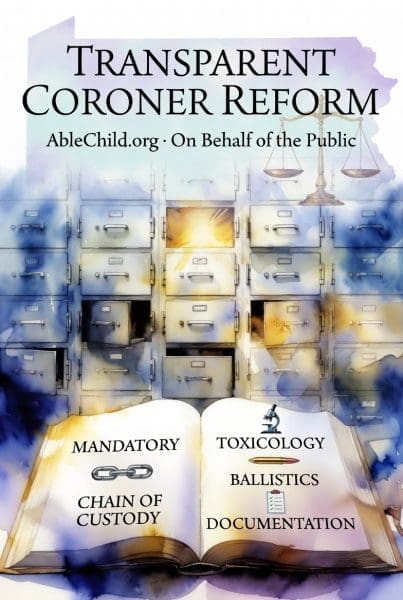
Republished with permission from AbleChild.
AbleChild: PROPOSED LEGISLATION PENNSYLVANIA CORONER STATUTE
An act amending Title 16 (Counties) of the Pennsylvania Consolidated Statutes, establishing mandatory forensic documentation standards, defining prohibited financial conflicts of interest for county coroners, and prescribing administrative and criminal penalties for violations.
The General Assembly of the Commonwealth of Pennsylvania hereby enacts as follows:
An Act Amending Pennsylvania Statutes Coroner
Section 1. Title 16 of the Pennsylvania Consolidated Statutes is amended by adding a section to read:
§ 13918.1. Chain of custody; conflicts of interest; penalties.
(a) Chain of custody and documentation.—Any coroner or deputy coroner shall maintain complete and accurate chain-of-custody records for all physical evidence, human remains, and associated samples received or handled in the performance of official duties. The coroner or deputy coroner shall document all items collected and shall create comprehensive investigative and autopsy documentation covering all aspects of the autopsy and related forensic testing. Where indicated by the circumstances of death, such documentation shall include toxicology, ballistic examination, and other forensic analyses. All records and documentation created under this subsection must be sufficient to support the stated cause and manner of death for each case within the county.
(b) Conflicts of interest.—
For purposes of this section, a “prohibited financial interest” means any direct or indirect ownership, employment, or commission-based arrangement with an insurance agency or company, a financial-services business that sells or advises on insurance or annuities, a funeral home, a body-transport service, or any other death-related business that may financially benefit from the outcome or documentation of a death investigation conducted by the coroner’s office.
A coroner or deputy coroner shall not use the powers, resources, or information of the office to solicit business for, or refer business to, any entity in which the official or an immediate family member holds a prohibited financial interest.
A coroner or deputy coroner shall recuse themselves from any investigation or official action in any case where a prohibited financial interest exists.
(c) Administrative penalties.—Any coroner or deputy coroner who violates subsection (a) by failing to maintain chain-of-custody records, failing to document items collected, or failing to create investigative and autopsy documentation—including required toxicology, ballistic, or other indicated forensic findings—sufficient to support the stated cause and manner of death for any case within the county shall be subject to:
- Immediate removal from office; and
- An administrative civil fine of not less than $100,000 per affected case, to be imposed by the designated state enforcement authority in a public enforcement action. The imposition of this fine shall not depend on, nor be stayed by, any private civil lawsuit.
(d) Criminal penalties for aggravated conflict-of-interest cases.—
A coroner or deputy coroner commits a felony offense punishable by a term of imprisonment of not more than five years if the person knowingly or recklessly violates subsection (a) in a case involving:
- (i) Homicide;
- (ii) Terrorism;
- (iii) Public corruption;
- (iv) An attack on a public official; or
- (v) Any offense affecting national security.
If a person commits an offense under paragraph (1) and, in connection with the same case, holds a prohibited financial interest as defined in subsection (b), the offense shall be deemed an aggravated violation. Upon conviction, an aggravated violation is punishable by a term of imprisonment of not more than ten years.
Section 2. Effective date.
This act shall take effect in 60 days.