
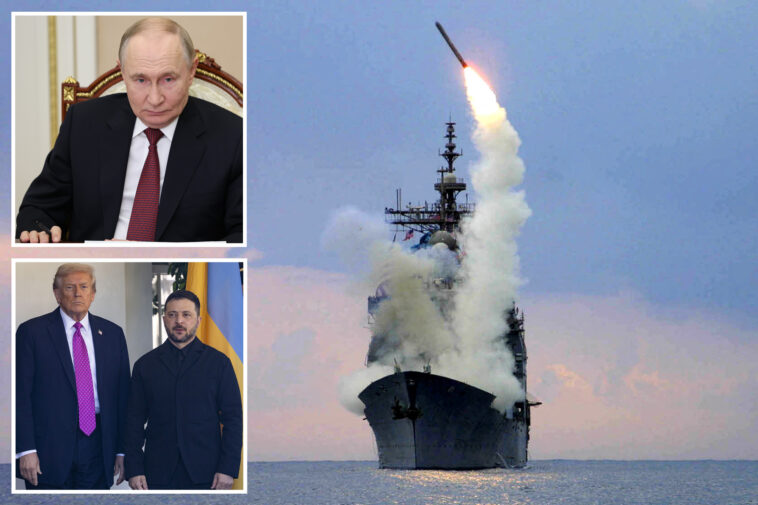
WASHINGTON — Russian dictator Vladimir Putin threatened President Trump not to send Tomahawk missiles to Ukraine in a phone call set in motion by White House special envoy Steve Witkoff ahead of a high-stakes meeting with Ukrainian President Volodymyr Zelensky.
With Zelensky scheduled to visit the White House the next day, Putin made the Oct. 16 call just as Trump was giving serious consideration to arming Ukraine with long-range Tomahawk missiles to ramp up the pressure on Moscow to end its nearly four-year war on the country.
The critical Putin-Trump call came after Witkoff suggested to Yuri Ushakov, Russia’s top foreign policy aide, that Putin ingratiate himself with the US president by stroking his ego on achieving the Gaza cease-fire deal about a week before, according to a transcript published by Bloomberg of an Oct. 14 call between the US envoy and Kremlin chief foreign policy advisor.

“I would make the call and just reiterate that you congratulate the president on this achievement, that you supported it, you supported it, that you respect that he is a man of peace and you’re just, you’re really glad to have seen it happen. So I would say that,” Witkoff suggested to the Russian. “I think from that it’s going to be a really good call.”
Ushakov responded: “OK my friend. I think that very point our leaders could discuss. Hey Steve, I agree with you that he will congratulate, he will say that Mr. Trump is a real peace man and so and so. That he will say.”
A readout of the Oct. 16 call from Russia says Putin indeed congratulated Trump about his “successful efforts” in Gaza and said Trump’s “peace work has been duly appreciated … around the world.”
Putin then told Trump that arming Ukraine with Tomahawks would “inflict substantial damage to relations between our countries, to say nothing of the prospects for a peaceful settlement,” according to Russia’s account of the call.
Witkoff did not tell the Kremlin to threaten Trump — and made no mention Tomahawks in the exchange, but said he believed Russia was ready to make a peace deal.
Putin was able to use the call to successfully talk Trump out of sending the long-range weapons — after Witkoff coached Ushakov on what Putin should tell the US president to convince him that Russia was ready to end its war on Ukraine, despite Moscow’s unwillingness to make any concessions.
“Maybe he says to President Trump: you know, Steve and Yuri discussed a very similar 20-point plan to peace and that could be something that we think might move the needle a little bit, we’re open to those sorts of things — to explore what it’s going to take to get a peace deal done,” Trump’s envoy said.
Witkoff then told Ushakov to ensure that Putin did not mention his intent to demand Ukraine give up land Russia has been unable to take in more than 11 years in the Donbas — which others in the Trump administration have dubbed a red-line “maximalist” demand — though he acknowledged that would be the long-term goal.
“Now, me to you, I know what it’s going to take to get a peace deal done: Donetsk and maybe a land swap somewhere,” he said, referring to the Donbas territory. “But I’m saying instead of talking like that, let’s talk more hopefully because I think we’re going to get to a deal here. And I think Yuri, the president will give me a lot of space and discretion to get to the deal.”

While Ushakov initially asked Witkoff for “advice” on whether it would be a good idea to get Putin and Trump on a call, it was the US envoy who suggested it take place ahead of the Zelensky meeting.
“And here’s one more thing: Zelensky is coming to the White House on Friday,” Witkoff said.
“I know that,” Ushakov said, chuckling.
“I will go to that meeting because they want me there, but I think if possible we have the call with your boss before that Friday meeting,” Witkoff said.
“Before, before — yeah?” Ushakov clarified.
“Correct,” Witkoff responded.
Leading up to the call, Trump had been signaling openness to sending Ukraine Tomahawks as a way to ramp up the pressure on Moscow to force them to the negotiating table after they consistently resisted ending its war throughout months of diplomatic talks.
Zelensky’s delegation had prepared maps of possible targets in Russia — from weapons facilities to oil refineries to help boost the impact of Trump’s Moscow energy sanctions — intending to talk Tomahawks.
However, the call with Putin had apparently convinced Trump against sending the weapons, choosing instead to hold onto hope that the Kremlin would be willing to end its war without the US having to give them reason.

Bonnie Cash/UPI/Shutterstock
By the time Zelensky arrived to the White House the next day to lobby for the weapons, Trump had written off the idea, according to sources familiar with the meeting.
The White House has brushed Witkoff’s exchange with Ushakov as everyday statecraft.
“This story proves one thing: Special Envoy Witkoff talks to officials in both Russia and Ukraine nearly every day to achieve peace, which is exactly what President Trump appointed him to do,” White House communications director Steven Cheung said in a statement Tuesday responding to the transcript’s release.
Trump has stood by Witkoff, saying the type of conversation was standard in negotiating.
“I haven’t heard it, but that’s a standard thing,” Trump said of the call. “You know, because he’s got to sell this to Ukraine, he’s got to sell Ukraine to Russia. That’s what a dealmaker does.”