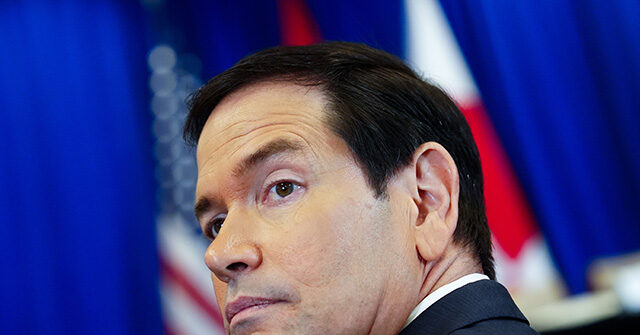
The Washington, DC, outlet Axios reported on Thursday that Secretary of State Marco Rubio personally ordered Iranian diplomats, allegedly in the United States to attend last week’s U.N. General Assembly, to leave the country after low-level discussions with the U.S. failed to produce results.
Two anonymous sources told Axios that the expulsion occurred; one of them described the reason as the Iranians “overstay[ing] their welcome” in America. The outlet described the situation as a “highly unusual diplomatic rebuke” from the State Department, particularly given that the Iranian delegation included high-level officials, most prominently Iranian Foreign Minister Abbas Araghchi.
Reports throughout the past two weeks indicated that informal conversations regarding the ongoing conflict between American and Iran had been taking place on the sidelines of the General Assembly, but had gone nowhere. Araghchi went public late last week with a proposal for the White House to end the American blockade of Iranian ships in the Strait of Hormuz – which has devastated Iran’s already limited oil industry – but President Donald Trump told reporters this weekend that he was not interested in the agreement. Trump suggested the Iranians were “desperate” to end the blockade, given the damage to the national economy they were enduring, but not offering any major concessions that could make for an appealing deal for Washington.
President Trump announced the launch of “Operation Epic Fury” on February 28 to neutralize the Iranian terror regime’s ability to pose a threat to America and Israel. On the first day of that operation, the military eliminated the country’s longtime dictator, “supreme leader” Ayatollah Ali Khamenei, and American and Israeli forces have since killed dozens of high-ranking regime officials, effectively replacing most positions at the top of the Iranian government. The Iranians have responded by bombing its Gulf Arab neighbors, rebooting the Houthi proxy terrorist organization in Yemen, and disrupting global shipping in the Strait of Hormuz.
The two countries signed an agreement in June to reopen the Strait and move towards ending the conflict, but Iran rapidly violated it and, while still technically viable, neither side has respected its terms since.
The Iranian government dismissed reports of its top diplomats being expelled from America on Thursday, denying that it happened. Iran’s United Nations mission confirmed that Araghchi and his underlings did leave the United States on Monday, but claimed they had planned to leave on that day, anyway.
“The Iranian delegation left New York on Monday evening, in accordance with the schedule that had also been communicated to the US Department of State in advance on September 17,” an Iranian mission statement read, according to the Emirati newspaper The National. “Having achieved nothing, the State Department has resorted to promoting baseless reports.”
The state-run Islamic Republic News Agency (IRNA) similarly denied the report, but elevated commentary from Iranian officials demanding dialogue and diplomacy to resolve the conflict with the United States. Foreign Ministry official Saeed Khatibzadeh, for example, was quoted on Russian television as insisting that Iran is looking “to resolve issues diplomatically” and promoting the Araghchi “seven-day initiative,” which would require the United States to lift the maritime blockade on Iran in the Strait immediately.
“We presented this plan to the American side via Qatar, and we recently received the other party’s views through the Qatari mediator and during the Foreign Minister’s brief stopover while returning from New York,” Khatibzadeh reportedly shared.
Araghchi publicly shared the “seven-day plan” on Friday as a form of pressuring the public to accept it. The deal would require the U.S. blockade to end and the lifting of all sanctions on the Iranian oil industry, as well as Iran receiving access to funds frozen in response to its status as the world’s most prolific state sponsor of jihadist terrorism. The agreement would also require Israel to end its campaign against the Iranian proxy terrorist organization Hezbollah in Lebanon. The Iranians offered to stop engaging in piracy against randoms ships in the Strait of Hormuz and to begin a discussion about its illicit nuclear program in exchange.
“They want to make a deal where they open the Strait immediately because they’re losing so badly,” Trump told reporters on Saturday. “They don’t have any money now, because they wanted to close the Strait. And I said, that’s fine. We’re going to close it on you, but everybody else is able to use it.”
“They want to make a deal, and I think that’s fine,” he added. “I like making a deal too, but that deal would not be acceptable.”
Iran’s currency, the rial, has been in freefall for months as a result of the conflict. The currency’s value fell to a record low on Tuesday of 2.5 million rials per U.S. dollar. Out-of-control inflation, supply issues, and other quality-of-life problems have led to widespread protests in the country, particularly in December 2025 and January 2026. The regime opted to silence the protests by engaging in widespread brutality, killing thousands of people in January.