The scale of damage inflicted by the US military operation to capture Venezuelan dictator Nicolás Maduro and his wife late Friday night came into focus over the weekend.
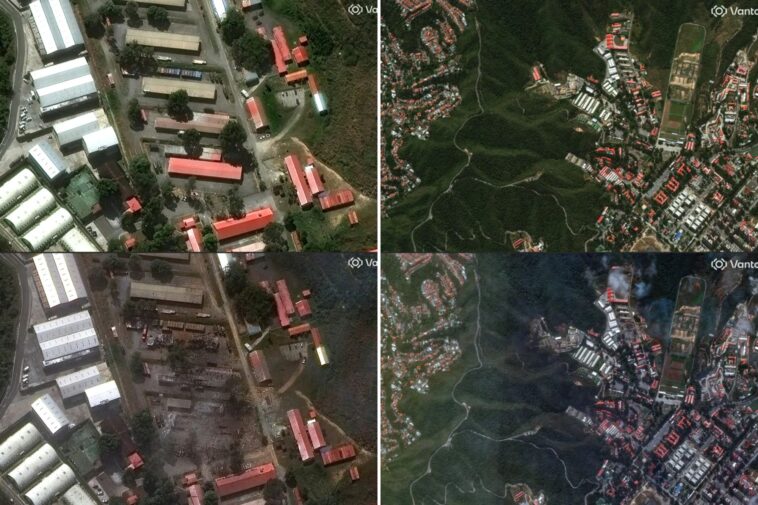
Before-and-after satellite images show vast sections of Venezuela’s military infrastructure torn apart in a matter of minutes — with several compounds reduced to rubble, scorched roads and twisted wreckage.
Entire buildings vanished while vehicles that had been parked in neat rows were burned out or blown apart.


Venezuelan government officials told the New York Times that at least 40 people, including soldiers and civilians, were killed in the raid, which US officials said took less than 30 minutes.
Venezuelan authorities did not say how many of the casualties were members of the military of the president’s Cuban bodyguards.
Rosa González, an 80-year-old woman who was living in an apartment building that was hit during the US raid, was identified by local authorities as one of the fatalities.
Fuerte Tiuna, Venezuela’s largest and most important military complex in Caracas, took the heaviest hit. Before-and-after satellite images from Vantor show entire buildings wiped out, with wide blast scars cutting through the base.
Here’s the latest on Nicolás Maduro’s capture:
- Marco Rubio says Venezuela’s VP Delcy Rodríguez isn’t a legitimate leader — as he outlines how next president will be chosen
- Nicolas Maduro flashes peace sign as deposed dictator’s grim-faced wife seen for first time since arrest, flight to US
- Mayor Mamdani’s comrades in DSA demand Trump release Nicolas Maduro: ‘Solidarity with the Bolivarian Revolution!’
- Maduro, wife greeted by jeers of ‘down with the dictator’ by hundreds of revelers at Brooklyn lock up
The assault also hit La Carlota, the military airbase where air-defense units and runways were taken out, according to witnesses.
La Guaira, the port that serves as a key logistics hub, sustained considerable damage to containers and dock facilities.

Several other military installations near Caracas, Miranda, Aragua and La Guaira were also hit, according to officials.
Eyewitnesses living in surrounding neighborhoods told local media that the strikes led to secondary explosions and fires — producing massive smoke plumes that were visible from a distance.
On the ground in Caracas, residents described the strikes as a night of explosions and low-flying aircraft, with power outages reported in parts of the city as people rushed into the streets and posted what they were seeing and hearing.
Maduro and his wife, Cilia Flores, are now in US custody in New York, with their first federal court appearances expected in Manhattan within days.
After arriving at a New York-area airport, Maduro and Flores were photographed under heavy guard as federal agents escorted them from the tarmac in frigid conditions.
Maduro appeared defiant, flashing a thumbs-up and a peace sign as he walked in handcuffs, while Flores cut a far more subdued figure, keeping her cuffed hands clasped in front of her and staring straight ahead.