
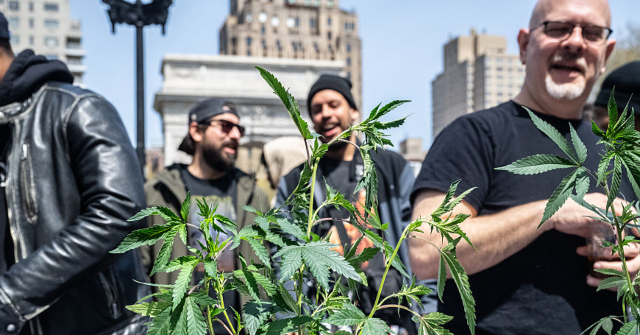
On Thursday the Supreme Court of the United States (SCOTUS) ruled against the prosecution of Ali Hemani for being a marijuana user in possession of a firearm.
The case is U.S. v. Hemani, and it centers Hemani’s conviction for being an “unlawful user” of marijuana who possessed a gun.
CBS News noted that the statute on which Hemani centers “was enacted by Congress in 1968 as part of the Gun Control Act and forbids an unlawful drug user from having a firearm. A violation of the law is a felony punishable by up to 15 years in prison.”
The defendant, Ali Hemani, was charged under the statute “after the FBI found a Glock 9mm pistol, 60 grams of marijuana, and a small amount of cocaine during a search of his family’s home in Texas.”
Oral arguments in Hemani were held on March 2, 2026, and Breitbart News reported that Justice Neil Gorsuch addressed the gun ban for “unlawful” users of marijuana by juxtaposing it with evidence that some of the Founding Fathers may be described as “habitual drunkards.”
Gorsuch said, “One can ask whether the habitual drunkard statutes are sufficiently… analogous. One could also ask though, more basically, whether this defendant would qualify as a habitual user. And I want to explore that before we lost track of it.”
He added, “[As for a] habitual drunkard, the American Temperance Society said back in the day, eight shots of whiskey a day only made you an occasional drunkard. We have to remember the founding era, if you want to invoke the founding era, to be a habitual drunkard you had to do double that.”
Gorsuch went on to note that John Adams, the Second President of the United States, “took a tankard of hard cider with his breakfast every day.” He pointed out that James Madison, the author of the Second Amendment, “reportedly drank a pint of whiskey every day.”
He also pointed to Thomas Jefferson’s alcohol consumption and then asked Principal Deputy Solicitor General Sarah Harris, “Are they all habitual drunkards who would be properly disarmed for life under your theory?”
The court ruled 9-0 in favor of Hemani and Gorsuch wrote the majority opinion.
In that opinion, Gorsuch explained that the government’s attempt to defend the ban fell short:
To square that expansive theory with the Second Amendment, the government invites us to draw an analogy between its present regulation and historical laws addressing habitual drunkards. Those laws, the government contends, demonstrate a tradition of firearm regulation consistent with its effort to disarm any regular user of any controlled substance without any further showing. But the government’s analogy fails under every measure it asks us to consider: The historical laws on which it relies targeted different kinds of people, did so for different reasons, and operated in different ways. And faced with all these shortcomings in the government’s submission, we cannot say it has carried its conceded burden of showing its prosecution of Mr. Hemani complies with the Second Amendment.
Justice Thomas wrote a concurring opinion and used it to warn about other outgrowths of the federal ban that he believes need correcting.
AWR Hawkins is an award-winning Second Amendment columnist for Breitbart News and the writer/curator of Down Range with AWR Hawkins, a weekly newsletter focused on all things Second Amendment, also for Breitbart News. He is the political analyst for Armed American Radio and the director of global marketing for Lone Star Hunts. He holds a PhD in Military History with a focus on the Vietnam War (brown water navy), U.S. Navy since Inception, the Civil War, and Early Modern Europe. He enjoys reading Philosophy and novels by Jack Carr and Nelson DeMille. He is a lever action man in an AR-15 world. Follow him on X: @awrhawkins. You can sign up to get Down Range at breitbart.com/downrange. Reach him directly at awrhawkins@breitbart.com.