
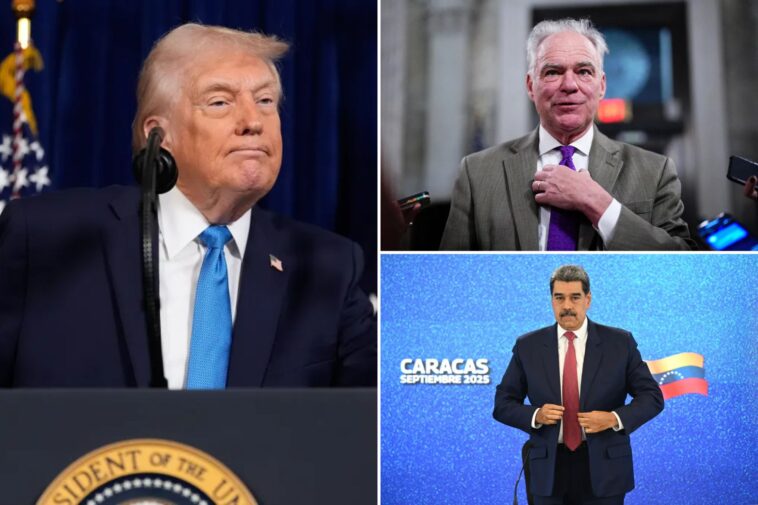
WASHINGTON — The Senate advanced a resolution Thursday to block President Trump from taking additional military action in Venezuela, just five days after the capture of Caracas strongman Nicolas Maduro.
In a 52-47 vote, the upper chamber agreed to consider a so-called “War Powers resolution” to force Trump to end hostilities toward the South American nation, in a blow to the administration.
The measure must still clear the Senate and House to take effect.


Five Republicans crossed party lines to support debate on the measure: Sens. Susan Collins of Maine, Josh Hawley of Missouri, Lisa Murkowski of Alaska, Rand Paul of Kentucky and Todd Young of Indiana.
Sen. John Fetterman (D-Pa.), a Democrat who has praised the Jan. 3 operation to apprehend Maduro, joined his colleagues in supporting the resolution, saying in a statement that he did it “so we can continue this important debate on the floor of the Senate.”
“I believe the arrest of Maduro was a positive development for Venezuela and its people,” Fetterman reiterated.
GOP leadership had frantically whipped opposition to the resolution, initially proposed by Sen. Tim Kaine (D-Va.)
Kaine — along with Paul, Senate Minority Leader Chuck Schumer (D-NY), and Sen. Adam Schiff (D-Calif.) — reintroduced the resolution last month, as Trump amassed military assets in the region and greenlit dozens of strikes against alleged drug boats.
“In the Senate, we Democrats are fighting to prevent military adventurism in Venezuela and other countries and endless wars,” Schumer told reporters ahead of the vote.
“Donald Trump said last night in his interview with The New York Times. It could take years to solve the problem in Venezuela. That is not what Americans want.”

Under the War Powers Act, Congress can adopt a resolution to stop a president from engaging in a military conflict without the consent of the legislative branch.
Unlike most legislation, it can pass the Senate with a simple majority rather than 60 votes.
The White House opposed the measure, arguing that it would undermine Trump’s authority as commander-in-chief.
“The actions of our Armed Forces have been directed by the President consistent with his inherent responsibility to protect US citizens both at home and abroad,” the White House wrote in a memo.

The Trump administration has defended the operation to capture Maduro as a law enforcement endeavor, pointing to the federal indictment against the Venezuelan strongman on drug and weapons charges.
The White House has sought to leverage its oil quarantine of Venezuela to pressure its current leader, Delcy Rodriguez, into making changes.
But there are questions about the longer-term strategy to transition Venezuela back to a democracy.
Trump has not ruled out boots on the ground in the country.
Start your day with all you need to know
Morning Report delivers the latest news, videos, photos and more.
Thanks for signing up!
“We will rebuild it in a very profitable way,” Trump told the New York Times in a wide-ranging interview Wednesday. “We’re going to be using oil, and we’re going to be taking oil.”
“We’re getting oil prices down, and we’re going to be giving money to Venezuela, which they desperately need.”
Lawmakers are also eyeing other war powers resolutions to stop Trump from taking military action against Iran or to acquire Greenland.
Last year, Congress repealed the Authorizations for Use of Military Force (AUMFs) for the Gulf War and the 2003 invasion of Iraq in passing the 2026 National Defense Authorization Act.