
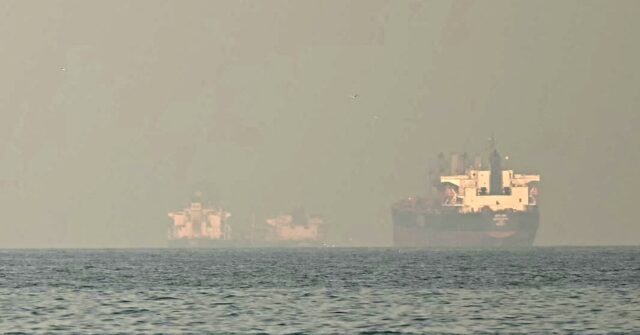
South Korean lawmaker Kim Young-bae revealed on Thursday that seven oil tankers operated by the nation’s refiners are presently stranded in the Strait of Hormuz.
This week, the Islamic regime in Iran threatened to “burn” any oil tanker attempting to sail through the Strait of Hormuz after the United States and Israel both launched a series of operations against high-profile targets of the regime. The attacks have so far resulted in the deaths of several key members of the rogue regime — including “Supreme Leader” Ayatollah Ali Khamenei.
Speaking at a Thursday emergency meeting of the ruling leftist Democratic Party, Kim, spokesperson on the National Assembly’s Foreign Affairs and Unification Committee disclosed that seven South Korean-flagged tankers carrying crude oil to local refineries are “effectively stranded” in the Strait of Hormuz, unable to proceed due to “deteriorating regional conditions.”
The lawmaker explained during the meeting that each tanker is carrying up to two million barrels of crude oil — the equivalent to one full day of the nation’s daily petroleum consumption. Collectively, all seven stranded tankers amount to seven days’ worth of consumption in South Korea.
“Each ship carries up to two million barrels of crude oil, equivalent to South Korea’s daily petroleum consumption. As this situation could disrupt national oil consumption, the business community has urged the need for countermeasures,” Kim said, as per the South Korean newspaper Chosun.
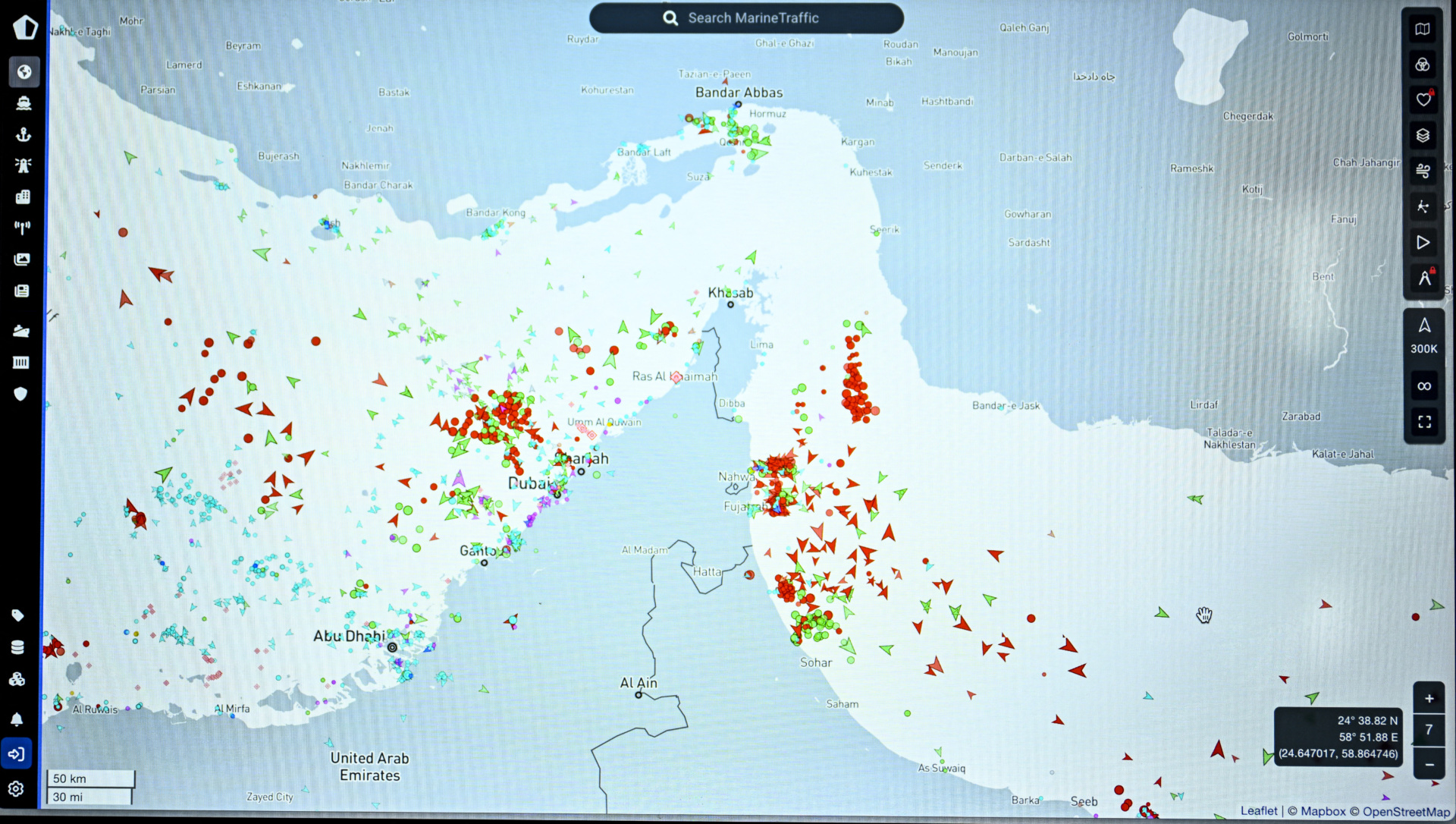
This photograph shows a page on the Marinetraffic website thats shows commercial boats traffic on the edge of the Strait of Hormuz near the Iranian coast, in Paris on March 4, 2026. (JULIEN DE ROSA / AFP via Getty Images)
“The seven ships are immobilized near the strait and cannot enter the route back to South Korea. If prolonged, this could disrupt the nation’s crude oil supply,” a source from the business community confirmed to Chosun.
According to Chosun, representatives from Samsung Electronics, Hyundai Motor Company, LG, HD Hyundai Oilbank, SK, GS Caltex, Hanwha Ocean, the Federation of Korean Industries, and the Korea International Trade Association were present in the emergency meeting.
“The semiconductor industry has expressed concerns that rising oil prices could lead to increased domestic electricity costs, ultimately raising production costs and undermining price competitiveness,” Kim said.
“Since 90 percent of helium, a critical material for semiconductor production, is sourced from the Middle East, the industry has raised concerns about potential disruptions in semiconductor manufacturing,” he continued.
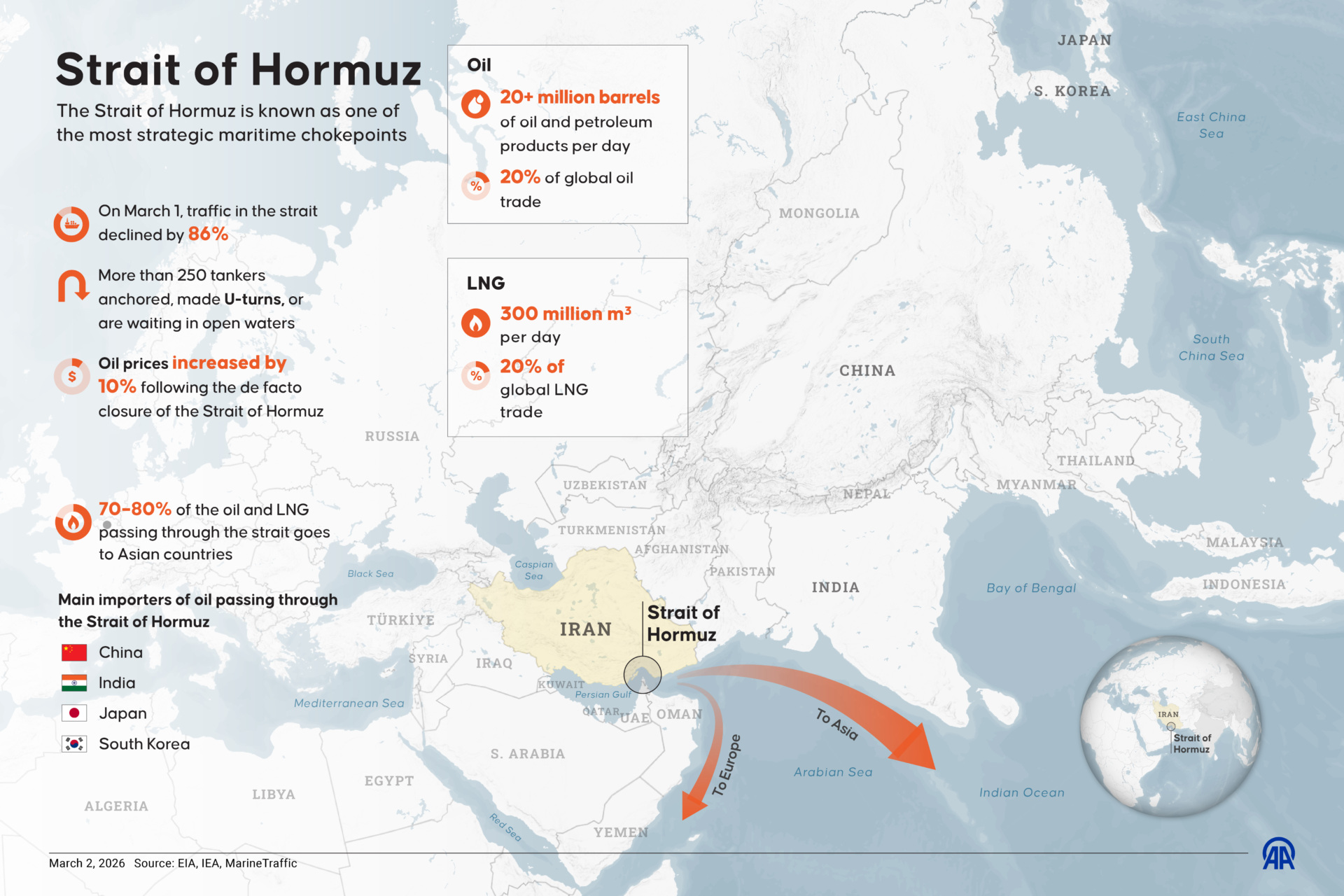
An infographic titled “Strait of Hormuz” created in Ankara, Turkiye on March 2, 2026. The Strait of Hormuz is known as one of the most strategic maritime chokepoints. (Photo by Mehmet Yaren Bozgun/Anadolu via Getty Images)
The Korea Herald reports that South Korea reportedly holds enough oil for 208 days, an amount that includes 76.4 million barrels of crude stored at government storage facilities. Representatives of the companies that attended the meeting reportedly inquired on whether there are “any ways for affected refiners to make use of government oil reserves to weather the crisis.”
The developing situation in Iran has raised concerns around the world’s shipping industry. As Breitbart News reported, President Donald Trump announced on a Truth Social post on Tuesday that he ordered the U.S. Development Finance Corporation to provide insurance “at a very reasonable price” for all maritime trade, especially energy shipments.
“If necessary, the United States Navy will begin escorting tankers through the Strait of Hormuz, as soon as possible,” President Trump’s message read in part. “No matter what, the United States will ensure the FREE FLOW of ENERGY to the WORLD.”