
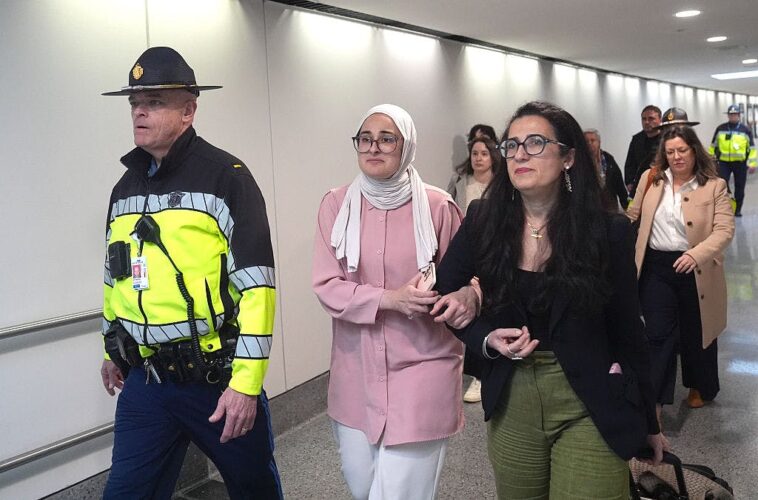
Turkish Tufts University student Rumeysa Ozturk, who was held in ICE detention last year after her visa was revoked over alleged “activities in support of Hamas,” has returned home to Turkey following a legal settlement with the United States.
The State Department canceled Ozturk’s student visa in 2024 after she co-authored an op-ed in her college newspaper calling on Tufts to recognize the “Palestinian genocide” and to divest from companies with ties to Israel.
In March 2025, ICE agents arrested Ozturk while walking on a street in Somerville, Massachusetts. She spent six weeks in federal custody before a judge ordered her release.
WATCH 🔴
Federal agents have arrested Turkish national Rumeysa Ozturk for her role in leading anti-Semitic, anti-Israel protests on her university campus. pic.twitter.com/WsU1VraUfK
— Open Source Intel (@Osint613) March 26, 2025
The government appealed the decision, but the case ultimately ended in a settlement after Ozturk completed her PhD in child study and human development.
Under the agreement, Ozturk returned to Turkey “without further interference by the Department of Homeland Security,” according to the ACLU.
“The time stolen from me by the U.S. government belongs not just to me, but to the children and youth I have dedicated my life to advocating for,” she said in a statement released by the ACLU. “With them in mind, I am choosing to return home as planned to continue my career as a woman scholar without losing more time to the state-imposed violence and hostility I have experienced in the United States – all for nothing more than co-signing an op-ed advocating for Palestinian rights.”
The resolution is welcome news to the Trump administration, which has taken a more aggressive approach toward foreign students involved in anti-Israel activism.
“Attending elite colleges and universities in the United States is a privilege afforded to foreign students who respect our values and follow our laws,” a Justice Department official said in a statement to Politico. “We will continue to seek the deportation of any foreign student who abuses their opportunity to study in America by engaging in vile antisemitism, harassment, or other illegal behavior.”
Ozturk’s detention became a flashpoint in President Donald Trump’s immigration enforcement efforts and emphasis on stopping antisemitism on college campuses.
Esha Bhandari, director of the ACLU’s Speech, Privacy, and Technology Project, accused the government of violating the Constitution.
“Rumeysa should never have been detained for expressing her opinions in a country that is supposed to protect freedom of speech,” Bhandari said.
As of early 2026, the State Department has revoked more than 100,000 visas, including roughly 8,000 student visas.
In a separate case, Mahmoud Khalil, a Syrian green card holder who led anti-Israel protests at Columbia University, recently lost a bid to have his deportation case thrown out.
“The bottom line is if you come here to stir up trouble on our campuses, we will deny you a visa,” Secretary of State Marco Rubio said last year. “These kids pay money to go to school, and they have to walk through a bunch of lunatics who are here on student visas.”