
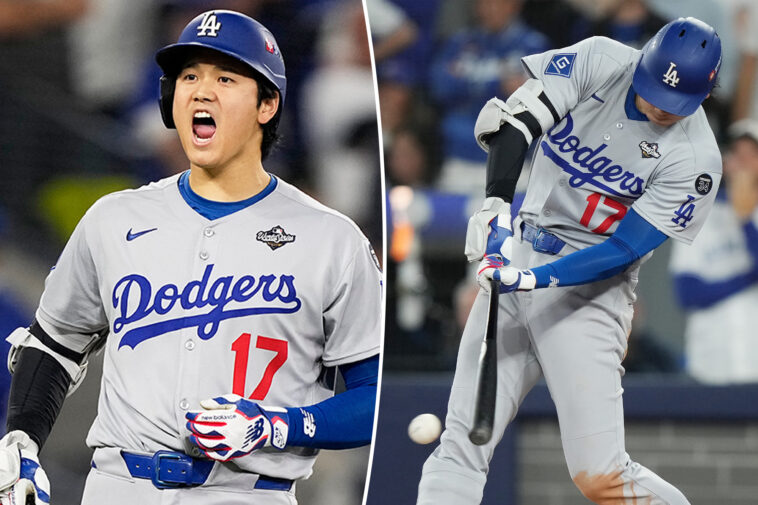
Kuyashii.
There isn’t an English equivalent to this Japanese word, which covers a wide range of emotions related to frustration.
You can feel kuyashii because you failed. Or because you gave your best and it wasn’t enough. Or because you didn’t give your best. Or because you were upset by what someone said. Or because you were humiliated.
Whatever the source of the anguish, ultimately you feel kuyashii because you can’t accept what happened.

In a television special by NHK that was aired in Japan last month, Shohei Ohtani reflected on his pitching performance against the Blue Jays in Game 7 of the World Series.
Only four days removed from his previous start, Ohtani looked gassed. He barely escaped a bases-loaded jam in the second inning. In the third, disaster struck, as he served up a three-run home run to Bo Bichette. The Dodgers were down, 3-0. With only one out in the inning, Ohtani was replaced by Justin Wrobleski.
Slipping into the past tense, Ohtani said to NHK of the home run by Bichette: “Kuyashikatta.”
Dodgers manager Dave Roberts sensed what Ohtani was feeling when he removed the ball from his hand on the Rogers Centre mound.
“There was a lot of frustration,” Roberts said, “maybe some anger.”
Reaching greater heights
Before leaving his home country in late 2017, Ohtani staged a news conference in Tokyo. There, he clearly articulated his goal for his upcoming MLB adventure.
“As long as you’re playing baseball,” Ohtani said, “I think it’s natural to want to be the No. 1 player.”

That designation has belonged to him for the last five years, a period in which he has won four MVP awards. His move to the Dodgers two years ago helped him fill the most significant gap in his resume. The Dodgers recovered from his 2 ⅓-inning start in Game 7 and went on to beat the Blue Jays, making him a back-to-back World Series champion.
But what makes a four-time MVP is an ability to discover new forms of inspiration, and Roberts thinks Ohtani’s memories of his final start will propel him to greater heights.
“There’s always something that Shohei needs to fuel him,” Roberts said. “He’s already the best player in the game, most likely, probably, the best to ever lace them up. So, how does he keep motivated? Things that have frustrated him or angered him. And going short in Game 7 probably is something that he’s not gonna let happen again.”
Ohtani is extremely polite in formal environments and playful when interacting with his teammates, his demeanor concealing the intensity described by Roberts. But it’s there.
Ohtani is Kobe Bryant with a glove and a bat.
Roberts thinks it’s entirely possible this is the year in which Ohtani wins the only major prize that has eluded his grasp in his first eight seasons: the Cy Young Award.
“I would not be surprised to see him and (Yoshinobu) Yamamoto both vying for a Cy Young in ‘26 and be (in) the top-three conversation all year,” Roberts said.
Responding to challenges
Ohtani was made available by the Dodgers in a news conference between games 2 and 3 of the National League Championship Series against the Brewers. Because he was in an offensive slump, he was asked multiple questions about how his pitching affected his hitting. The viability of his two-way role was being questioned.

Two days later, Ohtani shut up his skeptics, blasting three home runs and striking out 10 batters over six scoreless innings.
Ohtani has said he isn’t motivated by what reporters say or write about him. However, when he’s in situations that would make the average person feel kuyashii, he responds with performances that redefine the boundaries of reality.
When he joined the Nippon-Ham Fighters of the Japanese league out of high school, his decision to be a two-way player was criticized by the country’s baseball establishment, which accused him of underestimating professional competition.
Within a few years, he was the best player in the league — as a two-way player.
When Ohtani moved to the United States, he struggled at the plate in his first spring training with the Angels, inspiring questions of whether he could hit in the majors.
In the season that followed, he was named the Rookie of the Year — primarily as a hitter because an elbow injury limited him to 10 games pitched.
When he was told by Angels management before the 2021 season that he wouldn’t have any days off built into his schedule — he previously didn’t play the days before and after he pitched — he thought the team was trying to force him to give up either pitching or hitting.
Ohtani went on to win his first MVP award.
People familiar with Ohtani’s history, including Roberts, know what this means. Ohtani will be a monster of a pitcher this year.
Pushing the boundaries
Ohtani was the No. 3 starter on a Dodgers postseason rotation that included Blake Snell, a two-time Cy Young Award winner, and Yamamoto, the World Series MVP.
Outside of that last start against the Blue Jays, Ohtani performed well as a pitcher, going 2-1 with a 3.50 ERA in the three other games he started. The team’s reliance on him obscured what Ohtani was up against last season, spending most of the year rehabilitating.

Ohtani didn’t throw a pitch in his first season with the Dodgers in 2024, as he was recovering from an elbow operation he underwent the previous year. He returned to the mound in mid-June of last year, but even then, he was in recovery mode. His overwhelming talent allowed him to rehabilitate in major league games, first by pitching just an inning, then two, then three. His first five-inning start was in the last week of August.
Studying data about the control problems of pitchers in their first year back from Tommy John surgery, Ohtani adjusted his delivery to generate more velocity on his pitches. Previously, he placed more emphasis on control than speed, he told NHK.
Download The California Post App, follow us on social, and subscribe to our newsletters
California Post News: Facebook, Instagram, TikTok, X, YouTube, WhatsApp, LinkedIn
California Post Sports Facebook, Instagram, TikTok, YouTube, X
California Post Opinion
California Post Newsletters: Sign up here!
California Post App: Download here!
Page Six Hollywood: Sign up here!
Now, in his second year back from his second elbow reconstruction, the 31-year-old Ohtani should be able to pitch in a way that he believes is most effective.
Roberts doesn’t expect Ohtani to make the 28 to 32 starts generally required for a pitcher to be considered for the Cy Young Award — the manager said he wants to be mindful of Ohtani’s pitching future — but the two-way star could be ready to have the most complete season of his career.
He’s healthy. He’s in his prime. And, considering how last season ended, he might have the inducement to once again push the boundaries of what’s possible.