
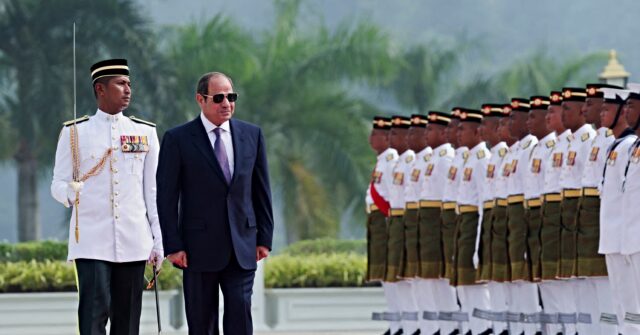
Egyptian President Abdel Fattah el-Sisi, who came to power after a 2013 coup, said on Saturday he will step down in 2030.
He was not clear about the process of selecting his replacement, but he said the Egyptian Military Academy would play a key role in training the next generation of national leaders.
“I will not leave the Egyptian state except when it is replete with sons and daughters capable of assuming responsibility,” Sisi said in an address to graduates at the military academy.
Sisi proposed a 30-month training program at the academy for candidates aged 40-50 who already hold doctorates, to prepare them for national leadership. He made contradictory statements about whether graduation from this training program would be a requirement for candidates in national elections or not.
“We will not prevent anyone, but from this group you might choose those who assume responsibility in the Egyptian state,” Sisi said at one point during his remarks to the Egyptian Military Academy graduates.
Later in the same address, however, he suggested drafting a law that would “regulate” the 2030 election to include only “those who meet the conditions I am talking about.” Later still, he suggested that “anyone who has served in a ministry for six years or more” could be exempt from the requirement to attend a leadership training program at the military academy.
“We should not hand it to just anyone. Not anyone who says a few well-arranged words should step forward to lead the Egyptian state,” Sisi said. “I will not leave the Egyptian state except when it is replete with sons and daughters capable of assuming responsibility.”
Sisi pointed out during his speech the putative end of his presidency was “approximately forty-three months” away, so there would be little time to lose in creating his 30-month military academy training program for candidates and getting them enrolled.
The sitting president said he wanted to announce the program early “so that no one can make accusations and say he is grooming someone, his family or relatives” to succeed him.
Sisi also made a point of saying the training program would be crafted by the Egyptian parliament, working with “a group of trusted thinkers and politicians,” rather than being unilaterally created by himself. He said the government would cover the cost for qualified candidates attending the Egyptian Military Academy, to forestall accusations of creating a high financial barrier to running for the presidency – although, of course, his administration could be accused of blocking candidates it disfavors by refusing to let them enroll in the leadership training program.
Sisi adamantly stated during his speech he would not try to amend the Egyptian constitution before leaving office, which made his departure in 2030 “a matter that has been completely settled and will not be discussed.”
The constitution was amended in 2019 to extend presidential terms to six years and make third terms possible, which is why Sisi, now 71 years old, will remain in office until 2030 after winning his first election in 2014, after deposing Muslim Brotherhood president Mohammed Morsi in the 2013 coup. Egyptian social media has recently been buzzing with rumors that Sisi could try amending the constitution again next year to make a fourth term possible.
If Sisi keeps his promise not to revise the constitution, it would also make his presidential training program a purely voluntary endeavor because the current constitution does not require any special training or academic credentials for the presidency.
On the other hand, Sisi hinted during his address on Saturday that a change he made to the constitutional language concerning the military in 2019 could open the door for requiring presidential candidates to receive certification from the Egyptian Military Academy by passing a law, rather than amending the constitution again.
The Global Arab Network (GAN) on Saturday suggested Sisi’s idea for candidate training would simply be “institutionalizing the pipeline for leadership in Egypt” that already exists, since the deposed Morsi was one of the few top leaders in generations who did not have a military background.
“The integration of high-level academic credentials with military-aligned leadership training suggests an emphasis on creating a cadre of candidates equipped with both deep intellectual backgrounds and a disciplined approach to governance,” GAN predicted optimistically.