
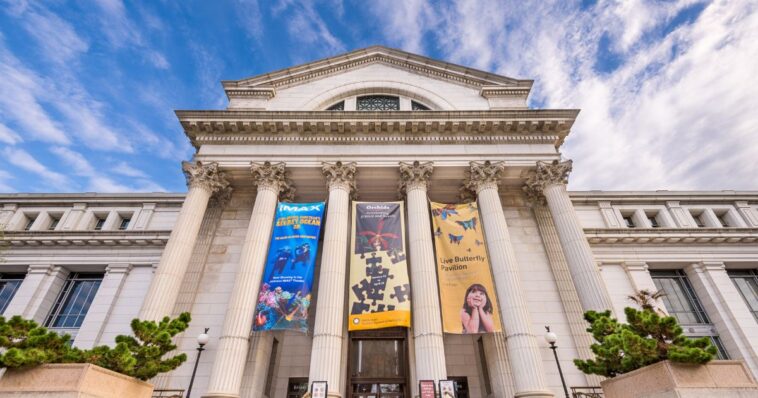
Banners hang at the entrance to the National Museum of Natural History in Washington, D.C., on April 12, 2015. (SeanPavonePhoto / Getty Images)

By Randy DeSoto July 7, 2026 at 9:00am
The Smithsonian Institution’s National Museum of American History has embraced “extreme political activism” rather than displaying the fundamentally inspiring story of the United States, according to a new White House report.
The findings come after President Donald Trump issued an executive order in March 2025 titled “Restoring Truth and Sanity to American History.”
The order stated, “Over the past decade, Americans have witnessed a concerted and widespread effort to rewrite our Nation’s history, replacing objective facts with a distorted narrative driven by ideology rather than truth.”
The White House’s Domestic Policy Council said in the executive summary of its 162-page “Saving America’s Story” report released on Monday, “Our central finding is not that the Museum has simply added overlooked stories, corrected perceived errors, or broadened its historical scope. Rather, it is that Museum leadership has explicitly adopted an ideological framework that no longer treats the American story as a shared national inheritance to be taught or celebrated, but as a political instrument to divide, dispirit, and discourage our citizens.”
“This ideological capture has moved the Museum’s mission away from straightforward historical education and scholarship toward an extreme political activism that seeks to transform our country,” the report said.
The report further noted that Anthea Hartig, the museum’s director since 2019, has stated on multiple occasions that such is her goal.
Hartig sees history as a “prime tool of social justice” and one of her roles as connecting “research and scholarship to activism and advocacy.” Hartig has also said that “we work to reframe the traditional celebratory narrative of U.S. history for visitors.”
Hartig moreover believes the museum profession has “to figure out” how “we’re going to” “problematize” the “250th Anniversary of the signing of the Declaration of Independence in 2026,” that “loving America is very complicated,” and that objects in the Museum’s collection “should be used to move attention away from an ‘Anglo-centric’ focus on the American Founding.”
The Domestic Policy Council pointed out, “These are not the words of an objective historian, but rather those of an activist advancing an ideological agenda contradictory to the Museum’s founding purpose of fostering patriotism.”
“A sweeping new White House report concluded that the Smithsonian Institution’s National Museum of American History (NMAH) has become a taxpayer-backed institution of ‘ideological capture’ and ‘extreme political activism.’”https://t.co/foAsSoPoaB
— Karoline Leavitt (@PressSec) July 6, 2026
How can one not be Anglo-centric when discussing America’s founding and the 250th anniversary of the signing of the Declaration of Independence?
After all, the Revolutionary War took place in Great Britain’s 13 American colonies. And the colonists argued in the Declaration that the reason they were separating from the mother country was because the King and Parliament were not securing their God-given rights as citizens of the realm.
You can’t get much more Anglo-centric than that.
“Any proper telling of American history should — as the Reverend Dr. Martin Luther King Jr. noted — explain that ‘the goal of America is freedom’ and bring ‘our nation back to those great wells of democracy which were dug deep by the founding fathers in their formulation of the Constitution and the Declaration of Independence,’” the Domestic Policy Council contended.
“As this report shows, the Museum purposely presents America as a problematic country irredeemably conceived, founded by deeply flawed men, and still operating today as an instrument of systemic racism and oppression. In the Museum’s current telling, the country is, above all, defined by white supremacy, slavery, conquest, exclusion, hierarchy, racism, xenophobia, misogyny, and systemic injustice,” the report said.
“To the extent that there is a story told at the Smithsonian’s National Museum of American History, it is not one of ‘the victory of freedom and genius of our country’ but one of regret, tragedy, and shame.”
In the new 2026 edition of my book “We Hold These Truths,” by contrast to the Smithsonian, I do chronicle the “victory of freedom.”
The book is divided into three main sections showing the progression: Liberty Brought Forth, during the Revolutionary War era; Liberty Carried Forward, during the Civil War; and Liberty Passed On in World War II. It concludes with where we stand today and what will be needed to flourish in the years ahead.
My new book, “We Hold These Truths: The Two Beliefs That Still Hold the Power to Transform the Nation and the World,” is out, and it could not be more timely with #America250 and the rise of socialism. The book hits key moments in US history from the founding to today!… pic.twitter.com/Ot0pWyKcag
— Randy DeSoto (@RandyDeSoto) June 25, 2026
Surprisingly, one of the key findings of the Domestic Policy Council’s report about the Smithsonian is that there are no major exhibits dedicated to the nation’s founding era.
If one were to give special attention to any one era in American history, you would think it would be the founding, when the purpose of the new nation was clearly stated in the Declaration.
The report found that “a visitor to the Museum today will find no major exhibit dedicated to America’s Founding era, George Washington, Thomas Jefferson, other Founding Fathers, the Continental Congress, the Pilgrims, the Puritans, or major moments of the American Revolution, such as Washington’s crossing of the Delaware. Instead, visitors will find Founders, such as Benjamin Franklin, introduced chiefly through their connection to slavery while their decisive roles in building the Republic and their anti-slavery efforts are minimized or ignored.”
As I record in my book and discussed in a recent Western Journal podcast, Franklin was president of Pennsylvania’s Abolition Society, whose chief aim was ending slavery in all of the United States, because at that point during the Revolutionary War in 1780, the state had already voted to outlaw slavery within its borders.
By 1804, during Thomas Jefferson’s first term as president, all the states north of Maryland followed Pennsylvania’s lead.
So the United States was actually at the forefront of abolishing slavery worldwide. No other governments were passing similar laws at the time.
Great Britain did not outlaw slavery in its empire until 1833.
Further, the United States Congress passed legislation banning the importation of slaves into the country, which President Jefferson signed into law on March 2, 1807, a few weeks before the British Parliament approved a similar measure.
It should also be highlighted that the Continental Congress, during the same summer of 1787 while the Constitutional Convention met across the street in Philadelphia, passed legislation banning slavery in the Northwest Territories, making up the future states of Ohio, Michigan, Indiana, Illinois, and Wisconsin.
And the notorious three-fifths compromise in the Constitution helped the pro-abolition movement over time.
Southern states wanted to count all the slaves in terms of population for the apportionment of seats in the House of Representatives. The Northern states wanted none of them counted unless they were freed.
As the nation grew, the number of anti-slavery members of Congress increased until they outnumbered the pro-slavery ones, thanks in part to the three-fifths compromise.
I go into more detail about this history in the book and the podcast.
Thankfully, the Trump White House is calling out the taxpayer-funded Smithsonian: Teach the whole truth, not a distorted woke version of it.
Advertise with The Western Journal and reach millions of highly engaged readers, while supporting our work. Advertise Today.
Randy DeSoto has written more than 4,000 articles for The Western Journal since he began with the company in 2015. He is a graduate of West Point and Regent University School of Law. He is the author of the book “We Hold These Truths” and screenwriter of the political documentary “I Want Your Money.”
Birthplace
Harrisburg, Pennsylvania
Nationality
American
Honors/Awards
Graduated dean’s list from West Point
Education
United States Military Academy at West Point, Regent University School of Law
Books Written
We Hold These Truths
Professional Memberships
Virginia and Pennsylvania state bars
Location
Phoenix, Arizona
Languages Spoken
English
Topics of Expertise
Politics, Entertainment, Faith