
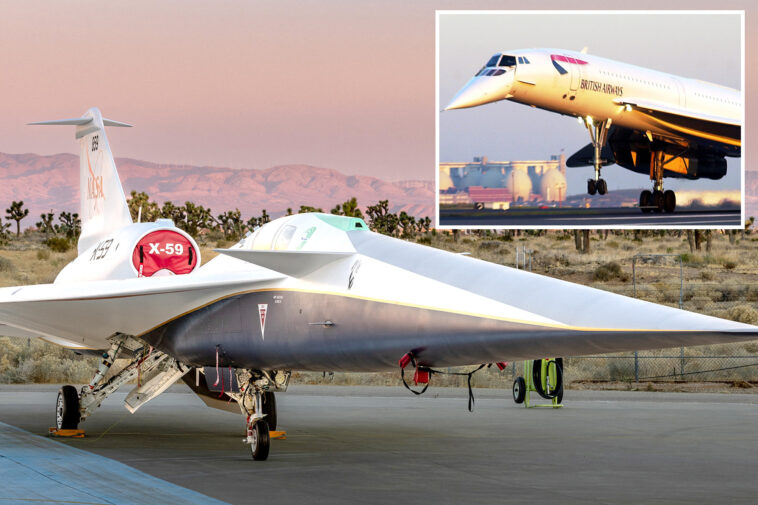
Cross-country travel could one day look very different if NASA’s newest experimental aircraft lives up to its promise as its prepares to make history in the California desert.
The agency’s X-59, a futuristic jet designed to fly faster than the speed of sound while dramatically reducing the noise that has plagued supersonic aircraft for decades, is now preparing to begin a new block of test flights that will include its first supersonic flights.
“Flying at supersonic speeds is a major milestone for the X-59 team,” project manager Cathy Bahm said.


The cutting-edge jet is being pushed to the limit at the US Air Force’s Plant 42 in Palmdale, California, where engineers are putting its critical safety systems through a gauntlet of tests.
With the final round of safety checks now underway, the aircraft is closing in on a major breakthrough — its long-awaited first supersonic flights.
The experimental aircraft is expected to reach speeds up to Mach 1.6, or about 1,218 mph during its tests.
At its mission-conditioning target, it is designed to fly at Mach 1.4 (about 925 mph).


At those speeds, the roughly 2,450-mile trip between Los Angeles and New York City could theoretically be completed in about two and a half hours, potentially cutting today’s typical five-to-six-hour journey by more than half.
NASA is developing the X-59 as part of an effort to prove that supersonic travel can be quieter and more practical than previous generations of high-speed aircraft.
Sign up for the California Morning Report newsletter
California’s top news, sports and entertainment delivered to your inbox every day.
Thanks for signing up!

Rather than producing the thunderous sonic boom traditionally associated with breaking the sound barrier, the aircraft has been engineered to create a much softer “thump.”
The jet has drawn comparisons to Concorde, the iconic supersonic airliner that once carried passengers across the Atlantic at speeds of up to Mach 2.04, or 1,354 mph (2,179 kph).

Concorde could reach New York from London in roughly three hours before being retired.
Based on the X-59’s projected performance range, a nonstop London-to-New York flight could still take about three hours and 44 minutes.
Download The California Post App, follow us on social, and subscribe to our newsletters
California Post News: Facebook, Instagram, TikTok, X, YouTube, WhatsApp, LinkedIn
California Post Sports Facebook, Instagram, TikTok, YouTube, X
California Post Opinion
California Post Newsletters: Sign up here!
California Post App: Download here!
Home delivery: Sign up here!
Page Six Hollywood: Sign up here!


The upcoming flight campaign will mark a major step for a program aimed at reopening the door to supersonic travel over populated areas, something that has remained largely out of reach for decades because of noise concerns.
The NASA X-59 has logged a total of 15 subsonic test flights to date, and engineers are currently prepping the aircraft for its first supersonic breakthrough in early June.