
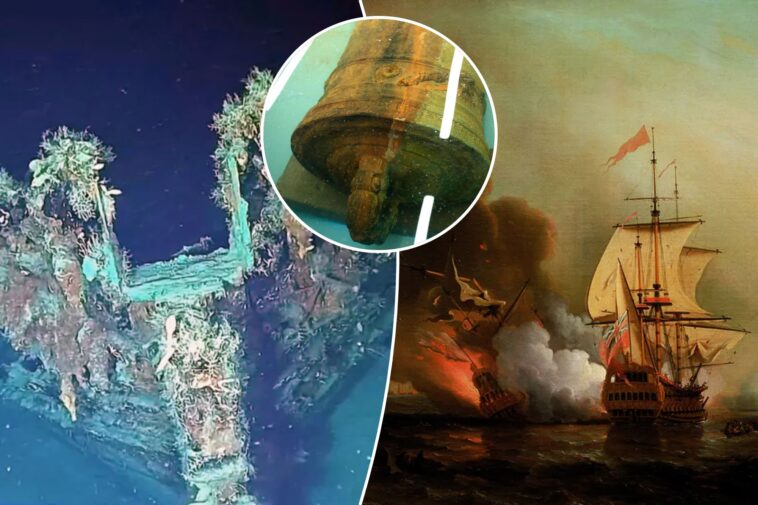
More than a decade after it was found, a centuries-old Spanish treasure ship worth billions remains nearly untouched on the seafloor while Spain, Colombia, Indigenous groups, and American booty hunters wage a bitter international legal war.
On Thanksgiving Day of 2015, Roger Dooley, a maritime archaeologist from Miami, saw something he’d been searching for for decades.
Looking at the computer screen in his waterfront apartment in Cartagena, Colombia, his hands trembled. He was reviewing footage from a Woods Hole Oceanographic Institution underwater robot that had spent seventeen hours scanning the Caribbean seabed.

Clicking through grainy sonar images, Dooley and his colleague saw a sword hilt sticking out of the sand, and three bronze cannons lay in a bed of seashells — each bearing a small dolphin-shaped marking, a telltale signature that identified the wreck beyond doubt.
“I’m still thinking I’m dreaming,” Dooley said.
They’d found the San José, a Spanish galleon that had vanished in 1708 carrying gold, silver and emeralds plundered from Indigenous peoples across the Americas — a cargo estimated to now be worth $5 billion or more.
“[It’s] the greatest sunken treasure in the history of humanity,” Julian Sancton, author of a fascinating new account of the discovery, “Neptune’s Fortune: The Billion-Dollar Shipwreck and the Ghosts of the Spanish Empire,” told The Post in an exclusive interview. “It has to contend with such famous gilded troves as Tutankhamen’s tomb.”

But the glorious booty has yet to be recovered from the ocean floor. The Court of Permanent Arbitration in The Hague is expected to rule this year on competing claims, including whether one American salvage company deserves half the treasure, and whether Dooley’s own backers — a British company called Maritime Archaeology Consultants (MAC) formed by hedge-fund titan Anthony Clarke — are entitled to a 45% share after Colombia declared the wreck “objects of cultural interest.”
Dooley’s journey to finding the San José began on a sweltering July day in 1984, when he walked into Seville’s General Archive of the Indies, a repository of Spanish colonial records, searching for clues to an entirely different shipwreck. The archive contained sixty million documents dating back to Columbus, but as Sancton writes, there was “no comprehensive catalog, no index.”

“It’s not like there’s a shipwreck section,” Dooley tells Sancton in the book. “You could spend twenty years there and not find what you’re looking for.”
At the time, the history obsessive was working for Carisub, Fidel Castro’s state-run treasure-hunting operation, a job that many archaeologists considered tantamount to piracy. He was searching for the Nuestra Señora de las Mercedes, a galleon that sank near Havana in 1698.
Midway through a file, he stumbled upon a packet of letters stitched together like a booklet that described three ships lost, a king’s ransom gone, and “everybody drowned.”

They were not about the wreck Dooley had been searching for. They were about the San José.
The galleon had been the flagship of Spain’s treasure fleet, carrying gold, silver, and emeralds extracted from across the Americas. On the evening of June 8, 1708, British commodore Charles Wager attacked the fleet off the coast of Cartagena. A fire broke out aboard the San José, and Wager believed victory was imminent. In his journal, he wrote that the ship “blew up,” and that “the heat of the blast came very hot upon us and several splinters of plank and timber came aboard us afire.”
But when the smoke cleared, the San José had vanished. “A floating city, gone in an instant,” Sancton writes.

Of the roughly six hundred people aboard, just over a dozen survived. The ship sank so quickly that anyone on or below the main deck would have been dragged under.
“One post-battle report at the time quotes a survivor saying they had no idea what happened,” Sancton said, “only that they were near the top of the mast one second, then in the water the next.”
The explosion’s cause remains a mystery. Casa Alegre, the San José’s 71-year-old commander who went down with his vessel, might have “felt honor-bound to send the ship and its treasure to the seabed — and himself and his men to kingdom come — rather than face the humiliation of returning to Spain empty-handed, having lost a fortune that could tilt the war in England’s favor,” Sancton said.

After uncovering archival clues to the San José’s whereabouts, Dooley returned to Cuba and his day job with Carisub. Castro wanted the Mercedes stripped for gold and silver. Dooley wanted to excavate it properly and ultimately quit over the disagreement.
He remained in Cuba for more than a decade, professionally stranded. In the late 1990s, he escaped without a cent to his name and eventually settled in the United States, where he spent years trying to convince investors to fund a search for the San José.
In 2013, he finally succeeded. Clarke formed Maritime Archaeology Consultants to back the hunt. Two years later, in November 2015, Dooley narrowed the search to a 43-square-mile patch of seabed off Colombia. Woods Hole Oceanographic Institution deployed its REMUS autonomous underwater vehicle, a $3=million yellow torpedo that can dive to 6,000 meters and scan the seafloor with sonar while swimming autonomously for up to 24 hours.

Dooley was 71 when he made the discovery, the same age Casa Alegre had been when he went down with the ship.
The huge finding immediately ignited an international dispute. Spain claims ownership over its lost naval vessels worldwide, invoking sovereign immunity. It’s described the San José as a mass grave that should remain untouched.
Colombia insists the wreck lies within or just beyond its territorial waters, at the edge of its twelve-mile limit, and in any case within its exclusive economic zone. The country has recovered a handful of less valuable items, such as coins and cannons, from the wreck.

Indigenous groups argue that the treasure represents wealth extracted through forced labor and should be treated as a form of reparations.
American treasure hunters have also staked claims. Sea Search Armada (SSA) says it located the wreck in 1980 and deserves half the treasure. A Colombian civil court ruled that SSA would be entitled to 50% of any qualifying treasure found at or near the coordinates it reported. But Sancton argues there is no trace of a ship at those coordinates, and that whatever SSA discovered was almost certainly not the San José.

MAC, Dooley’s backers, signed an agreement with the Colombian government under then-president Juan Manuel Santos entitling them to up to 45% of any recoverable treasure. But a subsequent Colombian administration declared the entire wreck and its contents “objects of cultural interest,” nullifying MAC’s share. The company is now suing the government.
Dooley has proposed that Colombia keep the treasure, display it in a museum and reimburse Clarke for the costs of finding the wreck.
Now 80, he still lives in Miami and remains deeply invested in the San José’s fate.
Sancton is adamant that the wreck doesn’t fall in the hands of private collectors. He believes it belongs either in a museum or at the bottom of the ocean floor.
“The Spanish treasure fleets were transporting the riches of an entire continent across oceans, laying the foundation of our globalized system of commerce and shaping the modern world,” he said. “The rightful owner of the ship is humanity itself.”