
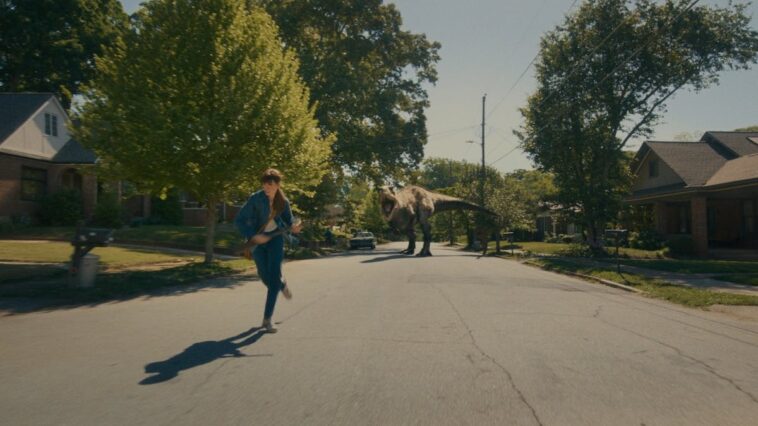
The most thrilling dinosaur movie in decades comes not from any “Jurassic Park” sequel or spin-off, but from a strikingly original sci-fi thriller by filmmaker David Robert Mitchell.
“The End of Oak Street” is a movie about family and responsibility packaged inside an unpredictable and enormously entertaining suspense thriller. Mitchell blends elements of “Jumanji” and “Jurassic Park” with a strong cast and a whizzing original score from composer Michael Giacchino that, in John Williams fashion, covers the full gamut of human emotion: from the unbound wonder of seeing a dinosaur to the heart-attack-inducing realization that it is a carnivorous raptor and has seen you too.
The film hooks into that dazzling sense of wonder Spielberg so effortlessly channeled in the 1980s, while shifting between saccharine suburban Americana and genuinely terrifying dinosaur chases.
From the outset, we are transported to an idyllic American suburb awash in winding cul-de-sacs and manicured lawns. These early scenes could easily fit inside a John Hughes picture. At a sun-soaked neighborhood barbecue, we first meet the Platt family. Jaunty housewife Denise (Anne Hathaway) smiles alongside her two children and ostensibly loving husband, Greg (Ewan McGregor).
The gleaming façade soon gives way to marital strain. “It embarrasses your mother,” Greg explains as his son helps him remove a pizza-delivery car topper from the family hatchback after another long day at work. The couple bickers prodigiously over everything from whether their son should bring the dog to the neighborhood barbecue to why Greg spends his evenings delivering pizzas.
Hathaway imbues Denise with discernible emotional depth. She furtively toils away in the basement writing a fantasy novel inspired by their adrift marriage, imagining herself running off to New York. Yet when a pesky neighbor threatens to shoot their dog over a lawn dispute, she firmly promises, “If you lay a finger on our dog, my husband will burn your house down.” Whatever frustrations have accumulated between the Platts, some fundamental loyalty remains intact.
Despite what its first act may suggest, “The End of Oak Street” is no remake of “Kramer vs. Kramer.” A series of inexplicable anomalies, including a supposedly extinct plant appearing on a neighbor’s property, eventually reveals that the entire subdivision and its denizens have been transported roughly 66 million years into the past, to the Cretaceous period.
With the local homeowners association characteristically nowhere to be found when it is actually needed, the neighborhood becomes a survival ground as cunning raptors and assorted carnivorous predators begin feasting upon their new supply of suburban fodder in spectacularly macabre fashion — torn limbs and severed torsos galore.
For the Platts, circumstances that initially seem hopeless become the impetus for Greg to assume his patriarchal role. “Someone might need help,” he tells his daughter before stepping outside with a flashlight to investigate a scream in the distance. Under these exaggerated conditions, Greg embodies the instinct fathers aspire to summon when their families are threatened. Mitchell also artfully conveys how Denise and the children are steadied by his resolve. They begin to believe they might survive largely because Greg behaves as though survival is possible.
That portrayal feels especially refreshing after years of popular film and television treating husbands and fathers as affable incompetents — the Phil Dunphys of the world, lovable precisely because nobody expects them to take charge. Greg, conversely, is allowed to be a husband whose masculinity is useful. His family looks to him for courage, judgment, and protection, and the film treats those qualities with admiration rather than embarrassment.
That becomes the film’s surprisingly uncompromising theme: that a loving and united family can withstand extraordinary hardship. Say what you will about Hollywood’s political tendencies, but this movie is about as trad as they come.
Around those family dynamics, Mitchell weaves a thrilling horror-suspense film that outclasses every dinosaur movie in recent memory. His creatures feel genuinely dangerous and capable of inflicting terrible violence, and the tension rarely slackens once Oak Street enters the Cretaceous.
“The End of Oak Street” may offer an absurd premise, but when an original idea is executed with this much conviction, suspense, and genuine meaning, it is difficult to resist.
***
Harry Khachatrian (@Harry1T6) is a film critic for the Washington Examiner. He is a software engineer, holds a master’s degree from the University of Toronto, and writes about wine at BetweenBottles.com.
This article is part of Upstream, The Daily Wire’s new home for culture and lifestyle. Real human insight and human stories — from our featured writers to you.