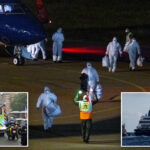
The MV Hondius cruise ship that became the epicenter of a hantavirus outbreak during its transatlantic voyage set sail April 1 from Argentina, where painful memories of the deadly virus still linger from the last major outbreak nearly a decade ago.
Around 100 people attended a birthday party in the picturesque Patagonian village of Epuyén in November 2018, which became a super-spreader event that ultimately killed 11 people.
It ultimately took severe quarantine measures to stop the spread.

Acting Centers for Disease Control and Prevention Director Dr. Jay Bhattacharya said Sunday that US health officials were looking to protocols developed during past hantavirus outbreaks to contain the one from MV Hondius.
An infected guest — who was experiencing symptoms of the virus at the time of the party — transmitted the virus to several others seated nearby, leading to a cascading series of infections that sickened 34 others, according to a report in the New England Journal of Medicine.
“The person with the virus was just sitting at the same table as my dad. And at that table there were several people who got infected, and people died,” said Mailen Valle, 33, who lost her father and both of her sisters in the outbreak.
Tragically, Valle and her two sisters came down with hantavirus at their father’s funeral — one of them died “within hours” of showing symptoms, and the other was buried without a wake, she told France 24.
“Nobody was prepared to see how, in a matter of days, a family table was left empty,” she tearfully recalled to the outlet.

Isabel Diaz suffered the tragic loss of her mother in the outbreak — who was sickened by her father, Victor.
He was later identified as the “patient zero.”
“People looked poorly at my father. It’s not his fault he got sick,” she told AFP, telling the outlet her family was discriminated against in the wake of the outbreak.
“Nobody chooses to get sick, much less infect others, much less lose a mother.”
Victor Diaz shared with the outlet that the virus caused body aches and left a taste in his mouth so bitter that even water was unpalatable for him.

“It started with a feeling of weakness. I didn’t feel like eating. And I started to get purple spots,” he said. “That same day, I lost consciousness.”
Since the region’s outbreak of the virus — which locals have come to call simply “the hanta” — locals have taken measures to mitigate future potential outbreaks, including regularly airing out sheds and even scrubbing them with bleach.
Human-to-human transmission of the virus is generally rare, it’s most commonly spread through the urine, saliva or droppings of mice.
After the first 18 cases were confirmed, public health officials enforced strict isolation protocols on patients with confirmed cases, as well as self-quarantine of anyone they may have come into contact with.
The Journal of Medicine said “these measures most likely curtailed further spread,” which halved after isolation was ordered.
It became a preview of the quarantining the world would see less than two years later during the COVID-19 pandemic.
Start your day with all you need to know
Morning Report delivers the latest news, videos, photos and more.
Thanks for signing up!
Unlike Covid, however, infectious disease experts say that human-to-human hantavirus transmission requires the exchange of large droplets of saliva — meaning only prolonged contact with an infected person is likely to lead to infection.
CDC honcho Bhattacharya said Sunday that he believes that American passengers who were on the boat can be treated safely — and without an outbreak in the US — thanks to lessons learned in the previous outbreak.
“We want to treat it with our hantavirus protocols that were successful at containing outbreaks in the past,” he said.
In all, 34 people were confirmed infected in Argentina between November 2018 and February 2019, 11 of whom succumbed to the virus.
So far, three of the MV Hondius’ 147 passengers have died, and the rest are being closely monitored in their home countries after a multinational repatriation effort.
Of the 17 Americans who were aboard, 15 are now being screened for symptoms at a quarantine facility in Nebraska, while the two patients known to be infected were flown to Emory University Hospital in Atlanta.
US health officials have repeatedly said the threat to public health from the isolated hantavirus outbreak is low, and will not lead to another COVID-19-like pandemic.