

Op-Ed
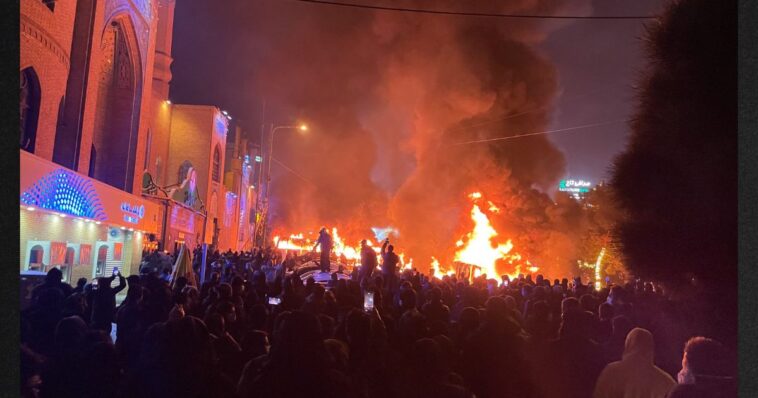
Iranian protesters gather around burning cars near a mosque while blocking a street during a protest in Tehran, Iran, on Jan. 8. The nationwide demonstrations spread across cities with slogans turning from economic grievances to political and anti-government calls. The protests were met by a violent crackdown in which thousands were reportedly killed, according to human rights groups. (Aghasht – AFP / Getty Images)

By Adelle Nazarian February 25, 2026 at 4:36pm
There are moments when silence is complicity. And then there are moments when speech itself becomes an instrument of repression.
In early February, as the Islamic Republic of Iran marked the 47th anniversary of its revolution, a small group of Western commentators traveled to Tehran, posting smiling photos, curated videos, and glowing accounts of a regime that, less than two weeks earlier, had overseen the mass killing of tens of thousands of its own citizens.
Among them were Rick Sanchez, Bushra Shaikh, Patrick Henningsen, and Calla Walsh, all presenting themselves as independent voices challenging Western power. Yet their content from Tehran mirrored, almost verbatim, the language and framing of Iranian state media.
What they produced was not journalism, nor was it dissent. It was not even naïveté. It was propaganda — propaganda that directly serves a regime the United States designates as a leading state sponsor of terrorism.
According to opposition networks, prison monitoring groups, and diaspora documentation efforts, as many as 40,000 to 50,000 Iranians were executed, killed in custody, or forcibly disappeared during the recent crackdown, with some sources warning the true number may be higher.
Reports indicate that security forces entered hospitals searching for injured protesters, raising grave concerns that medical facilities were not treated as neutral or protected spaces. Doctors treating the wounded were themselves placed at risk.
Families were denied bodies or forced to pay to retrieve remains. Death certificates were falsified. Mourning was criminalized.
None of this appeared in the content being broadcast from Tehran.
Instead, audiences were shown choreographed rallies, regime-approved neighborhoods, and the familiar aesthetic of authoritarian spectacle.
Bushra Shaikh proudly filmed herself without a hijab in Tehran, only to later appear on Iran’s state-run Press TV wearing one; “reality,” as she called it. It was the first time Iranian television aired images of bareheaded women publicly supporting the regime, despite mandatory hijab laws in place since 1979.
Spot the difference 🧐
Left: Bushra Shaikh on the streets of Tehran, claiming the hijab isn’t required.
Right: Bushra Shaikh on Press TV (the Islamic Republic’s state-owned news network) later that same day.
The hijab is mandatory by law in Iran for all women. While the regime… pic.twitter.com/8qaRW2R7LK
— Daughters of Persia (@fightforpersia) February 14, 2026
The hypocrisy was glaring, particularly in light of the brutal killing of Mahsa Amini, the 22-year-old Iranian-Kurdish woman arrested by morality police in September 2022 for allegedly violating hijab rules and killed in custody. That reality was erased in favor of a carefully staged illusion.
Despite their attempts to deny it, Bushra Shaikh and Calla Walsh were apparently paid by the Iranian regime through the Sobh Media Center to give the Islamic Republic favorable media coverage, according to American-Israeli journalist Emily Schrader. Schrader reported that the Sobh Media center is an Iran-linked entity, and the event in Iran was organized by Ahmad Noroozi, a senior IRIB journalist who is under U.S. sanctions.
The Islamic Republic does not need to persuade the world that it is democratic. It is not. It needs only to muddy moral clarity, to inject doubt, and to turn mass murder into a contested narrative.
Inviting Westerners fluent in the language of “anti-imperialism” to Tehran serves that purpose. Western passports confer credibility, Western accents disarm skepticism, and Western critics of the West are uniquely useful.
When Americans or Britons appear to independently validate Tehran’s version of reality, the regime gains something more valuable than praise; it gains confusion. Confusion delays sanctions, weakens accountability, and exhausts moral urgency. Most of all, it buys time.
There is a deeper hypocrisy at work. Many of these figures style themselves as champions of the oppressed. Yet when confronted with one of the most brutal mass killings in the Middle East in recent memory, they looked away.
This is the same hypocrisy that has been seen lately by far-left activists who flooded social media and college campuses in support of Gaza during Israel’s war against Hamas. Yet they were nowhere to be found when Iranians were being slaughtered in the streets of Tehran.
This is not anti-imperialism. It is selective human rights, applied only when the perpetrator fits a preferred ideological profile.
Students, women, laborers, dissidents, minorities, and even children as young as 2 were erased because acknowledging them would disrupt a narrative in which the Islamic Republic must always be framed as the underdog, never as the executioner.
To watch Western visitors stroll through Tehran praising “resilience” while graves were still fresh was not merely offensive. It was a second act of violence against the Iranian people, an attempt to erase truth, suffering, and memory.
Authoritarian regimes rely on fear to survive. But they endure through something quieter and more insidious: the laundering of atrocity into ambiguity.
This episode does not exist in isolation. It sits within a broader ecosystem of Western advocacy that has for years softened scrutiny of the Islamic Republic under the language of diplomacy, restraint, and de-escalation.
Few figures illustrate this controversy more clearly than Trita Parsi.
Parsi, a central advocate of Obama-era nuclear diplomacy with Iran, helped shape the framework that culminated in the Joint Comprehensive Plan of Action. Critics long warned that calls to “understand Iran’s security concerns” were being demanded of the West but never of Tehran toward its own citizens. Those critics were dismissed as alarmists. They were not.
What has changed is not the record. It is the public’s willingness to confront it.
The reckoning now facing figures like Parsi is not about disagreement. Democracies thrive on debate. It is about transparency and accountability. It is about whether Western policy discourse has been distorted by actors presented as neutral experts while advancing frameworks that reliably benefit one of the world’s most repressive regimes.
That scrutiny arrives too late for tens of thousands of Iranians who will never see justice. But it matters that it has arrived at all.
Because authoritarian violence is not laundered through slogans alone. It is laundered through institutions, commentary platforms, and intermediaries who transform repression into context and mass murder into complexity.
History is unforgiving to those who confuse access with insight and proximity with truth.
The Islamic Republic will not be judged by anniversary parades or the foreigners it temporarily flatters. It will be judged by its prisons, its execution chambers, and the names it tried to erase.
And those who helped obscure that record will not be remembered as brave contrarians, but as useful voices for power at its most lethal.
The question is not whether these Western visitors knew what they were doing.
The question is why propaganda continues to receive moral immunity simply because it is spoken in English and delivered with confidence.
The views expressed in this opinion article are those of their author and are not necessarily either shared or endorsed by the owners of this website. If you are interested in contributing an Op-Ed to The Western Journal, you can learn about our submission guidelines and process here.
Adelle Nazarian has over 15 years of experience in journalism, geopolitics, and the media world. She is also an entrepreneur who has founded and served as CEO of several organizations including a geopolitical consulting firm. Adelle is also a Senior Fellow at the Gold Institute for International Strategy (GIIS) in Washington, D.C. She enjoys traveling, is constantly learning and is inquisitive by nature. Adelle speaks English, Persian (Farsi), French and Mandarin Chinese. Follow Adelle Nazarian on X @AdelleNaz.
Adelle Nazarian has over 15 years of experience in journalism, geopolitics, and the media world. She is also an entrepreneur who has founded and served as CEO of several organizations including a geopolitical consulting firm. Adelle is also a Senior Fellow at the Gold Institute for International Strategy (GIIS) in Washington, D.C. She enjoys traveling, is constantly learning and is inquisitive by nature. Adelle speaks English, Persian (Farsi), French and Mandarin Chinese. Follow Adelle Nazarian on X @AdelleNaz.
Advertise with The Western Journal and reach millions of highly engaged readers, while supporting our work. Advertise Today.