
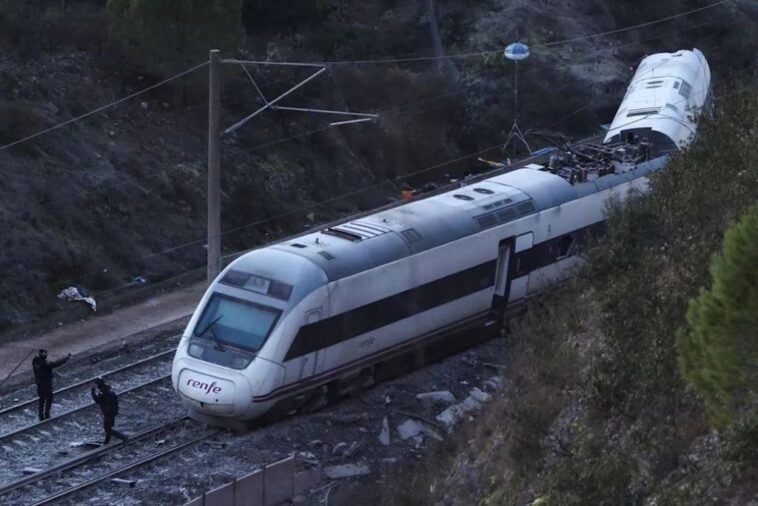

The brutal derailment and collision of two high-speed trains in the municipality of Adamuz, Córdoba province, has caused at least 40 deaths and over 150 injuries, becoming one of the deadliest railway accidents in Spain in decades.
What happened cannot be dismissed as a “strange accident,” as Transport Minister Óscar Puente has attempted to present it, but rather as the result of negligent management detached from the technical reality of the railway system.
The disaster occurred on a straight stretch of track recently renovated, where an Iryo train derailed and crossed onto the opposite track, colliding head-on with a Renfe Alvia train. These circumstances—which should never occur on a modern and safe railway network—reveal failures in supervision and control that are far from trivial.
Minister Puente himself described the accident as “extremely strange and difficult to explain,” highlighting the apparent contradiction between the modernity of the trains and the recent infrastructure upgrades. Such statements, far from reassuring the public, reflect a lack of clear and decisive technical response from those in charge of the ministry.
WATCH:
However, this insistence on the inexplicable sounds more like a political excuse than a rigorous analysis. When a public official hides behind constant surprise, they are implicitly admitting that they do not fully control the system they are supposed to oversee.
Even more serious is the fact that in previous months, incidents had already been reported on the same stretch related to signaling systems and technical components, demonstrating that this is not a purely random problem. These warnings and prior failures have not been publicly explained, and citizens still do not know what corrective measures, if any, were taken.
There was no effective response, no preventive decisions, and no respect for the technical authority of those who safeguard railway safety daily.
The official investigation will need to clarify the exact causes of the accident, but the political context is indisputable.
Under Pedro Sánchez’s government, ministries have become ideological platforms more concerned with narrative and propaganda than with serious management of critical infrastructure.
Óscar Puente is a paradigmatic example of this style of governance: lots of speech, political confrontation, and an alarming lack of rigor when it comes to real responsibilities regarding citizen safety.
Emergency services responded swiftly after the collision, and their professionalism contrasts sharply with the chain of errors that led to the disaster.
WATCH:
No subsequent deployment can compensate for the lack of prevention, maintenance, and control required by a high-speed rail network. When the state fails in its basic function of protecting citizens’ lives, the responsibility is political before it is technical.
This accident highlights an uncomfortable truth that the left refuses to face. Undermining authority, disregarding professional expertise, and politicizing institutions have direct and tragic consequences.
The government of Pedro Sánchez, supported by a coalition more concerned with identity agendas than order and safety, has proven incapable of ensuring essential public services. The price of this irresponsibility is being paid today by dozens of broken families in a country that needs less propaganda and more authority, law, responsibility, and respect for institutions.
READ MORE:
Stay informed with the most important news and reliable analysis!
Subscribe to our newsletter: https://gatewayhispanic.com/sl-newsletter
About The Author

Rafa Gómez-Santos Martín
Rafael Santos is a Portuguese writer and political analyst dedicated to educating Hispanics on traditional values and the importance of protecting children and families. With years of experience in media and public discourse, he has been a strong advocate for cultural preservation and moral principles in an ever-changing world. Passionate about culture, sports, and current affairs, Rafael brings insightful analysis to political and social debates, striving to empower the Hispanic community with knowledge and a deeper understanding of the issues that shape their lives.