
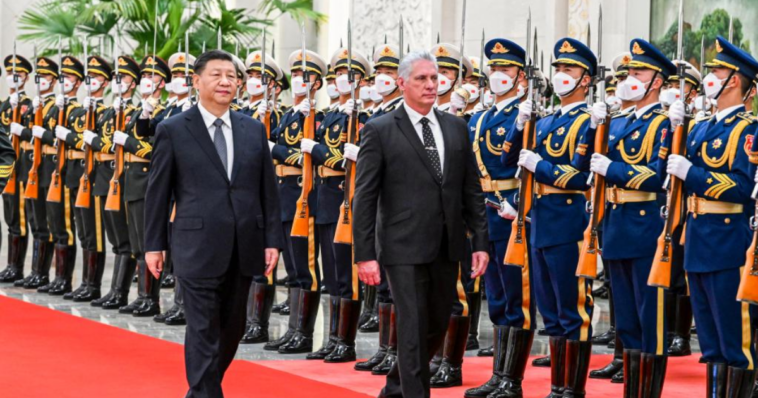

On May 26, 2026, Cuba received a 60,000-ton rice shipment from the Chinese Communist Party. The following day, Beijing condemned the U.S. blockade and what it called increasing military threats against Cuba.
China is deepening its foothold in Cuba precisely as the Trump administration moves to sever it. The result is an escalating confrontation, playing out through sanctions, indictments, spy satellites, and back-channel ultimatums, over who controls the island 90 miles from Florida.
Satellite imagery has confirmed that China is actively expanding its signals intelligence infrastructure in Cuba. The Center for Strategic and International Studies has identified four facilities as highly likely sites supporting Chinese intelligence operations against the United States: Bejucal, Wajay, and Calabazar near Havana, and El Salao, located roughly 70 miles from the U.S. Naval Station at Guantanamo Bay.
A May 2025 CSIS satellite update documented major construction at Bejucal, where excavation crews removed six existing pole antennas and began building a Circularly Disposed Antenna Array (CDAA) with an outer ring nearly 574 feet in diameter. Imagery confirmed the facility is active, with satellite dishes repositioning across multiple image captures. CDAAs are used for high-frequency direction finding and can pinpoint radio-signal origins from 3,000 to 8,000 miles away — the same technology China has deployed at Mischief Reef and Subi Reef in the South China Sea to monitor U.S. naval activity.
Collectively, the four Cuban facilities provide coverage of approximately 20 U.S. military installations in Florida, including U.S. Southern Command (SOUTHCOM) and U.S. Central Command (CENTCOM) headquarters, the Kennedy Space Center, Cape Canaveral Space Force Station, and multiple submarine bases.
A May 2025 letter from the House Homeland Security Committee to DHS Secretary Kristi Noem warned that by combining telemetry interception, geospatial intelligence, and electromagnetic surveillance, China is positioning itself to “systematically erode U.S. strategic advantages without ever firing a shot.” The 2025 SOUTHCOM Posture Statement similarly noted that Cuba “serves as a proximate location for intelligence gathering and force projection by our adversaries.”
In May 2026, the Wall Street Journal reported that China and Russia had nearly tripled their combined intelligence personnel in Cuba since 2023 and upgraded equipment at listening facilities within range of both U.S. combatant commands. The 2025 National Defense Authorization Act mandates the Pentagon to deliver a classified report to Congress on Chinese and Russian intelligence capabilities in Cuba by June 2026, a deadline that arrives this month.
China has provided nearly $8 billion in financing to Cuba since 2000. In 2023, the Wall Street Journal reported that Beijing agreed to pay Cuba several billion dollars for the rights to establish electronic eavesdropping facilities on the island. China also built Cuba’s telecommunications infrastructure, supplying Huawei equipment that includes filtering software used to monitor and block citizen communications. The regime demonstrated this capability in July 2021 when it shut down internet and phone services to suppress anti-government protests.
Cuba’s intelligence cooperation with China extends into human intelligence. In December 2023, former U.S. Ambassador to Bolivia Manuel Rocha was arrested and charged with espionage after allegedly serving as a Cuban intelligence asset inside the U.S. government for 15 years, helping shape Washington’s foreign policy toward the Western Hemisphere. Attorney General Merrick Garland described it as one of the “highest-reaching and longest-lasting infiltrations” of the U.S. government by a foreign agent. Because Cuba and China routinely share collected intelligence, classified information obtained by Cuban assets inside the U.S. government likely reached Beijing.
Secretary of State Marco Rubio identified Cuba as a direct and growing national security threat in May 2026: “Cuba not only has weapons that they’ve acquired from Russia and China over the years, but they also host Russian and Chinese intelligence presence in their country, not far from where we’re standing right now. The other thing that poses a threat to the national security of the United States is to have a failed state 90 miles from our shores run by friends of our adversaries.”
An Axios report from May 17, 2026, citing classified U.S. intelligence provided by a senior Trump administration official, stated that Cuba has acquired more than 300 military drones from Russia and Iran since 2023, with Cuban military officials discussing scenarios involving their use against the Guantanamo Bay Naval Station, U.S. military vessels, and Key West. Defense Secretary Pete Hegseth confirmed before Congress that the Russian nuclear submarine Kazan has used Cuban ports. The drone figure, sourced from a classified leak with no corroborating public document, has not been independently verified.
Since February 2026, the U.S. Air Force has conducted at least 25 reconnaissance flights near Cuba under Operation Southern Spear, deploying RC-135V Rivet Joint signals intelligence aircraft to assess Cuban military capabilities and defense systems.
The Trump administration has pursued Cuba across diplomatic, legal, economic, and military tracks simultaneously. On January 3, 2026, U.S. forces captured Venezuelan President Nicolás Maduro, ending Venezuela’s subsidized oil shipments that had been supplying Cuba approximately 26,500 barrels per day, roughly 24% of the island’s daily consumption.
On January 29, 2026, Trump signed Executive Order 14380, declaring Cuba an “unusual and extraordinary threat” under IEEPA and imposing tariffs on any country supplying oil to Havana. On May 1, 2026, Trump signed Executive Order 14404, extending secondary sanctions to all foreign entities, including foreign financial institutions, that provide material support to the Cuban government or any designated Cuban entity. The model mirrors secondary sanctions applied against Iran, Russia, and North Korea.
On May 7, Rubio used that authority to sanction GAESA (Grupo de Administración Empresarial S.A.), the military-run conglomerate controlling Cuba’s hotels, ports, banking, and retail sectors, along with its executive president, Ania Guillermina Lastres Morera, and the Moa Nickel joint venture. Rubio described GAESA as sitting on “$18 billion of assets, and not a penny of that transfers over to the state budget. Not a penny of that goes over to help the people of Cuba.” Canadian firm Sherritt International suspended its participation in Cuban joint venture activities the same day the sanctions were announced.
On May 20, the Department of Justice unsealed an indictment against 94-year-old former Cuban President Raúl Castro on charges of conspiracy to kill U.S. nationals, destruction of aircraft, and four counts of murder in connection with the 1996 Cuban Air Force shootdown of two Brothers to the Rescue civilian aircraft that killed four men. The following day, ICE arrested Adys Lastres Morera, sister of GAESA’s executive president, in Miami, after Rubio revoked her green card on grounds she was managing real estate assets in Florida while aiding the Cuban regime, under the authority of Section 237 of the Immigration and Nationality Act.
Since January 2026, the administration has imposed more than 240 new sanctions against Cuba and intercepted at least seven tankers carrying oil to the island, slashing Cuba’s energy imports by 80 to 90 percent. CIA Director John Ratcliffe traveled to Havana in May 2026 and issued a direct ultimatum: structural political changes in exchange for sanctions relief, with an explicit warning that the offer would not remain open indefinitely. Three rounds of diplomatic talks between Washington and Havana have produced, by Cuba’s own ambassador’s account, “no progress.”
The Trump administration’s push against Chinese influence has extended beyond Cuba. Following meetings with Rubio, Panama withdrew from China’s Belt and Road Initiative in February 2025, becoming the first country in the Western Hemisphere to do so, and moved to restore Panamanian control over canal port operations previously dominated by Chinese state-linked companies. Operation Absolute Resolve, the U.S. military operation that captured Maduro in January 2026, disrupted China’s access to subsidized Venezuelan oil and weakened Beijing’s strategic position in the country.
Honduras moved to reactivate its trade relationship with Taiwan. Mexico imposed tariffs of up to 50% on Chinese imports to close the backdoor route into the U.S. market. Chile cancelled a China Mobile submarine cable concession connecting Valparaíso to Hong Kong after a U.S. warning. Peru withdrew congressional authorization permitting a Chinese military hospital ship to dock. U.S. security cooperation has been strengthened with Guyana, El Salvador, Argentina, and Peru.
The rollback has limits. Colombia formally joined the Belt and Road in May 2025. China has surpassed the United States as the top trading partner of Brazil, Peru, Chile, and other regional economies, with two-thirds of Latin American and Caribbean nations signed onto Belt and Road. Bilateral trade between China and South America reached a record $518 billion in 2024.
As U.S. sanctions have cut off Cuba’s oil supply, China has stepped into the resulting energy vacuum. Chinese solar equipment exports to Cuba rose from approximately $3 million in 2023 to $117 million in 2025, according to the British energy think tank Ember. Cuba connected 49 new solar parks to its grid between early 2025 and early 2026, adding more than 1,000 megawatts of capacity with Chinese equipment and financing, one of the fastest renewable energy transitions ever recorded by a developing country. In January 2026, President Xi Jinping personally approved an $80 million emergency aid package for Cuban electrical infrastructure alongside the 60,000-ton rice shipment.
China’s Foreign Ministry has dismissed U.S. sanctions as “brutal” and “unlawful,” demanding their immediate end. Spokesman Lin Jian stated that Washington was “creating pretexts and spreading rumors to defame” Cuba while maintaining an illegal blockade. Beijing framed its energy cooperation explicitly as resistance to U.S. economic pressure. CFR analysts have noted that China’s growing role in Cuba’s solar infrastructure could provide additional leverage to expand intelligence-gathering capabilities on the island beyond what satellite sites already provide.
The FY2026 National Defense Authorization Act mandates the Pentagon to deliver a classified report to Congress on Chinese and Russian intelligence capabilities in Cuba by June 2026. The requirement was inserted by the Senate and covers the four identified signals intelligence (SIGINT) facilities, personnel levels and equipment upgrades at each, Russian naval use of Cuban ports, and the combined threat to U.S. military installations across Florida and the Caribbean.
The report will be the first congressionally mandated, on-the-record Pentagon assessment of the full Chinese and Russian intelligence presence in Cuba. It lands as the most acute U.S.-Cuba confrontation since the 1962 Missile Crisis. The COINS Act, incorporated into the FY2026 NDAA, expanded the definition of “country of concern” for outbound U.S. investment restrictions beyond China to include Cuba, Iran, North Korea, Russia, and Venezuela, a congressional signal that these actors are understood to operate in coordination.
Rubio has stated that Cuba has a history of “buying time and waiting us out” and that the current administration will not permit that strategy. Trump has said that previous U.S. presidents considered intervening in Cuba for decades but that “it looks like I’ll be the one that does it.”
The Raúl Castro indictment gives Washington a legal pretext for a capture operation modeled on the Maduro raid. On the other hand, with the White House focused on the war with Iran, the likelihood of military action against Cuba is assessed as moderate. Polymarket, the world’s largest online prediction market, where traders stake real money on geopolitical outcomes, currently places the probability of U.S. military action against Cuba by December 31, 2026 at 54%, with more than $5.2 million traded on the question.
Cuba’s ambassador to the United States has confirmed that three rounds of face-to-face diplomatic talks have produced no results. The Pentagon report due this month will define, for the first time in official terms, the full scope of what the Trump administration is demanding Cuba dismantle, and what it is prepared to do if Havana refuses.
Ad block users: Some site features may not work correctly while an ad blocker is enabled, because they break scripts and content this website depends on. If you can’t see comments below, for example, please disable your ad blocker.