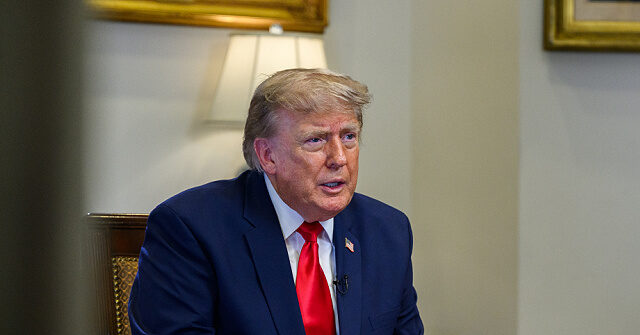
President Donald Trump warned that Iran may be exploring chemical and biological weapons after U.S. operations devastated its nuclear capabilities, vowing to “wipe them out” if Tehran launches an attack on Washington.
The president made the remarks during a Fox News interview with White House correspondent Jacqui Heinrich while visiting Asia, as reports detailed his consideration of renewed strikes against Iran following Israeli intelligence warnings about Tehran’s chemical weapons activities and alleged plots against senior U.S. officials.
Heinrich asked Trump about intelligence indicating that Iran might attempt to detonate a radioactive “dirty bomb” in Washington and the heightened security precautions surrounding senior administration officials.
“Well, there is indication that Iran is looking at gases, looking at bio because we’ve shut them out with the nuclear,” Trump said. “Nuclear is much harder, and they’re looking at gas, and they’re looking at the bio. You know, the biological weapons, not nice, and other things.”
Trump also raised the prospect of further developments after the start of the new year, without specifying what he expected to happen.
“We’re going to have a new year coming up, and we’ll see what happens after January 1st,” he said. “But they’ve been nasty. You know, these are nasty people.”
Asked whether Washington residents should be alarmed by the reported threat, Trump dismissed the prospect of an imminent attack while promising overwhelming retaliation if one occurred.
“I don’t think so. No, I mean, look, if it does happen, we wipe them out,” he said.
When Heinrich pressed him on whether that was a promise, Trump replied: “Oh, I give you my word. Absolutely.”
Trump’s remarks followed a CNN report that U.S. intelligence agencies had uncovered indications of Iranian planning for possible radiological or chemical attacks targeting senior administration officials in Washington, although officials disputed how far any preparations had progressed.
The intelligence reportedly included intercepted communications and claims that materials had been positioned inside the United States, but officials had not independently verified those claims or established that Tehran possessed the means to execute an attack.
Secretary of State Marco Rubio subsequently said he did not believe there was an imminent threat, even as intelligence officials continued monitoring possible Iranian plots against American officials.
The warnings came as Director of National Intelligence Jay Clayton told Congress that Iranian threats against Americans at home and abroad had “substantially increased.”
The reported threats have already prompted extraordinary security measures for senior administration officials, including Treasury Secretary Scott Bessent, who relocated with his family to a military installation following what a senior U.S. official described as “advanced” Iranian threats.
Bessent subsequently confirmed that the Secret Service directed the move, linking the threats to the administration’s campaign to economically isolate Tehran.
Speaking to CNBC on Friday, Bessent denounced the Iranian leadership and described the regime as a “dangerous animal backed into a corner,” arguing that the threats demonstrated the effectiveness of Trump’s economic pressure campaign.
The New York Times reported Wednesday that Israeli intelligence had uncovered an alleged Iranian plot to use chemical agents against senior American officials, with one person briefed on the intelligence linking the threat to the security concerns surrounding Bessent.
U.S. intelligence agencies have independently detected increased Iranian activity involving chemical and biological weapons, according to the report, but American officials have not established that Tehran is capable of carrying out such attacks.
Some officials believe the activity may be intended primarily to deter further U.S. military action, underscoring disagreements over the intelligence as Trump considers whether to authorize another round of strikes.
Those intelligence disagreements have become central to Trump’s deliberations over renewed military action, with Axios reporting that the president remains open to joint strikes with Israel despite recently describing another major offensive as “quite unlikely.”
The White House has asked the Pentagon and intelligence agencies to assess how Iran might retaliate against different military options, including potential attacks on oil and gas infrastructure across the Gulf, according to the report.
Israeli officials have pressed their case for renewed military action in recent meetings with their American counterparts, including a U.S. visit by Mossad Director Roman Gofman, who met with CIA Director John Ratcliffe and White House Special Envoy Steve Witkoff.
Gofman reportedly presented intelligence concerning Iranian chemical weapons research and testing, warning that further delays could allow Tehran to strengthen its capabilities and make future strikes more difficult.
Trump was briefed on the intelligence, although some American officials questioned whether Israel’s assessment reflected an effort to build support for renewed military action.
American and Israeli officials have acknowledged increased Iranian chemical weapons activity, but U.S. assessments have not established that Tehran currently possesses the capability to carry out the attacks described in the intelligence.
The intelligence dispute comes as Prime Minister Benjamin Netanyahu has reportedly urged Trump to authorize a concentrated joint American-Israeli air campaign lasting four to seven days, according to the Times.
Netanyahu and other Israeli officials have argued that the substantial U.S. military presence in the region presents an opportunity to strike before Tehran further rebuilds its missile and drone capabilities.
A senior Israeli official disputed the characterization that Netanyahu was pressuring Trump, while the prime minister’s office maintained that he has consistently acted to safeguard Israel’s security.
The United States has assembled substantial forces capable of conducting such an operation, including carrier-based aircraft and long-range bombers reportedly maintained on 96-hour readiness, while additional air defenses have been supplied to Israel.
American options reportedly emphasize Iran’s rebuilt missile and drone capabilities and Islamic Revolutionary Guard Corps (IRGC) facilities, while Israeli planning has extended to nuclear installations and energy infrastructure, including targets whose destruction could disrupt civilian electricity supplies.
Among the potential targets discussed is the suspected nuclear facility known as Pickaxe Mountain, although no operation against the site has been authorized.
Trump has not approved the broader Israeli proposals, according to officials familiar with the discussions.
Separately, Israel Hayom reported that discussions have also included possible strikes against senior Iranian regime figures, citing a diplomat familiar with the deliberations.
Even as his administration weighs additional military action, Trump said Washington remains in contact with Tehran and that he is still seeking an agreement capable of preventing Iran from rebuilding its nuclear program.
“Yeah, we talked to them. They want to make a deal, but I want a deal that can be lasting,” Trump said.
He said he wanted an agreement that would remain enforceable beyond his presidency, regardless of who occupies the White House.
Trump also dismissed the need for assistance from China or Russia in resolving the confrontation, arguing that U.S. operations had already devastated Iran’s military capabilities.
“We’ve defeated their navy. We’ve defeated their air force. We’ve defeated their anti-aircraft,” he said, claiming Iran’s missile capabilities had fallen to roughly 12 percent of their previous strength.
“They have nothing left. Their leaders are gone. Their ships are gone. Their planes are gone,” Trump added.
“They want to make a deal. So I don’t need help,” he said.
Trump also described the U.S. naval blockade as among the most effective measures taken against Iran, while expressing frustration with an earlier diplomatic effort involving a memorandum of understanding.
“We had a little memorandum of understanding. I never believe too much in memorandums. You go right to a contract; forget the memorandum,” he said.
Asked whether pursuing the memorandum had been a mistake, Trump acknowledged that it delayed progress but argued that the experience exposed Tehran’s unreliability.
“It delayed things a little bit. It wasn’t a mistake. Actually, we got to know them very well during that period, and we got to know that they can’t be trusted.”
Asked whether American forces would remain in the region until an agreement was reached, Trump made clear that he intended to bring the confrontation to a conclusion.
“Yeah, I’m going to finish it off. Yeah, soon. I mean, one way or the other, we’ll finish it off,” he said.
Joshua Klein is a reporter for Breitbart News. Email him at jklein@breitbart.com. Follow him on Twitter @JoshuaKlein.