The U.S. Treasury Department’s Office of Foreign Assets Control (OFAC) on Tuesday announced new sanctions against “35 entities and individuals that oversee Iran’s shadow banking architecture and facilitate the movement of the equivalent of tens of billions of dollars.”
“These networks allow Iran’s armed forces — including the Islamic Revolutionary Guard Corps — to access the international financial system to receive payment for illicit oil sales, purchase sensitive components for missiles and other weapons systems, and transfer money to Iran’s terrorist proxies,” OFAC said.
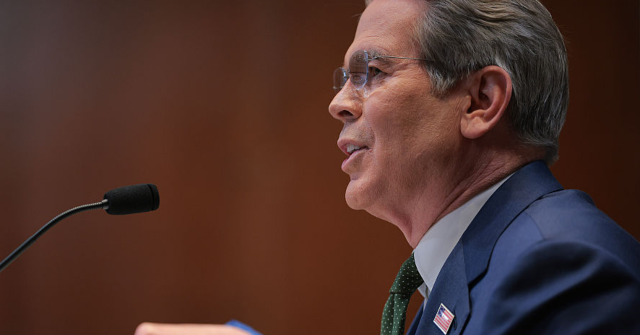
“Iran’s shadow banking system serves as a critical financial lifeline for its armed forces, enabling activities that disrupt global trade and fuel violence across the Middle East,” said Treasury Secretary Scott Bessent.
“Illicit funds funneled through this network support the regime’s ongoing terrorist operations, posing a direct threat to U.S. personnel, regional allies, and the global economy,” he said.
“Financial institutions are on notice: Any institution that facilitates or engages with these networks is at risk of severe consequences,” Bessent warned.
OFAC explained that Iranian banks use a network of private companies, called rahbars, to move their money through a vast network of overseas shell companies. The shell companies open accounts with foreign banks with the goal of “illicitly accessing the formal international financial system,” which Iran has been locked out of.
“The rahbar companies closely coordinate with Iranian exchange houses and a myriad of front companies in multiple jurisdictions to facilitate payments for Iran’s sanctioned trade, including on behalf of the IRGC, Iran’s Armed Forces General Staff (AFGS), Iran’s National Iranian Oil Company (NIOC), and other sanctioned entities,” OFAC said.
Treasury’s announcement listed sanctions against numerous rahbar companies, the Iranian banks they serve, and the techniques they employ to collect payments for illicit sales of Iran’s sanctioned oil.
Some of the banks running these shell-company schemes have been sanctioned since 2018 when President Donald Trump withdrew from his predecessor Barack Obama’s nuclear deal and reimposed sanctions against Iran.
The OFAC announcement repeated Bessent’s warning that foreign financial institutions could trigger secondary sanctions against themselves by doing business with any of the listed Iranian entities.
Bessent said on Tuesday that the Treasury’s Operation Economic Fury has targeted “Iran’s international shadow banking infrastructure, access to crypto, shadow fleet, weapons procurement networks, funding for terrorist proxies in the region, and independent Chinese ‘teapot’ refineries that support Iran’s oil trade.”
OFAC sanctioned one of China’s biggest independent “teapot” refineries, Hengli Petrochemical, on Friday, along with some 40 shipping companies and vessels that transport Iranian oil. China’s independent refineries are heavily dependent upon shipments of deeply discounted oil from sanctioned suppliers like Iran.
“These actions have disrupted tens of billions of dollars in revenue that would be used to fund terrorism,” Bessent said on Tuesday. “Under President Donald Trump’s maximum pressure campaign, Tehran’s inflation has doubled and its currency has rapidly depreciated.”
The Treasury Secretary pointed out that a tipping point envisioned by the plan to blockade Iran has nearly been reached, as Iran’s primary oil export terminal on Kharg Island has nearly exceeded its storage capacity.
With nowhere to store their oil, the Iranians will be forced to sharply reduce production, “resulting in an additional approximately $170 million per day in lost revenue, and causing permanent damage to Iran’s oil infrastructure.”
Iran has tried, and failed, to slip overloaded supertankers past the U.S. Navy blockade. The Iranians have reportedly broken out last-ditch measures to boost their capacity with “junk storage,” from reactivating long-decommissioned containers to dragging old tankers to Kharg Island to serve as floating emergency storage.
Research firm Kpler estimated on Monday that Iran could cobble together enough emergency storage for another 12 to 22 days before it would be forced to make the dramatic production cuts Bessent envisioned. As the Treasury Secretary pointed out, oil wells tend to suffer permanent damage from that level of reduced production.
Kpler also calculated that since money flows more slowly than oil, the worst revenue impact from the blockade will not be felt by Iran for three to four months. The standard delay is about two months for oil to reach foreign ports, particularly China’s, followed by two months for the buyers to remit payment. This would explain why Operation Epic Fury is targeting the banks and shell companies that manage the flow of Iranian money.
The delayed financial impact gives Iran a little more room to reach an agreement with the United States that could mitigate the damage from the blockade.
Iranian state media has lately published some reports that suggest the regime is feeling the pain from Operation Epic Fury and Operation Economic Fury, including a statement from the Society of Seminary Teachers in the religious city of Qom that described the death of former Supreme National Security Council secretary Ali Larijani as an irreplaceable loss for the theocracy.
The statement praised Larijani, who was eliminated by an airstrike in March, as “one of the most capable managers of the revolution,” and his death as a “major loss for the Islamic Republic.”