
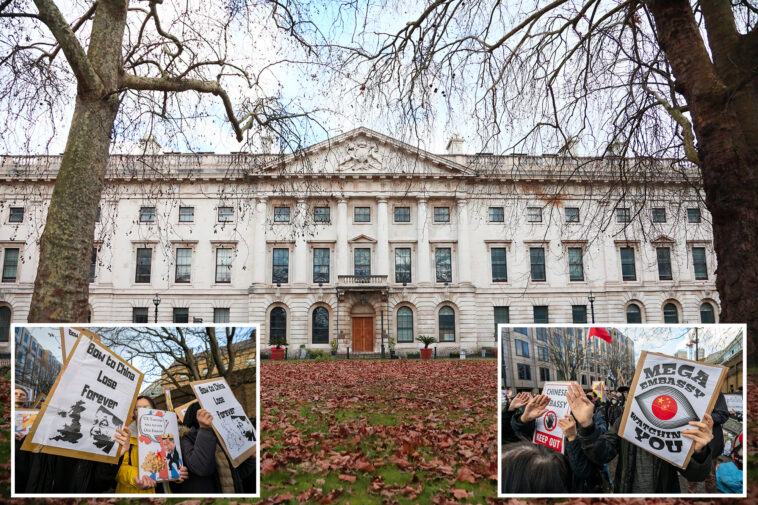
The United Kingdom has approved plans for a new Chinese “mega embassy” in central London, despite fears it could make it easier for the Chinese Communist Party to conduct nefarious spying operations on the West.
The approval — which clears the way for what would become Beijing’s largest diplomatic outpost in Europe — allows China to redevelop a sprawling former Royal Mint site near the Tower of London into a single, consolidated embassy complex.
It would replace Beijing’s current, smaller facility elsewhere in the capital.


The proposed site, colloquially dubbed a “mega embassy,” has been under consideration for years, drawing political scrutiny due to its size, location and potential security threats.
The site will enable China to house thousands of staff under one roof.
The decision ends a years-long planning fight that drew warnings from MPs and human rights groups.
UK Security Minister Dan Jarvis defended the move in parliament, insisting national security had been fully assessed.
“While some would stick their heads in the sand and ignore the obvious need to engage, this government is engaging with China confidently and pragmatically,” Mr Jarvis said.
Still, he acknowledged that China posed threats to Western security, including through “cyber attacks, foreign interference and espionage targeting our democratic institutions, the transnational repression of Hong Kongers and of course, China’s support for Russia’s illegal invasion of Ukraine.”
“But following detailed consideration of all possible risks around this new embassy by expert officials across government, I am assured that the UK’s national security is protected,” he added.


Critics were unconvinced.
Rep. John Moolenaar (R-Mi.), chairman of the House Select Committee on the CCP, blasted the decision as defying common sense on Tuesday.
“The UK’s decision defies common sense. It is effectively rewarding China for spying on Parliament, interfering in the UK’s elections, and fueling Russia’s war in Ukraine,” he said in a statement.
“China is also suspected of cutting undersea cables, so letting it build on the land above critical infrastructure is a serious security risk. The only safeguard against the mega-embassy is to prohibit its construction,” he added.


Conservative MP Alicia Kearns also last week warned the embassy could become “a launch pad for economic warfare against the UK,” citing its scale and location.
Labour MP Sarah Champion was even more blunt, saying: “Every security briefing I’ve had identifies China as a hostile state to the UK,” according to the BBC.
China has pushed back on the criticism.
In a statement, previously released during the planning process, Chinese officials urged Britain to approve the project “without delay,” saying the design followed “customary diplomatic practices.”

Wang Hanyi, a research fellow at the China-UK Center for Cultural Exchange at Shanghai International Studies University, told China’s state-run Global Times newspaper that the move is a “victory of pragmatic and rational diplomacy over an over-securitized mindset in the country.
“Only by moving beyond zero-sum thinking and focusing on broad shared interests can China-UK relations remain stable and advance steadily,” he added.
China bought the Royal Mint site more than seven years ago, but the project stalled after local planners rejected earlier proposals in 2022. With national approval now granted, construction can move ahead.