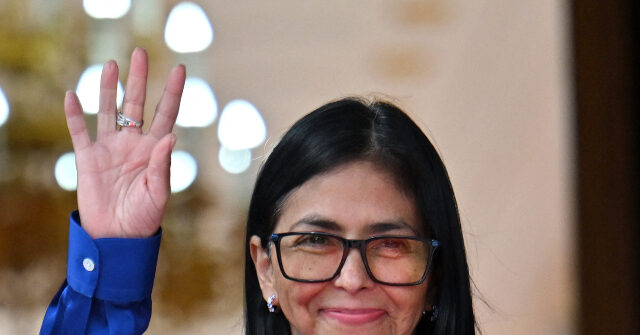
Venezuela’s socialist “interim” leader Delcy Rodríguez held a phone call on Monday with the Emir of Qatar, Sheikh Tamim bin Hamad Al Thani, and expressed “solidarity” after the Islamist Iranian regime targeted his country with dozens of drones and missiles over the weekend.
Qatar is one of 12 countries, according to the Doha-based Al Jazeera, that Iran has bombed since Saturday, when President Donald Trump announced “Operation Epic Fury.” The operation, Trump explained, was intended to weaken the brutal tyranny in the country and neutralize Iran’s ability, as the world’s foremost state sponsor of terrorism, to pose a threat to America and to Iran’s neighbors in the Middle East. The government of Israel also launched joint military operations alongside the United States to destroy Iran’s military assets and eliminate its leadership.
As of Tuesday, “Operation Epic Fury” has killed dozens of senior Iranian government officials, most prominently the “supreme leader” of the country, dictator Ali Khamenei. In response, Iran’s Islamic Revolutionary Guard Corps (IRGC), a U.S.-designated terrorist organization, has launched a barrage of attacks against its neighbors because of their friendly relations with Washington.
Venezuela’s outreach to Qatar in particular is notable as the latter country has been forced to shut down much of its energy industry in response to the Iranian strikes. Once ostracized from the Gulf community for establishing friendly ties to Iran, Qatari officials have now become among the most vocal to condemn what is left of the jihadist regime. Support from Caracas to Doha is also a marked change in foreign policy in this context for the Latin American nation, which, under the “Bolivarian socialist” regime that has dominated it for over two decades, became one of Iran’s closest allies. The Venezuelan socialist regime published a statement on Saturday condemning “Operation Epic Fury” only to hastily delete it within a day, and has refrained from any detailed commentary since.
Rodríguez, who has governed the country since the American arrest of deposed dictator Nicolás Maduro, announced on Monday that, in her conversation with the emir, she offered “our solidarity before the grave situation of instability and violence that has erupted in the Middle East, which has placed the entire region at the brink of a dangerous escalation of war.”
While Rodríguez’s statement did not mention Iran, the context of her support is an ongoing assault by the IRGC on the country, which has on several occasions served as host of various terrorist organizations, including the Iranian proxy terrorist organization Hamas, and mediating nation in years of talks involving a host of international parties. In an irate letter to United Nations Secretary-General Antonio Guterres and American U.N. envoy Michael Waltz, as of Sunday morning, Qatar had documented “92 ballistic missiles and 17 drones” from Iran targeting Qatari sites.
The letter detailed:
The Ministry of Interior of the State of Qatar responded to 114 reports of debris falling in various parts of the country. Eight people were injured, four of whom remain hospitalized, one of them seriously, while four others received treatment and were discharged. On Sunday morning, eight additional injuries were reported, bringing the total to 16. Material damage to public and private property was also recorded.
The letter, sent by Qatari representative at the U.N. Sheikha Alya Ahmed bin Saif Al-Thani, condemned Iran for the “flagrant violation of its [Qatar’s] national sovereignty, a direct infringement upon its security and territorial integrity, and an unacceptable escalation that threatens the security and stability of the region.”
Notably, the envoy added that Qatar affirmed “its full right to respond … in a manner commensurate with the nature of the attack, in defense of its sovereignty and in safeguarding its security and national interests.”
At press time, there is no information indicating that the Qatari military has targeted the Iranian Islamist regime.
In addition to Qatar, Iranian forces have bombed Israel, Jordan, Oman, the United Arab Emirates (UAE), Saudi Arabia, Bahrain, Kuwait, Iraq, and Cyprus. Qatar announced on Monday that it had been forced to stop its lucrative liquified natural gas (LNG) production and, on Tuesday, expanded the pause to LNG-related products.
Iran’s Foreign Minister Abbas Araghchi denied that the strikes on Iran’s neighbors were targeted attacks on those neighbors.
“We are not targeting our brothers or neighbours in the Persian Gulf. But we are targeting US targets, and this is clear,” Araghchi claimed on Tuesday, continuing:
We started by attacking their military bases, and they evacuated their military bases and moved them to hotels and created human shields for themselves. We try to target military personnel, infrastructure and facilities helping the US and its army in launching operations against Iran.
In reality, the strikes targeted airports, oil infrastructure, and other civilian sites. In the early hours of Tuesday, the Kingdom of Saudi Arabia confirmed an attack on the U.S. embassy in Riyadh.
“The Kingdom affirms that the repetition of this cowardly and unjustified attack blatantly violates all international norms and laws,” the Saudi Foreign Ministry said in a statement on Tuesday. “The Kingdom reaffirms its full right to take all necessary measures to protect its security, territorial integrity, citizens, residents, and vital interests, including the option of responding to the aggression.”
Venezuela’s first outreach in this conflict being to Qatar follows a visit by Qatari Prime Minister Mohammed bin Abdulrahman bin Jassim Al Thani to the country two weeks ago. While neither side provided any details on the discussions, Venezuelan media reported that the prime minister and Rodríguez engaged in a “thorough review of the comprehensive cooperation agreement between the two nations.”
Rodríguez herself most recently visited Qatar in April while she served as Maduro’s vice president, and thus had a pre-existing personal relationship with the leadership in Doha.
Following Maduro’s arrest in January, Qatar aided the transition by offering to store profits from Venezuelan oil sales temporarily as the United States helped Caracas revamp its business and lifted sanctions. Storing the money in Qatar reportedly protected it from being seized immediately by creditors, as Maduro had plunged the nation deep into debt with many global entities. In mid-January, reports surfaced that the Trump administration helped Venezuela, through Qatar, keep $500 million in oil revenue.
Prior to Maduro’s arrest, Venezuela was one of Iran’s closest allies. Iran invested significantly in the run-down oil industry in that country, rebuilding refineries and then using them to process its oil. Rodríguez’s government initially condemned “Operation Epic Fury” but rapidly deleted its statement on Saturday.
“This situation, which stems from a disregard for the principles of diplomacy, the peaceful settlement of disputes, and the Charter of the United Nations, places the region and the world in a scenario of extremely serious instability,” the now-deleted statement read in part. Notably, it also condemned Iran for its “inappropriate and reprehensible reprisal” attacks on neighbors such as Qatar.