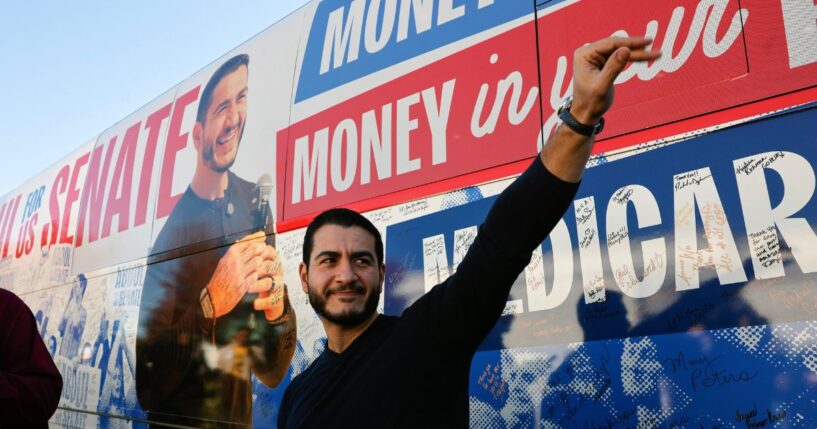
Abdul El-Sayed waves to supporters near his campaign bus after a rally in Flint, Michigan, on Oct. 18, 2026. (Jeff Kowalsky – AFP / Getty Images)
By Samuel Proctor October 19, 2026 at 4:07pm
In 2018, he said he was named after Paula Abdul. Now, Senate candidate Abdul El-Sayed claims his name means “Servant Leader.” Which is it?
Abdul El-Sayed is currently saying that his name “Abdul” means servant and that’s why his parents chose it.
That’s funny because when Abdul was running for Governor in 2018 he claimed numerous times that his parents named him Abdul after Paula Abdul. https://t.co/s6dF4BmsXy
— MAZE (@mazemoore) October 19, 2026
Both, probably. Admittedly, it’s tempting to paint this as a lie to the American people, yet it’s much more likely that El-Sayed’s parents had several factors driving their decision.
While this deprives us of the perfect opportunity to use a bad Paula Abdul pun asking El-Sayed to be “Straight Up” with us, it allows a much more detailed analysis of how the political climate on the left has shifted since 2018.
The Council on American-Islamic Relations counted 57 Muslim elected officials in 2018. This summer, however, CAIR revealed that number had risen to a record-breaking 255.
More Muslims are running for office, and more are winning. Our whole political system has shifted rapidly toward Mecca.
What changed?
President Donald Trump’s so-called Muslim ban during his first term appears to be the primary suspect. This ban, which went into effect six months into Trump’s first year, severely limited the number of immigrants from five major Islamic nations: Iran, Syria, Libya, Yemen, and Somalia.
The political fallout from that policy is visible in the data.
A poll by the Institute for Social Policy and Understanding revealed that Muslim voter registration jumped by 18 percentage points from 2016 to 2020. NBC News reported that Trump’s ban acted as a catalyst for Muslim political engagement.
There is no better example than Mayor Zohran Mamdani’s victory in New York City.
According to an AP poll, nine in 10 Muslim voters in New York City supported Democratic Socialists of America candidate Mamdani last November. Other Muslim politicians with formal or informal DSA ties, such as Rep. Rashida Tlaib and Rep. Ilhan Omar, have experienced similar support.
To be clear, El-Sayed has tried to distance himself from the DSA — which is understandable, since they want to abolish the presidency, eliminate the Supreme Court, and nationalize the means of production. It’s difficult to win in a battleground state with such extreme ideas.
However, that doesn’t erase the fact that many DSA politicians have endorsed him, that he’s appeared at their events, and that the DSA has admitted to helping campaign for him.
He may not claim the title of DSA for himself, but these progressive ideas will chase him to the finish line this November.
All that being said, the recent entrance of Islam into the American left helps explain why El-Sayed now readily highlights his name’s Arabic roots, whereas highlighting the musical origin of his name likely played better in a less Islamized America. He’s playing the audience like a fiddle.
Has the rise of Muslim politicians changed your view on American politics?
Now, I don’t want to appear “Cold Hearted,” but there is one last matter to be addressed: El-Sayed might not have lied about where his name came from, but he glossed over an important translation detail.
Saying “my name means servant leader” plays well on the campaign trail, but it’s a slight mistranslation.
In a 2018 video, El-Sayed explains that his full name is “Abdulrahman Mohamed El-Sayed,” which means “Servant of the All-Merciful, Praiseworthy, the Master.”
So, yes, “Abdul El-Sayed” means “servant leader,” but when we step back, we see the name doesn’t describe a leader serving his people, but rather a leader serving “the All-Merciful” — Allah. But does El-Sayed’s name actually have any serious implications?
Not necessarily. Caleb means “dog,” Rachel means “ewe,” and Tabitha means “gazelle,” yet we don’t expect them to start acting like animals. Names don’t determine destiny.
What matters, however, is what his potential victory signals about the cultural and religious landscape. An ascendant El-Sayed marks a shift away from Matthew, Hannah, and Nathan and toward Mohammed, Hassan, and Fatima.
In November, we’ll find out whether the people of Michigan are comfortable with the change wrought by Islam, the ideas of the DSA, and the man trying to keep a foot in both worlds.
Advertise with The Western Journal and reach millions of highly engaged readers, while supporting our work. Advertise Today.
Samuel Proctor is a first year student at Iowa State University, studying political science and writing for the Iowa State Daily. His specialization in political theory and philosophy led him to join The Western Journal in 2026. When not writing, Samuel can be found playing guitar and praising Jesus.