
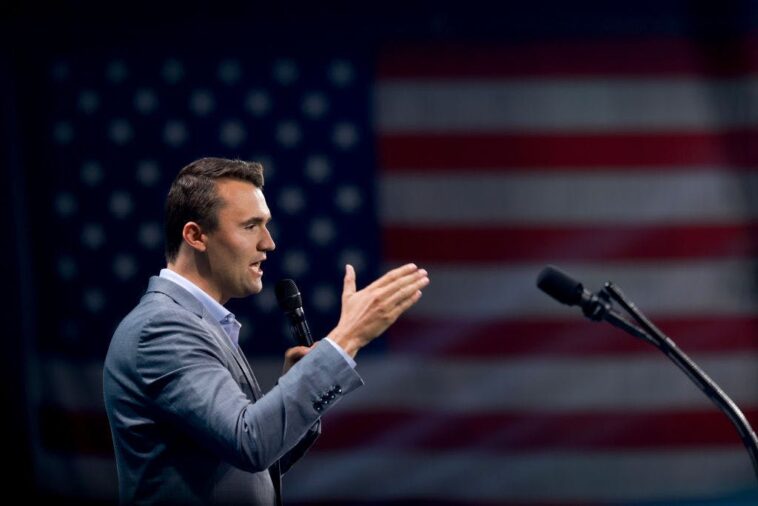
A year ago, my friend Charlie Kirk was shot and killed just feet from me.
Millions knew Charlie as one of the most influential voices of his generation. He built a movement, mobilized young people, challenged institutions, and refused to accept the idea that Christians should keep their convictions safely tucked inside church walls.
I knew that Charlie too. But I also knew him as a friend, a student, and as someone I came to love like a son.
Our friendship began in 2020, when Charlie asked me to mentor him in Christian apologetics. I often joke that it can be hard to mentor somebody smarter than you. But not Charlie — because the only thing that exceeded his intellect was his humility.
In fact, despite being twice Charlie’s age, I think I learned more from him than he ever learned from me. Charlie didn’t teach simply through what he knew, but through how he lived. His intellect was remarkable and his work ethic relentless, but both were driven by something deeper: a hunger to know and serve God, a fierce love for his family, and an unwavering hope for his country.
Depending on which side of the algorithmic bubble your social media scrolling landed you on, Charlie was either a courageous voice for truth and reason or a hateful, bigoted fascist. He was, admittedly, a rather peculiar kind of “fascist”: one who routinely put himself in harm’s way by walking onto hostile college campuses, handing his opponents a microphone and inviting them to the front of the line.
Because if there’s one thing Mussolini was famous for, it was his tireless enthusiasm for open microphones and hostile questions. (News flash: The leftist who shot Charlie is the fascist!)
Despite his youth, Charlie possessed a wisdom that seemed well beyond his years. He understood that if you genuinely love people and want to reach them with the truth, you had to be willing to make yourself vulnerable. And that takes courage.
Charlie spoke often about courage because he believed it was one of the few virtues available to absolutely everyone. It requires no special talent, no money, no status, and no connections. You don’t have to be born with it or wait until you feel brave enough to use it. Courage is simply a choice: to show up, stand firm, and speak the truth even when you know you’ll be challenged, misunderstood, mocked, hated, or maybe even murdered.
That was a choice Charlie made every day, and it cost him his life.
Just days before his death, Charlie and I took what would become our final long walk together. I didn’t know it was our last. If I had, I probably would have walked a lot slower. That night, Charlie wasn’t talking about his fame, his platform, or what he had already accomplished. He was thinking about the future and the three institutions God established to help that future flourish: the family, the church, and the government.
That conversation captured Charlie remarkably well. For all he had already accomplished, his mind was fixed on the generation coming behind him. He worried that young people, particularly young women, had grown disillusioned with the beauty of marriage, family, and children, and he wrestled with how to remind people that those things are still worth aspiring to.
He had spent years laboring alongside the church, urging pastors to be bold and to equip their congregations not only in matters of salvation, but in matters of culture too, about which, inconveniently for those who would prefer Christianity remain safely confined to Sunday mornings, Scripture has quite a lot to say.
And he dreamed about the America his children would inherit. An America that remembered the Christian roots of its past and recognized that our rights are not gifts bestowed upon us by governments, but from the author of reality himself. The one to whom we owe those audacious ideas of life, liberty, and justice.
Charlie spent his life defending reality and its author. In the end, he became a casualty in the war. But he did not lose it.
A bullet can end a life. It cannot make a lie true. And death does not get the final word over someone who belongs to Christ. The murderer only managed to change Charlie’s address, while motivating thousands to come to Jesus.
Today, Charlie is absent from the body but present with the Lord. And while I long for the day when I will see my friend again, those of us still here have work to do.
For 365 days and counting, his spirit-guided wife, Erika, his faithful friends, and his devoted Turning Point family have honored Charlie not merely by remembering what he did, but by continuing what he started. Together, they have chosen to build rather than destroy, to focus rather than distract, and to defend truth, family, faith, and country even when it costs them something. I pray you have made the same choice.
Charlie once said that, for everything he accomplished, he wanted to be remembered above all for two things: his courage and his faith in Jesus Christ. One year later, that is how I remember him.
***
Frank Turek is coauthor of “The War on Reality” and was a good friend and mentor to Charlie Kirk.
This article is part of Upstream, The Daily Wire’s new home for culture and lifestyle. Real human insight and human stories — from our featured writers to you.
![[thursday-5am]-trump-puts-himself-back-on-the-ballot:-5-takeaways-from-gop-midterm-convention-night-1](https://cybernistas.com/wp-content/uploads/2026/09/373399-thursday-5am-trump-puts-himself-back-on-the-ballot-5-takeaways-from-gop-midterm-conve6aa275d97eeed-150x150.jpg)