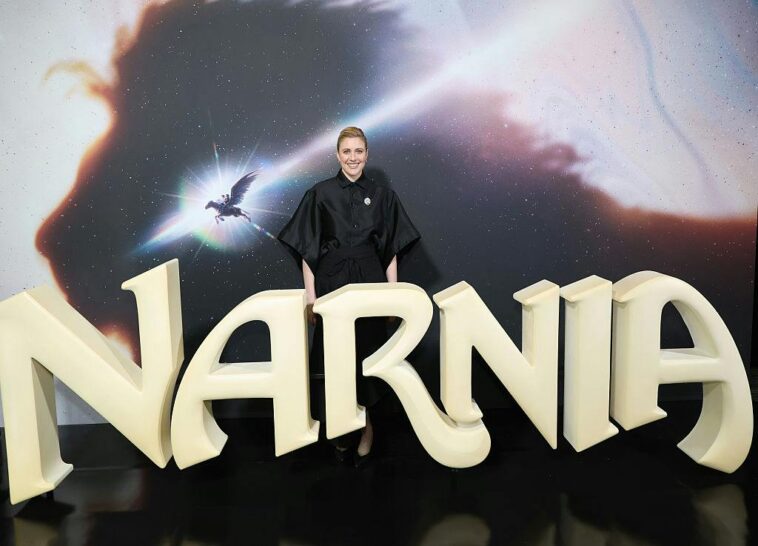
I don’t believe Greta Gerwig is actively trying to sabotage The Chronicles of Narnia, but she’s doing it anyway. The problem is that her imagination was shaped by an era of immature aspirations, where the most glorious thing a person can be is a celebrity.
When Gerwig reaches for transcendence, she looks to drugs and rock and roll, not holiness or grace.
An ecstatic experience evokes, well, taking ecstasy. Rather than a communion with a higher power, it’s a resort to material, medicalized magic. It’s a way to be outside of yourself without having to yield to another Person.
C.S. Lewis would have recognized the phenomenon of spectacle divorced from substance right away because he wrote Narnia to address just such a divide.
He wrote for a society that was secularizing, but not yet post-Christian. His audience retained nostalgia for the old, morally significant symbols of royalty, fatherhood, and liturgical ritual, even if they didn’t connect those aesthetic experiences to literally believing the Christian faith.
A male lion raised from the dead is a sort of evocative fairytale that made a 1940s reader think of King Arthur, or Odin, or, more close at hand, the rituals of a coronation at Westminster Cathedral, or the morning scripture readings at Eton that include passages about the Lion of Judah.
The language and social imaginary of American culture is littered with the debris of Christian thought, but these terms are increasingly disconnected from their concepts.
Growing up in Sacramento and attending a Unitarian Universalist church, Greta Gerwig was catechized by a post-Christian culture that dismissed the symbolic, meaningful language C.S. Lewis used.
While I, a Southern evangelical from Virginia, talk about Aslan’s transcendence and glory, Gerwig, a filmmaker living in Los Angeles, translates the terms into ecstasy and glamour and thinks we’re saying the same things.
Thus you get a punk-rock, androgynous Aslan voiced by Meryl Streep, a casting choice that assumes Aslan derives his power from his aesthetics and is thus more akin to David Bowie than Jesus Christ.
Christians consider the moral component primary and the aesthetic component secondary. Secular post-Christians, if they consider morals at all, tend to center the aesthetic. In the absence of objective truth, morality becomes a matter of taste, and taste is particularly drawn to the shiny and the arousing.
(This is not to say that secular people can’t be moral or that Christians can’t be swept into the false high of spectacle and thrill. To the contrary, Christians understand that the moral law is written on the human heart, so it’s a rare person who has no healthy tastes at all, and conversely, since we’re all sinners, just believing true things isn’t enough to overcome sinful passions.)
But taste isn’t something you can defend in the way you can a truth claim. Societies that are built on the authority of taste spiral into decadence. If you’re in a society that is imploding, your grace-given good tastes won’t give you escape velocity. You’ll need the conviction that comes from defensible truth.
Many defenses of Gerwig’s Narnia retreat to the language of taste. If you feel instinctive disgust at the rock-opera aesthetics, you’re portrayed as an unadventurous rube, lacking the discerning, cosmopolitan taste of someone who likes Led Zeppelin.
I give you permission to dislike rock opera Narnia. In fact, I’d make the bold aesthetic judgment that Led Zeppelin doesn’t lend but borrow aura from C.S. Lewis, so the oohs and aahs of people impressed that Greta Gerwig obtained the rare license to use their work expose their own philistinism, not inoculate them against accusations of it.
But in one way, Gerwig is right: Narnia needs to be powerfully appealing to an audience’s emotions and sensations. I’ve dismissed Gerwig’s impoverished taste, but we should also acknowledge that Christians worried about Epicurean excess often pivot to the opposite error of Stoicism.
Stoicism is Pagan nonsense too. C.S. Lewis wrote Narnia not just to connect emotional images to truth, but to make truth come alive to the emotions. He understood that our truth claims must be girded and guarded by our desires, and that emotionless fact motivates no one to action.
I like rock and roll. Attending a sold-out Killers concert at Madison Square Garden is one of my favorite memories. At the end of the evening, lead singer Brandon Flowers shocked the room by introducing Bruce Springsteen for a surprise encore. It was like an unexpected visitation by a minor deity.
This was what the ancients called apocalypse, or revelation — an unveiling that the world we thought we inhabited was, in fact, quite different. We had been at a Killers concert. Now we were at a Springsteen concert. All the associations and emotions that name carried flooded the arena with the thudding bass of “Born to Run.”
The frisson that comes from proximity to celebrity is a minuscule imitation of religious revelation, but the quality of feeling was similar in a way that made me feel gratitude to God. “I tell you, something greater than Madison Square Garden is here,” I thought.
It felt like a religious experience.
But it wasn’t. It was an aesthetic experience that pointed me to the greater moral experience. Bruce got his aura from something greater, even if he was pretty great himself.
As someone who’s also had actual religious experiences, I can attest that the knowledge that my sins have been paid for by the death of the God of the universe is a high that lasts long after the mountaintop experience has faded.
It’s a heaven of a drug.
***
Hannah Long is an editor for Harper and Broadside Books at HarperCollins. She also writes cultural commentary and film criticism for The Dispatch, Angelus News, Arc Digital, P. J. O’Rourke’s American Consequences, the American Cinema Foundation, and Athwart. Twitter: @HannahGraceLong