
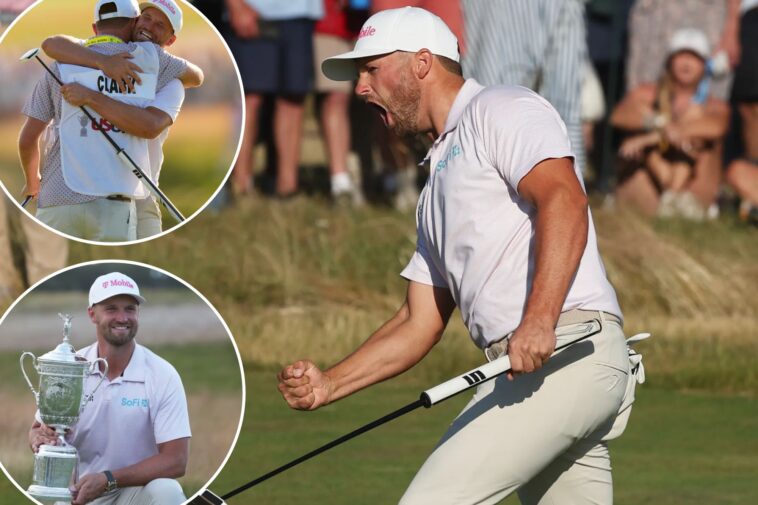
Everything was in place for a historic collapse by Wyndham Clark, and based on the jeers and taunts that followed him throughout the final round of the U.S. Open, the Shinnecock Hills Golf Club fans would’ve been OK with that. Everything was in place for an equally historic comeback by Sam Burns, too, and with Clark the villain, Burns emerged as the unlikely hero.
Burns’ putt on the 18th hole rolled right up to the edge of the pin. When it didn’t go in, he fell to his knees and flipped his putter, the reality of heartbreak for a second consecutive year at the U.S. Open starting to sink in. Clark soon made a 24-foot birdie putt on No. 16 and unleashed a powerful fist pump as his lead grew.

Entering Sunday with a six-shot lead, Clark — whose locker-bashing incident at Oakmont last year turned him into a villain — did just enough to finish 4 under par and defeat Burns by a shot for his second U.S. Open win in the past four years.
Clark, who was 3 over Sunday, became the first wire-to-wire winner of the major since Martin Kaymer in 2014. He avoided an epic collapse, like the one by Greg Norman in the 1996 Masters — still the only golfer to lose a major when leading by six or more shots entering the final round, according to the Elias Sports Bureau. And if Burns, who entered Sunday at even par, completed the seven-shot comeback, it would’ve tied Arnold Palmer — who was in 15th place entering the final round in 1960 — for the largest comeback after 54 holes in tournament history. Instead, the celebration belonged to Clark.
The jeers had followed him wherever he went. “Get in the bunker” shouts came after tee shots. There were “don’t choke” jabs that got fans ejected. If Clark thought the Shinnecock crowd was “flat” after his third round, then this was the polar opposite.
Clark, the 2023 U.S. Open champion, clung to the momentum from a blistering opening round as long as he possibly could. He was 3 over on the front nine Sunday, but it could’ve been worse if he didn’t save par on the fourth hole. Clark’s second shot bounced twice on the walkway, and after he sank the putt, he pumped his fist.


He added a stroke to his lead with a birdie on No. 10 but lost it with a bogey on No. 13, and by that point, Burns had started to make a run. Entering the final round, Scottie Scheffler had been positioned as the chaser, as the one who finally seemed to have solved Shinnecock on the back nine Saturday and — in his push to finish the career Grand Slam on his birthday and Father’s Day — upend Clark. But Scheffler failed to capitalize on his chances, instead settling for pars and hoping they wouldn’t turn into worse.
So that left Burns, the 29-year-old with three top 10 finishes at majors, to serve as the hero in the eyes of the Shinnecock fans. He sank four birdies on the front nine, but after bogeying the ninth, Burns only managed one birdie the rest of the round, left a putt short on the 17th and watched as his ball, somehow, didn’t end up in the cup on the final hole.

Burns, the 54-hole leader last year who fell all the way to a tie for seventh during the final round, was forced to wait by the range as Clark birdied the 16th, bogeyed the 17th and then two-putted for par on the 18th. For better or worse — and, on two occasions, most recently Sunday at Shinnecock Hills Golf Club, in the best way possible for him — Clark has become synonymous with the only major he has ever won. There was the 2023 title. There was the villainous turn.
And here in eastern Long Island, on a weeklong redemption tour that may or may not resonate in the court of public opinion, Clark emerged on top again. This became Clark’s tournament to lose from the moment he fired his 64 on Thursday. He did just enough to survive three days later.