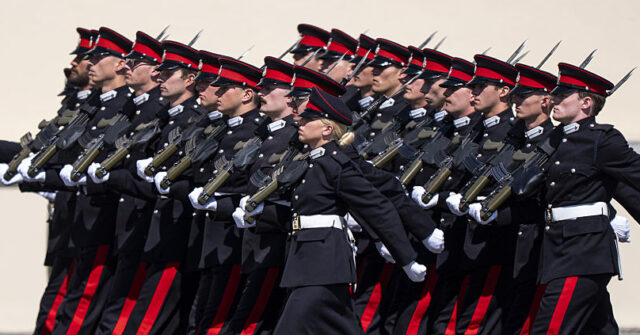
Conviction of the importance of military service and defence spending is slowly rising in Britain, but among the key demographic who would actually do the fighting in a future war, belief in the defence of the nation is close to rock-bottom.
Whether the public would be willing to fight in a future war is a question which has been frequently polled in the United Kingdom in recent years. itself a clear sign of growing concern with world events. Now new major polling — as part of the rolling annual, decades-long British Social Attitudes Survey — suggests that while the British public are as a whole becoming more amenable to military service and defence spending, a major split has developed between young and old.
The number of people who think military service in society is “not at all important” is falling fast, going from 23 per cent in 2023 to 15 per cent in 2025, suggesting as the global situation changes attitudes towards the military are changing too.
In a sign that some may be treating the question of the importance of military service as less of a hypothetic question as time goes on, the survey also noticed the number of people who didn’t feel able to answer the question has increased in recent years. The BSA research also revealed a link between those who think willingness to serve and acceptance of using tax money for defence.
It stated: “Among those wanting much more defence spending, 57% also attached high importance to willingness to serve”.
Citizens aged 55 and over are much more likely to say “willingness to serve in the military at a time of need” is important than not, the survey found, with just eight per cent in the oldest cohort saying willingness to serve in the military was not important. This contrasted strongly with both young and middle aged respondents, with around 20 per cent of people in the broad range of 18-54 years old finding willingness to serve important.
Interpreting the data, Sophia Gaston of the Centre for Statecraft & National Security at King’s College London, noted the question was somewhat impersonal, asking in general terms whether military service was important, rather than whether they personally were ready to join up in a crisis. The academic suggested the massive age differential in support for military service may come down to young people simply not feeling strongly involved in national identity, or well served by the social contract.
In other words, why protect a country that has failed to protect you. Gaston said “there might be a fundamentally different conception of the relationship between the individual and the nation. ” and further added of her report:
Young Brits, who’d be asked to serve the nation in a time of need, are much less inclined to think it’s important to do so than older Brits. This doesn’t capture personal willingness – it’s about a civic conception of personal responsibility to the nation… The intergenerational gap on serving the nation is not a problem that can be solved in the MoD alone. This reflects the byproduct of intergenerational unfairness, a lack of a stake in the social contract, weak connections to national identity and purpose. This is structural.
In additional comments she told The Times of London:
I think that some of this comes from the fact that we are in a time of perceived generational unfairness. There are a lot of young people who don’t feel that they have a stake in the nation or its national institutions in the way that older Brits do. That has a follow-on impact into their willingness to put themselves on the line and defend that nation.
Another stark divide in groups of respondents was political. While support for the military was practically universal across all British political parties and rising — with Nigel Farage’s Reform UK the most enthusiastic — the sole exception are voters of the Green Party. Just three per cent of Reform voters want to slash defence spending, while 47 per cent of Greens said they felt too much was being spent on the armed forces.
Over all, 89 per cent of Britons said they believe Russia is a threat, more than double who felt so at the end of the Cold War. Likewise, the proportion of people who see China as a threat has doubled to 62 per cent this century.
It has been the case for several years that British defence leaders, including government ministers and top officers, have been emphasising to the public that the global security picture is changing and the age of small volunteer armies doing low-intensity war fighting a long way away has come to an end. As previously reported:
Both NATO and Westminster have spent the past two years drumming the idea into the British public that the post-Cold War era is over and the West is now in a 1930s-like pre-war state, if not already in the prelude of ‘Hybrid war’. The leitmotif of these warnings is the coming conflict, be it successfully deterred or not, will be a “whole of society event” and young Britons will be a particularly important part of that.
Yet British society is much changed since its last mass-mobilisation events. Not just in the establishment of a considerable and ever-larger welfare state that removed the military as the employment of last resort, but also in the transformation of Britain into a multicultural experiment of so-far dubious results. Governments of various colours going back decades have pursued aggressively open-borders policies and ethnic Britons stand to be a minority in what traditionally would have been called their own country a little later this century.
Such remarkable change has evidently left at least some young people — the key demographic for military conscription — wondering whether fighting for the government is synonymous with fighting for their own interests. Remarkably, concern over war sceptics among those who would be doing the conscripting is so pronounced this talk is not confined just to the pub or social media, and has broken through into Britain’s most establishment-facing newspapers.