
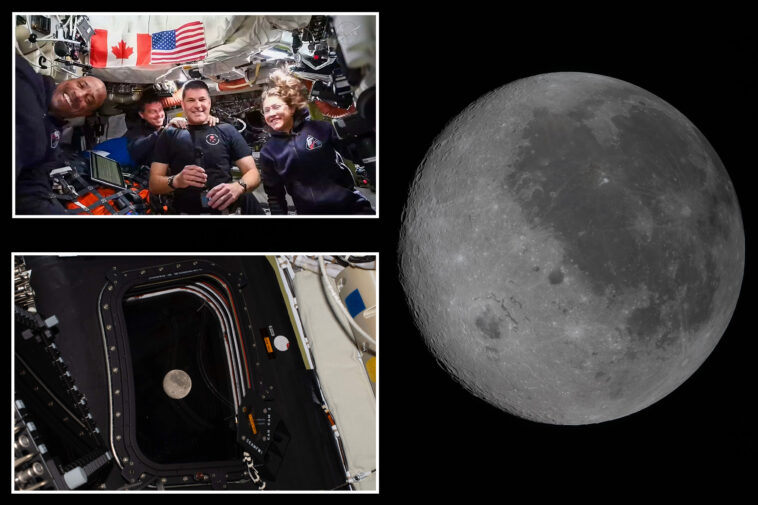
Humanity on Monday traveled the farthest ever into space, breaking the record set more than 50 years ago by Apollo 13.
Artemis II’s four astronauts zoomed past Apollo 13’s 248,655-mile mark around 1:56 p.m. ET, reaching 248,656 miles as it hurtled past the moon at nearly 2,000 mph.
The extraordinary new record occurred nearly 56 years ago to the day that Apollo 13 set it on April 14, 1970, as the troubled spacecraft used the moon’s gravity to slingshot itself back to Earth without using any of its waning power after suffering an onboard explosion.


But Artemis II isn’t done yet.
The astronauts are flying farther than any humans in history moment by moment until about 7:07 p.m., when they are expected to begin their journey back to Earth.
Their new distance record is expected to end up at about 252,757 miles.
Artemis II’s Orion capsule will be making its way to Earth from there, returning home around 8 p.m. Friday.
The record will be set just minutes after the capsule makes its closest approach to the moon, which is expected to be around 4,000 miles from the lunar surface.


It will also come in the thick of Artemis II’s communications blackout, which is expected to last about 40 minutes while the moon blocks any signals between Orion and the Earth.
Communications are expected to resume around 7:25 p.m.
The crew will be busy during that time making observations of the moon during their historic lunar flyby — which will reveal swaths of the moon’s far side never before seen by human eyes.

While the far side has been partially seen by human eyes in the past — beginning on Apollo 8 in 1968 — much of it remained hidden in shadow throughout the Apollo program.
Those crews orbited the moon for days at a time and passed over the far side, but the missions were timed so that sun was shining on the near-side landing sites — which left the far side largely obscured as the capsules passed over it.
Artemis II will see the entirety of the far side during its flyby, with the moon appearing about the size of a basketball held at arm’s length out the cabin windows.

That flyby will begin around 2:45 p.m. and will last until about 9:20 p.m., if everything goes according to schedule.
Artemis II’s 252,757 miles is no small distance: If Earth were the size of a soccer ball, the moon would be roughly as big as a tennis ball sitting around 30 feet away.
The mission is able to break Apollo 13’s record because it is using the same trick of orbital mechanics to get back home: After whizzing around the moon on Monday, the capsule will use its momentum to fly home without needing to fire its thrusters beyond small trajectory corrections.