
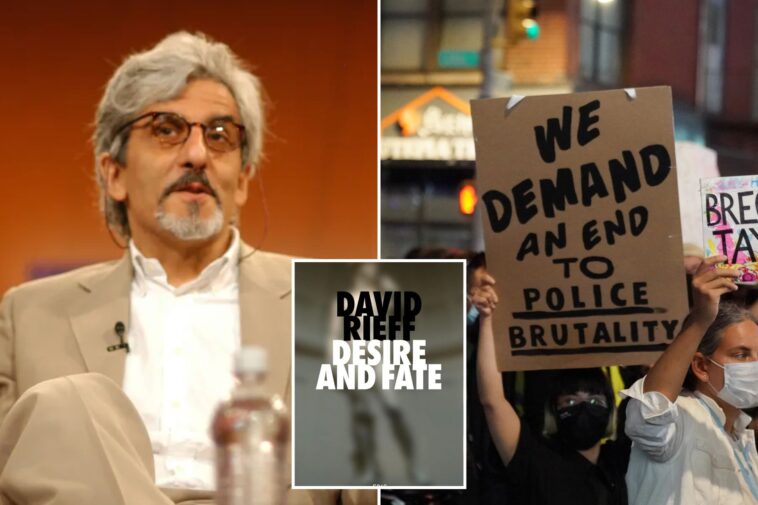
David Rieff is a fixture of New York’s woke literary scene, but he’s not afraid to break with the pack.
“I don’t think I’d ever made a secret of my disdain for the woke takeover of the humanities and the arts, not just in universities, but museums, philanthropy, all the rest of it,” Rieff told The Post. “If there’s one thing that the liberal left does that is really beyond disingenuous, it’s claiming that this [woke] takeover hasn’t happened.”
Rieff, an essayist and former war correspondent, told The Post that he worries his fellow opponents of wokeness are celebrating its end prematurely.

“All these people talk about the woke tide having peaked, but I’m afraid I agree with people like Chris Rufo on this,” he said. “I don’t think it’s peaked at all. I think it’s too deeply embedded institutionally.”
Rieff defines wokeness as “moral and social hypochondria” in his 2024 book “Desire and Fate” on the issue, and he sees it as a corrosive ideology on our institutions, particularly universities and cultural centers.
“I can’t think of a world more monolithic in terms of its opinion sets, its cultural assumptions, its politics, than the humanities,” he said. “But it’s not just the university humanities departments. It’s every major museum on the planet, all the major philanthropies… They’ve all been underwriting all this absolute junk science, junk thought, junk culture.”

A recent example of institutional wokeness he pointed to is the American Historical Association’s move to condemn “scholasticide” in Gaza in January, a gesture that he sees as unnecessarily political.
“What business is it of the American Historical Association to be taking political stands,” he contended. “Why should [what] someone who is an expert in industrialization in Rhode Island in the 1840s [has to say about Israel] be any more important than the voice of the person at the corner bar?”
Rieff doesn’t identify with a political party, but considers himself a “critic of utopian ideology.”
“Woke is a moral utopia,” he explained. “I hate utopias. And I’m afraid of them. [Wokeness] is one of these spasms of moral reform that never end well. Historically, we’re always worse off after these damn things.”

Aspects of the trans movement are what “pushed [him] over the edge” to speak out about wokeness. He is the son of acclaimed author Susan Sontag, who was bisexual and pursued relationships with women in his youth. Growing up around them made him wary of trans ideology.
“I remember all these women so vividly,” he recalled. “They wanted to get away from penises. Bluntly, they didn’t want to be told, ‘Uh, I still have a penis, but I feel like a woman, and you have to be at least willing to entertain the possibility of having sex with me, because I’m a woman and you’re a lesbian.’”

“At that point, I thought, we really have fallen down the rabbit hole,” he said.
Though he is highly critical of the Trump administration, he’s found some unexpected allies in his anti-woke commitments.
“I’m not a fan of this administration,” he said. “But I think some of this cultural stuff, whether they did it for the right reasons or the wrong reasons, I’m certainly willing to entertain them.”
Rieff, who has taught at various colleges including Bard College and University of California, Berkeley, criticized professors for going into “turtle mode” now that wokeness is under attack from the right, and pretending it was never really an issue.

“I think you can criticize the Trump administration for certain free speech violations of its own, but the idea that here was this place of free inquiry at the university which the wicked Trumpies came in and tried to undermine — I mean, that’s just rubbish,” he said.
The author is also highly suspicious of corporate wokeness, which he considers to be cynical — and proof that the ideology isn’t all that transgressive or revolutionary.
“Woke people present themselves as communist, anti-capitalist anarchists, whatever words make you think they must be left, when, in fact, all businesses and major corporations have been able to take on board a kind of woke,” he explained.
He thinks corporations’ refusal to cut ties with Israel upon the demand of the woke left goes to show how half-hearted their commitment to wokeness really is.

“[The woke] rapidly discovered that [corporations] might be all for Pride Day and everyone having whatever god-awful pronoun name tags, but canceling a $2 billion contract with the Israeli state — that wasn’t going to happen,” Rieff said. “It was a wakeup call for them and instructive for the rest of us, because it showed what happens when something is a threat to business.”
He told The Post that he doesn’t care if he’s socially ostracized for his views. He simply refuses to bow to an ideology that promotes utopian ideals and hypersensitivity over reason.
As Rieff writes, “This is a world in which it is deemed worse to be offended linguistically — misgendered, micro-aggressed, or traumatized by a book written in 1823 because it doesn’t have the same attitudes as those in 2023 — than to be deprived materially.”