
in

Exclusive from the Burma War: Life on the Front Lines

exclusive-from-the-burma-war:-life-on-the-front-lines
Exclusive from the Burma War: Life on the Front Lines

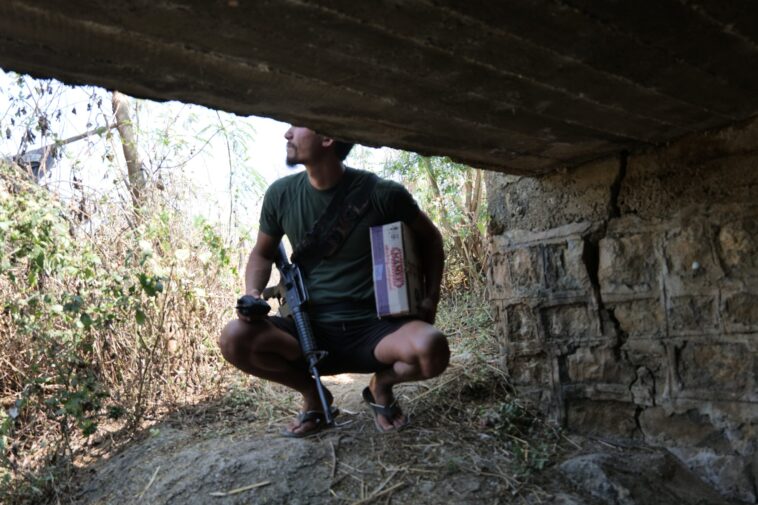
A man crouches under a concrete structure holding a rifle and a box, surrounded by overgrown vegetation.
Bunker and trench lines on the front lines of the war in Burma separate government-controlled areas from revolution-controlled areas. Although large-scale ground assaults with troops charging the lines are rare, government mortars, artillery, drones, and airstrikes target and kill civilians in revolution-controlled areas on a daily basis. Photo by Antonio Graceffo
Two soldiers in camouflage uniforms sit on a wooden bench at a lookout point, surrounded by military equipment and greenery.
Resistance soldiers guard a railroad bridge. The train stopped running years ago, but the bridge remains crucial for infantry crossing the river. Photo by Antonio Graceffo

The revolution began when most of these young men were around 14 years old, forcing them to leave school behind. While visiting a bamboo university the other day, the director told me that girls now outnumber boys in higher education by three to one. “Boys would rather pick up a gun and fight for our country,” she said. Wasted time and a loss of purpose have destroyed more lives in this war than bombs ever have.

Young soldier in military uniform sitting against a stone wall, displaying a serious expression and wearing insignia patches.
Most resistance soldiers are so young that the war already spans a quarter of their existence, and they know no other kind of life. Photo by Antonio Graceffo
Entrance to a makeshift shelter with red blankets and military gear scattered around, set in a natural environment.
The rainy season must be like hell, sitting in water and mud for five months out of the year, exposed to mosquitoes and malaria.

Where some of the holes looked lonely, others were overcrowded. But there was always a pervasive feeling of discomfort and close quarters. Weapon maintenance helps fill part of the day, both to fend off boredom and as a practical necessity to ensure weapons will fire when needed to ensure survival. The nonstandard uniforms—soccer shirts and gym shorts—underscore the ad hoc nature of the resistance.

Young individuals in a makeshift shelter handling firearms amidst bags and clothing, highlighting a scene of conflict or military training.
Boot camp is generally short, and young soldiers learn most of their craft on the front line from more experienced soldiers acting as teachers. Photo by Antonio Graceffo

The past ten days have been relatively quiet. Normally, the sounds of explosions are constant, but in the past twenty-four hours there have been only one or two. It is possible that the Tatmadaw is preparing for a major attack. If so, these guys will spring to life with renewed purpose, as they have time and again in the past. If not, they will sit and wait, sleep, and live in discomfort while worrying about their families in internally displaced people’s camps, dreaming of the day they can come down from the mountains and no longer need to protect their homeland from their own country’s government.


Close-up of a solemn soldier in a military helmet, captured in black and white, reflecting a moment of contemplation.
Antonio Graceffo reporting from Karenni State, Burma (Myanmar).

Leave a Reply

deputy-pm-lammy-turns-on-starmer,-reveals-he-warned-the-prime-minister-against-appointing-mandelson-as-us-ambassador-over-epstein-ties-–-update:-morgan-mcsweeney,-chief-of-staff-for-starmer,-resigns

Deputy PM Lammy Turns on Starmer, Reveals He Warned the Prime Minister Against Appointing Mandelson as US Ambassador Over Epstein Ties – UPDATE: Morgan McSweeney, Chief of Staff for Starmer, Resigns

‘america-the-beautiful’-singer-at-super-bowl-thrilled-to-represent-‘queer-community’

‘America the Beautiful’ Singer At Super Bowl Thrilled To Represent ‘Queer Community’