
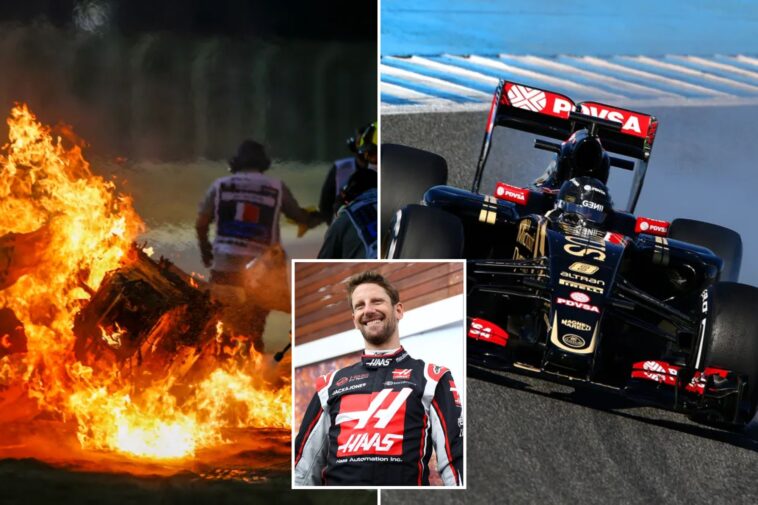
Nobody expects a Formula 1 Grand Prix auto race to end the way it did for Romain Grosjean on November 29, 2020, on the track in Bahrain.
Driving at a speed of 119 miles per hour, his Haas VF-20 got hit by fellow driver Daniil Kvyat. It sent his car ramming into a guardrail, generating a peak gravitational force equivalent (G-force) of 67. For comparison’s sake, fighter pilots experience a G-force of about nine during their maneuvers.
After Kvyat hit him, Grosjean knew the impact was coming. But he is no stranger to such an event. Wrecking your $15 million racecar is an occupational hazard of being an F1 driver. When the inevitable was nigh in Bahrain in the middle east, he did what he always does in such situations.

“I closed my eyes and tensed very hard,” he told The Post. “Then I opened my eyes and everything was orange. That’s not normal.”
Grosjean’s car was engulfed in flames. And there was another concern: His car hit the rail so hard it split in two.
“The gas cap broke,” the gas leaked out “and exploded,” said Grosjean — who still races, but retired from F1 after the incident. This weekend he will be an F1 commentator for the Las Vegas Grand Prix and host of “Fan Prix,” a free gathering for race fans that runs parallel to F1.

On Thursday, nine days before the fifth anniversary of his death-defying crash, Grosjean recalled how his brain would not allow him to register exactly what was going on during the 27 seconds he spent in the burning car.
The good news, at least, was his head was still attached to his body.
That happened thanks to a titanium bar called a halo, a protective device in the car to guard a driver’s head in the event of a high impact crash.
“If not for that,” said Grosjean, who is French-Swiss, “I would have been guillotined, just like a French king.”

Considering the fiery outcome, Grosjean, a married father of three, briefly came to terms with the fact he was inside a red-hot death chamber. Briefly, he told F1, “My body starts to relax, I’m in peace with myself and I’m going to die.”
Then he thought about his family, about himself, about his life as a driver and he realized he could not go out that way, burned to death.
Those 27 seconds “felt like a minute-and-a-half to me. Everything went slow. I tried to be methodical [about devising an escape plan],” he said.


“There was a lot of fire. My brain put that information aside so that I could focus on what was important: Jumping out of the car.”
But his eyes could not lie to him. “I was wearing red gloves,” said Grosjean. “They started getting black and dark and dirty. I knew they were burning.”
In fact, he was suffering second degree burns to his hands.
As the seconds piled up, the situation became increasingly dire and the temperature inside the Haas is believed to have reached 1,800 degrees. To save his own life, Grosjean began maneuvering for his escape. “I pushed out a piece of foam over my head that allowed me to exit through the roof.”

But there was a serious obstacle. As he lifted his body to climb out of the open top, his left leg would not cooperate. “My foot was stuck [in the wrecked front of the car],” he said. “I came back down and landed pretty hard.”
Giving escape another shot, he said, “My foot came out of my boot.”
Leaving the boot behind, he pushed himself up through the car’s open top and landed on the asphalt. In video of the crash, safety workers had, by then, surrounded the car and began spraying it with flame retardant.
It’s unclear whether or not they expected to see Grosjean emerge alive.

But he did. Video of the crash shows him stepping through the fire, with just one boot. Emergency medical workers on the track wanted to put him on a rolling bed for transport to the ambulance. But, as a show of strength, Grosjean insisted on walking with their help.
Miraculously, his hands were burned but the fire had not gotten to the rest of his body. He suffered a broken knee and “my left ligament was gone.”
Incredibly, just three months later following skin grafts and rehab, Grosjean was back behind the wheel and even racing again by February 2021.
Asked if his wife tried to talk him out of competing again, Grosjean answered in the negative.

“I think she knew that if I was doing something that was not what I deeply wanted, I would probably be miserable,” said Grosjean whose next race is the annual 24-hour race, Rolex 24 at Daytona in January 2026.
“She gave me the freedom to decide what I wanted to be. But she knows that I do the best I can to stay in one piece.”