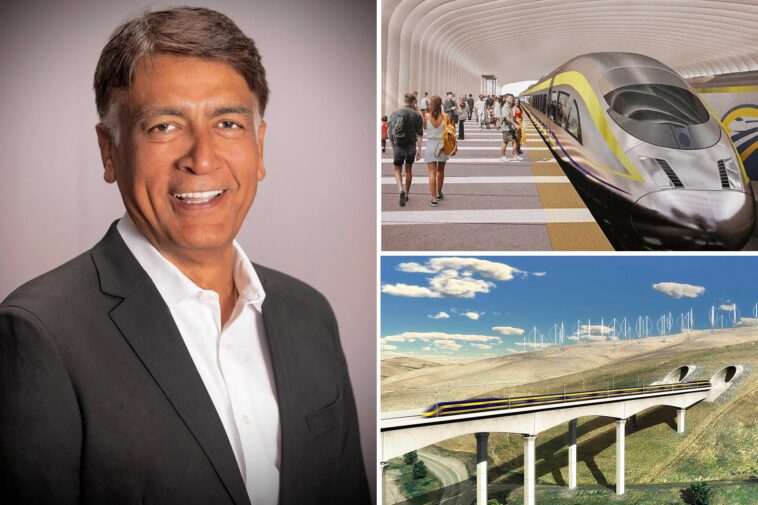

The man in charge of California’s beleaguered high-speed rail line offered up in a Monday speech the underlying reason why the project has failed to materialize after a decade of work: the state’s own crippling regulations.
High-Speed Rail Authority CEO Ian Choudri spoke at a Fresno rotary club and pinned blame on California’s byzantine building rules for out-of-control costs and delays for the initially projected $231 billion project, the Fresno Bee reported.
“Every little thing gets a lot of attention — positive or otherwise,” the rail boss said.

“Back in the day, in the 1800s, we were able to build infrastructure like this in a very short amount of time,” he said.
“What happened after that, continuously we kept regulating ourselves more and more and more.”
He seemed to particularly emphasize laws requiring environmental reviews, specifically the California Environmental Quality Act, for causing delays. Such a regime requires public input from every community and can turn into messy lawsuits that stretch the timeline further.
“Construction goes through those — I will not call them constraints — but those environments that were not there in the past, so it takes longer to build a program like this,” Choudri said.
The CEO has been urging lawmakers to help him cut through red tape to get construction going, such as exemptions from state environmental law or workarounds on eminent domain.
Sign up for the California Morning Report newsletter
California’s top news, sports and entertainment delivered to your inbox every day.
Thanks for signing up!

State Republicans agree with Choudri on what they describe as unnecessary overregulation under CEQA, but they blasted rail officials for seeking exemptions.
The answer, instead, should be to scrap it all.
“I’ve been saying this for years now, but this is the most wasteful government project in probably world history,” state Sen. Tony Strickland (R) told The Post. “It goes from a $33 billion projected estimate to the voters to go from LA to San Francisco. Now it’s $231 billion and climbing.”

“My dad always taught me at an early age, when you dig a hole for yourself, the best way to get out of the hole is to stop digging.”
The project is far from complete since workers broke ground on the project in 2015. Only this year did the ill-fated rail project enter what officials called the “track-laying phase.”
Meanwhile, costs for the original plan have ballooned past $200 billion, though the rail authority insists the reassessed project cost is $126.3 billion.

Gov. Gavin Newsom, who himself admitted in 2019 there was no path to get the train from San Francisco to Los Angeles, pushed the state to instead focus on a 171-mile segment between Merced and Bakersfield.
About 119 miles are under active construction with completion now targeted for 2032, though the Office of the Inspector General, in charge of auditing the project, recently said that goal may be optimistic.
The rail project is also facing potential financial disaster. The Inspector General warned recently that the California High-Speed Rail Authority’s funds could dry up as soon as December 2027 unless it secures financing — and the authority would need to borrow as much as $9.5 billion over five years just to keep construction on schedule.
The High-Speed Rail Authority issued a statement to The Post saying that it “values constructive oversight and partnership that helps strengthen the program.”
Download The California Post App, follow us on social, and subscribe to our newsletters
California Post News: Facebook, Instagram, TikTok, X, YouTube, WhatsApp, LinkedIn
California Post Sports Facebook, Instagram, TikTok, YouTube, X
California Post Opinion
California Post Newsletters: Sign up here!
California Post App: Download here!
Home delivery: Sign up here!
Page Six Hollywood: Sign up here!