
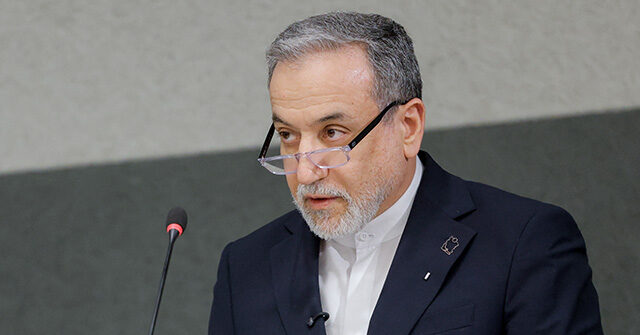
Iranian Foreign Minister Abbas Araghchi claimed on Thursday that an “understanding” was reached on “most elements of a potential agreement with the U.S.” during talks in Geneva, Switzerland, but no major breakthroughs were announced.
Iran does not appear to have offered any significant concessions to U.S. demands on uranium enrichment or ballistic missile development.
Araghchi told Iranian state media that the third round of talks on Thursday – the second in Geneva, and all mediated by the foreign ministry of Oman – were the “most intense so far,” running hours longer than previous meetings.
“There is agreement on most elements,” he said. “Some technical aspects need to be discussed later.”
“The U.S. must choose either the path of dialogue or the path of confrontation and tension,” he declared.
Oman’s Foreign Minister Badr al-Busaidi was upbeat as ever, reporting “significant progress” had been made, and “discussions on a technical level will take place next week in Vienna.”
Busaidi was scheduled to meet with senior U.S. officials in Washington on Friday, including Vice President JD Vance, “in an effort to avoid war with Iran.”
Vance said on Thursday he remains “skeptical of foreign military interventions,” and “we all prefer the diplomatic solution,” but he told reporters that a limited kinetic military action against Iran could be conducted without triggering a larger conflict.
“The idea that we’re going to be in a Middle Eastern war for years with no end in sight — there is no chance that will happen,” he said.
Vance said the ball was in Iran’s court, even as Araghchi was insisting the ball was in America’s court. “It really depends on what the Iranians do and what they say,” the vice president said.
Despite the assurances of progress from Araghchi and Busaidi, Iran reportedly rejected several key U.S. demands, including handing over its near-weapons-grade uranium stockpiles to a neutral third country, halting further uranium enrichment, and demolishing its nuclear facilities.
At least one unnamed U.S. official nevertheless characterized Thursday’s talks as “positive,” while others said they were “disappointed” by Iran’s intransigence.
The aircraft carrier USS Gerald R. Ford, the largest and most advanced carrier in the world, departed from the Greek-owned island of Crete on Thursday and could arrive off the Israeli cost within 24 hours, greatly increasing the military pressure on Iran. The USS Abraham Lincoln carrier battle group is already within range of Iran, as are numerous advanced American warplanes at ground bases.