
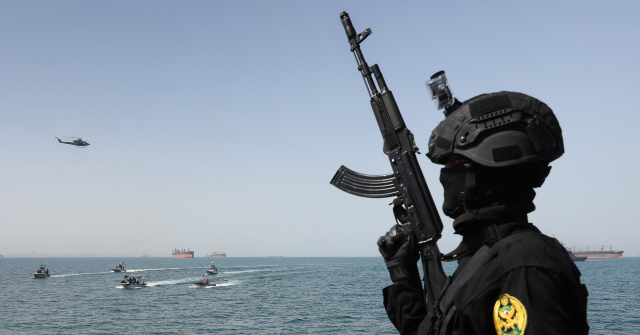
Iran’s Islamic Revolutionary Guard Corps (IRGC) held military drills on Tuesday, reportedly including tests for new weapons, even as top military official Ali Larijani was preparing to deliver Iran’s latest response in negotiations with the United States, and President Donald Trump was preparing to deliver his State of the Union (SOTU) address.
According to Iranian state media, Tuesday’s IRGC drills in southern Iran included “live-fire operations carried out using a range of weapons and newly adopted combined tactics, while employing modern technologies across multiple operational levels.”
The weapons tested included drones, naval and amphibious units, artillery, and ground-launched anti-ship missiles. IRGC ground forces commander Brig. Gen. Mohammad Karami said one goal of the exercise was to demonstrate how well Iran’s disparate land, sea, air, and missile units could coordinate their efforts against unspecified “security threats.”
Iranian state media reports made frequent mention of “new tactics” and “modern combat technologies.” The Fars News Agency said “micro-drones and loitering munitions” were tested, including the latest generation of Iran’s Shahed suicide drones.
Fars also claimed the IRGC tested “new missile systems” with “pinpoint strike accuracy” and “enhanced warheads,” including missiles that could switch targets while in flight.
The drill was transparently presented as a show of force combined with last week’s IRGC naval drills in the Strait of Hormuz to illustrate how the Iranian military has “optimized” its “strategic use of Iran’s geopolitical advantages in the Persian Gulf and the Sea of Oman.”
In other words, the Iranians appear to be attempting to telegraph their ability to blockade the Strait of Hormuz and interfere with global shipping in the event of U.S. military action.
While this show of force was in progress, Secretary of the Supreme National Security Council Ali Larijani — recently elevated to the top of Iran’s military hierarchy by Supreme Leader Ayatollah Ali Khamenei — was reportedly en route to Oman to present Iran’s latest offers and demands in negotiations with the United States.
Larijani, a former IRGC commander, was given greater authority to control both Iran’s external military forces and internal systems of oppression by Khamenei during last month’s uprising, which threatened to topple the Islamist regime. Khamenei was also said to be worried about preserving the regime’s military command and control, in the event he was liquidated by a U.S. airstrike.
Larijani is said to be carrying Iran’s official response to the latest proposals from Washington to Oman, which has acted as mediator between Washington and Tehran throughout the latest round of negotiations. Iranian Foreign Minister Abbas Araghchi said Iran would present the U.S. with a “draft of a possible agreement” sometime this week.
President Trump is likely to mention the Iran situation during his SOTU address, which begins at 9:00 p.m. Eastern Time on Tuesday night. The president recently said he believes successful negotiations with Iran — or, in the absence of a deal, military actions to neutralize Iran — are necessary before further progress can be made on his Gaza peace initiative, since Iran is a key supporter of Palestinian terror groups like Hamas.