
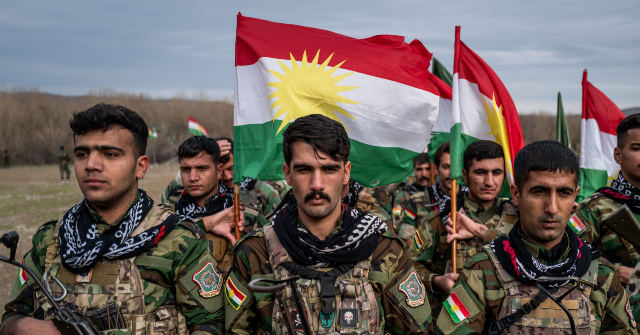
The Kurdistan Regional Government (KRG) of Iraq categorically denied that its Peshmerga were preparing an invasion of Iran alongside the United States on Thursday, following rumors that some Iranian Kurdish groups are planning ground operations on what remains of the Iranian terror state.
President Donald Trump launched “Operation Epic Fury” on Saturday against critical targets in Iran, designed to neutralize the ability of the world’s most prolific state sponsor of terrorism to pose a threat to the United States and Israel. The operation, alongside a simultaneous Israeli military engagement, has targeted hundreds of Iranian military sites, reportedly including some nuclear facilities, and eliminated some of Iran’s most important senior officials, including “supreme leader” Ayatollah Ali Khamenei.
This week, following reports that dozens of leaders within both Iran’s government and the terrorist Islamic Revolutionary Guard Corps (IRGC) were eliminated, reports in establishment media sites, citing anonymous sources, began claiming that Kurdish forces were preparing a ground attack in Iran. The Kurds, an ethnic group indigenous to the heart of the Middle East, are comprised of a wide variety of political and military groups, as the region traditionally known as Kurdistan spans across Iran, Iraq, Syria, and Turkey. The most powerful and organized of these is the Kurdistan Regional Government (KRG) of Iraq, which largely operates as an autonomous government; the Iraqi Kurdish Peshmerga proved to be some of the most effective forces on the ground during the war with the Islamic State terrorist group.
Syrian Kurdistan, or Rojava, hosts its own ecosystem of Kurdish autonomous civilian organizations and militaries, the latter most prominently represented by the People’s Protection Units (YPG/YPJ). In Turkey and Iran, the federal governments there have traditionally oppressed the Kurdish attempts at political organizing, which have included both political parties and, prominently, the militant Kurdistan Workers’ Party (PKK). The YPG and its broader military coalition in Syria, the Syrian Democratic Forces (SDF), as well as the KRG in Iraq have long maintained friendly relations with the United States, particularly in the fight against ISIS.
The president of the KRG, Nechirvan Barzani, issued a statement on Thursday denying that his forces or political officials would involve themselves in the ongoing Iran conflict.
“We reaffirm that the Kurdistan Region will consistently serve as a cornerstone of peace and will not engage in any conflict or military escalation that jeopardizes the lives and security of our people,” he declared, according to the Kurdish news outlet Rudaw.
Another official in the region, Hemin Hawrami of the Kurdistan Democratic Party (KDP), similarly declared, “We are not a part of this war & our goal is to preserve, maintain peace and security of our region & beyond,” directly responding to suggestions that the Iraqi Kurds would work to arm and support any Iranian Kurdish military activity against the regime there.
Elsewhere in Iraq, an official with the Kurdistan Freedom Party (PAK), Khalil Nadiri, reportedly said that they had moved some of their forces close to the Iranian border on Wednesday, but stated that they did not cross into Iran and had not yet planned to do so. The PAK had denied any movement into Iran categorically on Tuesday.
In Iran, the Democratic Party of Iranian Kurdistan (PDKI) told Rudaw on Tuesday, “none of our forces have entered the territory of Eastern Kurdistan [Rojhelat],” claiming, “such media reports are intended to create divisions within the coalition of East Kurdistan forces and are not true.” Rudaw reported that another Iranian Kurdish political party, Komala, similarly rejected the reports, but added, “we are on standby for all possibilities.”
The PDKI has involved itself rhetorically in the ongoing operation against the Iranian terror state. The group’s leader, Mustafa Hijri, on Wednesday published a message calling for Iranian soldiers to abandon the regime.
“I call upon all aware and freedom-seeking soldiers and personnel across Iran, and especially in Kurdistan, to abandon the barracks and military centers of the IRGC, the army, and other military forces of the regime,” Hijri shared, “to refuse their assigned duties, and to return to the embrace of their families.”
Komala, another Kurdish political organization in Iran, did claim that they had forces “waiting for the grounds to be suitable” to march into Iran, but reports on Thursday did not indicate they had crossed into Iran already. Komala’s comments followed a major development in Iranian Kurdistan: the unification of several major Kurdish parties, including Komala, into one major organization called the Alliance of Political Forces of Iranian Kurdistan.
A flurry of anonymous reports arose on Tuesday and Wednesday claiming that the Trump administration reached out to Iranian Kurdish groups asking them to attack the Iranian Islamist regime, all citing “people familiar” and other such sources. The reports also claimed that the CIA was involved in recruiting and arming Kurdish soldiers to fight Iran. The White House has not confirmed any such reports, but White House spokeswoman Karoline Leavitt told reporters on Monday, “President Trump has been in contact with many allies and partners in the region throughout the past several days.”