
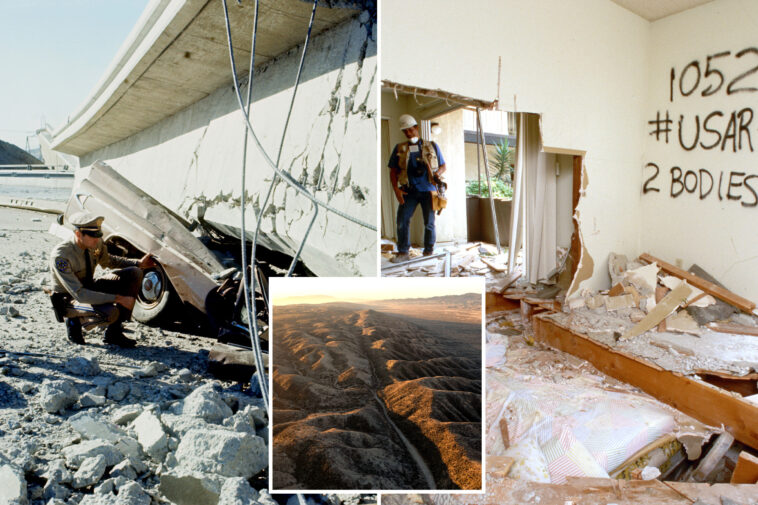

The West Coast’s worst nightmare may not end with one catastrophic earthquake.
Scientists have uncovered evidence suggesting the long-feared magnitude 9 Cascadia “Big One” could trigger a second major quake on California’s San Andreas Fault, creating a devastating chain reaction that would hammer much of the Pacific coast.


The startling discovery, published in Geosphere, is based on thousands of years of underwater sediment that appears to show both fault systems ruptured close together in the past.
“It’s kind of hard to exaggerate what a M9 earthquake would be like in the Pacific Northwest,” said Dr. Chris Goldfinger, a paleoseismologist at Oregon State University, in a statement to the Geological Society of America. “And so the possibility that a San Andreas earthquake would follow, it’s movie territory.”
A magnitude 9 Cascadia earthquake would already rank among the most destructive natural disasters imaginable, unleashing violent shaking, massive tsunamis and landslides across the Pacific Northwest.
The new findings suggest California may not have much time to recover before another major disaster strikes.
Sign up for the California Morning Report newsletter
California’s top news, sports and entertainment delivered to your inbox every day.
Thanks for signing up!


Ironically, the discovery happened because of a mistake.
During a 1999 research expedition, scientists were collecting seafloor sediment to reconstruct Cascadia’s earthquake history when a graduate student accidentally entered the wrong latitude, sending the research vessel about 90 kilometers south into an area influenced by the San Andreas Fault.
Download The California Post App, follow us on social, and subscribe to our newsletters
California Post News: Facebook, Instagram, TikTok, X, YouTube, WhatsApp, LinkedIn
California Post Sports Facebook, Instagram, TikTok, YouTube, X
California Post Opinion
California Post Newsletters: Sign up here!
California Post App: Download here!
Home delivery: Sign up here!
Page Six Hollywood: Sign up here!
“We wound up off northern California,” Goldfinger recalled. “When I woke up, I was pretty hot. But, once we were there, I thought, ‘well, let’s take a core here.’”
The wrong turn revealed something researchers never expected.
A sediment core collected from Noyo Canyon near Fort Bragg contained repeated pairs of deposits left behind by underwater landslides instead of the single layers scientists normally see.

The same unusual pattern also appeared in samples collected from Cascadia.
“There were these big, thick, sandy doublet events where it had a fine-grained element, and on top of it was a very coarse grained sandy unit. And we were just scratching our heads,” Goldfinger said.
Radiocarbon dating showed many of those paired layers formed at nearly the same time.
After eliminating other explanations, the team concluded the first deposit likely recorded a massive Cascadia megathrust earthquake, while the second was likely caused by movement on the San Andreas Fault.

“A lightbulb went on,” Goldfinger said. “What if Cascadia went off… and then the San Andreas went off some time later?”
Researchers cannot say exactly how much time separated the events.
Some evidence suggests it could have been only minutes or hours.

If that scenario plays out again, emergency responders could face back-to-back disasters stretching from the Pacific Northwest into California.
The findings have even changed Goldfinger’s own emergency plans.
“I’m from the Bay Area originally,” he said. “If I were in my hometown of Palo Alto, and Cascadia went off, I think I would drive east. There looks to me like a very high risk the San Andreas would go off next.”