
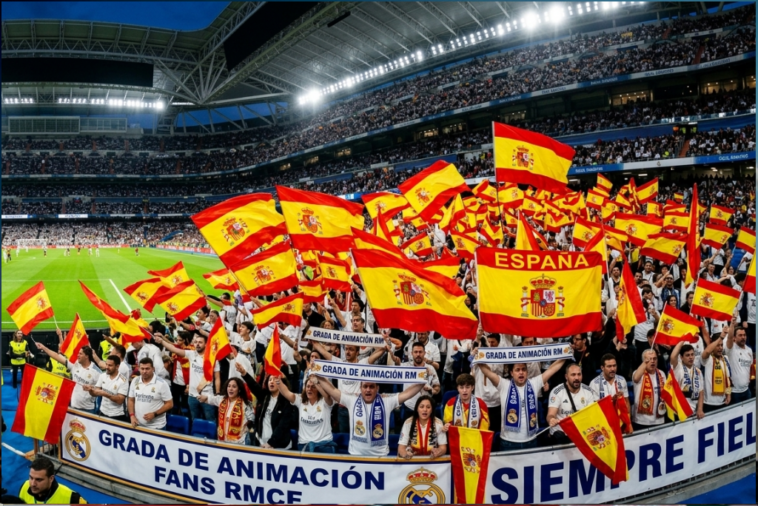

A controversy has erupted in European football, and the stage is one of the sport’s most iconic stadiums. Real Madrid decided to remove the Spanish flag from its supporters’ section at the Santiago Bernabéu during the match against Manchester City due to concerns about possible disciplinary sanctions from UEFA.
The decision has not gone unnoticed among fans. Many supporters of the Spanish club were surprised to see the absence of the national flag in an area of the stadium where it has traditionally been present for decades during major European nights.
According to various reports circulating among supporters and within the club’s environment, the move follows previous warnings from the governing body of European football. UEFA maintains strict regulations regarding banners, symbols, and messages that could be interpreted as political or ideological during international competitions.
Faced with that scenario, the club appears to have chosen a cautious approach. The main objective is to avoid any disciplinary case that could lead to financial penalties or sporting consequences during a crucial stage of the European competition.
However, the decision has sparked clear frustration among part of the Real Madrid fan base. For many supporters, it is difficult to understand how the official flag of Spain could become a source of warning inside a stadium located in Spain itself.
For decades, the Spanish flag has been a natural part of the atmosphere at the Santiago Bernabéu, especially during historic European nights. Thousands of fans have brought it to the stadium simply as a symbol of pride and support for one of the country’s most internationally recognized clubs.
That is why the measure has generated surprise and criticism on social media, where numerous fans have expressed disbelief. Many are asking how it is possible that displaying the flag of one’s own country could create problems during a sporting event.
UEFA has long defended a policy of strict neutrality inside stadiums. Under this interpretation, any symbol that could be linked to political or identity-related issues may be subject to warnings or sanctions depending on the context in which it appears during official matches.
This is not the first time the European governing body has faced criticism over its interpretation of stadium symbolism. Similar debates have emerged in other European countries when clubs or supporters were warned for displaying national or regional flags during international matches.
In Real Madrid’s case, the club has opted to minimize risk during a crucial moment of the season. Protecting the team from potential sanctions remains the top priority as the competition progresses.
Still, the episode has sparked a broader debate that goes beyond football. Many supporters find it difficult to understand how a national flag—officially recognized by the state—could become controversial inside a sports arena.
For some observers, what happened at the Bernabéu reflects a growing trend within certain international institutions to limit the presence of national symbols in public spaces, even when those symbols are deeply tied to the cultural identity of citizens.
And that is where criticism increasingly emerges across Europe. While bureaucratic institutions impose ever more rigid regulations, many ordinary citizens feel they are being asked to abandon symbols that are part of their history, culture, and identity.
For years, sectors of the political left promoted precisely that idea: diluting national identities in favor of supranational structures that promised harmony and progress. But what many citizens now perceive is something quite different—distant institutions attempting to dictate even which flag people can display inside the stadium of their own country.
READ MORE:
About The Author

Rafa Gómez-Santos Martín
Rafael Santos is a Portuguese writer and political analyst dedicated to educating Hispanics on traditional values and the importance of protecting children and families. With years of experience in media and public discourse, he has been a strong advocate for cultural preservation and moral principles in an ever-changing world. Passionate about culture, sports, and current affairs, Rafael brings insightful analysis to political and social debates, striving to empower the Hispanic community with knowledge and a deeper understanding of the issues that shape their lives.