
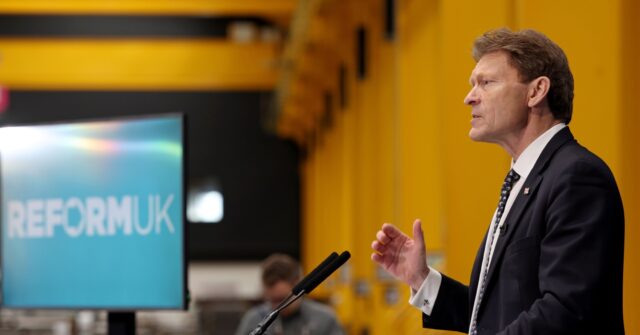
A Reform UK government would create a Sovereign Wealth Fund along the line of Norway or Singapore to back key British industries in a strategic and directed manner, Shadow Business, Trade, and Energy Secretary Richard Tice said on Tuesday.
In a speech delivered at USP Steel in Birmingham, Boston and Skegness MP and Deputy Leader of Reform UK, Richard Tice, outlined plans for a British Sovereign Wealth Fund (BSWF) of up to £575 billion, that would instantly become one of the top eight largest funds in the world.
The Shadow Business Secretary said that a Reform government would create the fund by merging the currently disparate local government pension schemes, which he argued have underperformed for pensioners “because they’re investing in a whole load of woke nonsense”.
Instead, his proposed fund would seek out “patriotic” investments, such as in defence, energy, and emerging tech like artificial intelligence. Tice specifically pointed to British Steel, which pressure from Reform leader Nigel Farage was taken over last year by the government to prevent its former Chinese owners from shutting the plant down for good.
“This fund could actually own British Steel,” he said. “It could renew, realign, refurbish those two blast furnaces ready for the next 60 years, that’s how we can ensure that great businesses like this one are buying British Steel and not steel from overseas.”
The Reform deputy said that he expects that BSWF could generate an annual surplus of between £20-30 billion, which would could be used to further invest in growth companies and spur “renewal and regeneration across our regions.”
“This is such a huge opportunity. It’s an absolute game changer. This could be one of our greatest legacies that Reform essentially brings to the United Kingdom. It could drive prosperity, it could drive growth,” he said.
“Other successful nations like Norway and Singapore have these sovereign funds and over the medium to long term they have been instrumental to those countries’ growth and prosperity,” Tice added.
The Reform deputy leader, who worked in the property industry prior to entering politics, will oversea a new “super department” that would combine multiple cabinet posts into one office, including housing, trade, business, and energy. This, Tice argued, will be necessary for the government to provide a unified strategic approach in shaping the British economy of the future.
The willingness to forge an effective industrial policy in which government would invest in certain sectors of the economy has been criticised by members of the former Conservative Party, who have claimed that it would represent a form of “socialism“.
However, Reform has rejected the notion of pure laissez-faire capitalism, particularly in the wake of globalisation, which has seen Western industries hollowed out by multinational corporations seeking cheap labour overseas. In addition to targeted investments, Tice presented a trade strategy for Britain that would follow a similar model to that forged by President Donald Trump in the United States.
He called for “tight quotas and significant tariffs, as we’ve seen other nations do” in areas such as the automotive industry in order to prevent Communist China using its cheap labour to flood the zone with electric vehicles, imperilling hundreds of thousands of British jobs.
Another key aspect of Reform’s economic agenda would be to unleash British energy and to scrap the “madness” of the Net Zero green agenda, which both Westminster establishment parties have sought to impose on the nation to the detriment of the UK economy by failing to take advantage of using British oil and gas, such as in the North Sea.
“It’s our patriotic duty to use our energy treasure. That’s the difference. If we do that, then we can again reduce bills, reduce the cost of living, and therefore everybody has more money in their pocket at the end of the week,” he said, adding that there will be a “multiplier effect” if a nation retains jobs and money from using its own natural energy resources.
Finally, Tice laid out plans for a “Great Repeal Bill” to scrap onerous regulations, notably in the housing sector, by using trusted partners and pre-approved homebuilders to eliminate the constant need for planning permission, to drive down the cost of building and thereby reduce the cost of living.
“If we do this, we can make our families more prosperous. We can make our communities more prosperous, and our country more prosperous. Family, community, country; the core values of Reform, because we all know this is the only way to fix our broken economy, and only Reform can fix broken Britain.”