
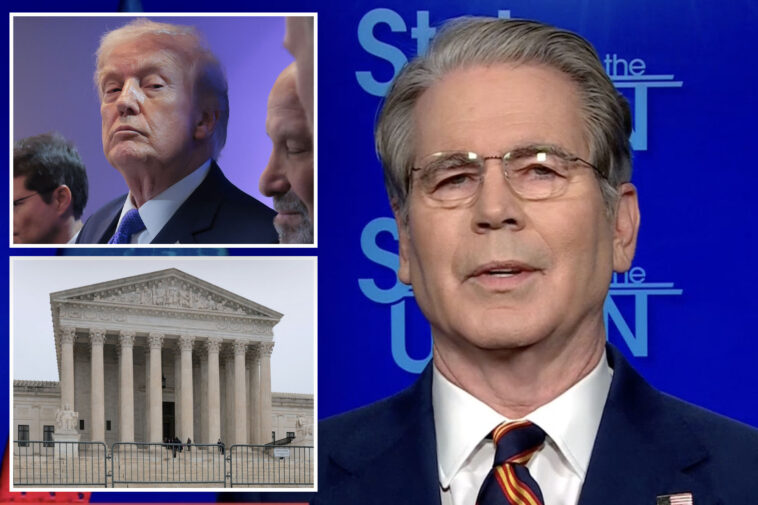
WASHINGTON — Treasury Secretary Scott Bessent deferred to the lower courts to determine how refunds for President Trump’s International Emergency Economic Powers Act (IEEPA) tariffs will work in the wake of the Supreme Court’s ruling.
“The Supreme Court didn’t even address that,” Bessent told CNN’s “State of the Union” Sunday. “The Supreme Court remanded it down to a lower court. And we will follow what they say, but that could be weeks or months when we hear them.”
Since the Supreme Court shot down Trump’s IEEPA tariffs, which were the centerpiece of his protectionist economic agenda, numerous companies have sued for refunds.

Bessent had previously warned that if the Supreme Court quashed the IEEPA tariffs, the Trump administration would get dragged into a messy refund process.
Ultimately, the Supreme Court declined to address how the refund process will work in its 6-3 decision, having largely ignored the issue during oral arguments last November as well.
Over $133 billion in revenue had been collected from the IEEPA tariffs as of last December — out of the $251 billion total from tariffs earned from the start of Trump’s second term, according to US Customs and Border Protection.
Last year, Trump repeatedly dangled the possibility of sending tariff dividend checks to American families. Illinois Gov. JB Pritzker (D) publicly suggested the president send tariff refunds to taxpayers in response to the Supreme Court’s decision.

While Trump has other methods of collecting tariffs via executive power, IEEPA has been his favorite vehicle due to its flexibility and the cumbersome requirements of the other options. Critically, IEEPA doesn’t mention the word tariff and hasn’t been used by another president to impose them.
Bessent, who had been in attendance when the Supreme Court heard oral arguments in the IEEPA tariff case last November and predicted the high court would uphold them, contended that Trump’s protectionist policies will continue.
“The president, the administration remains undeterred in reshoring American factories and getting rid of these massive trade imbalances. That’s the big story here,” the Treasury boss stressed.
“We are immediately going to go to Section 122 tariffs and that the revenue for the U.S. treasury for 2026, the projections, are unchanged.”
Since the Supreme Court decision, Trump used Section 122 of the Trade Act of 1974 to reimplement his 10% baseline tariff and jacked it up to 15%.
Section 122 tariffs are limited to 150 days and need Congressional approval to get re-upped after that. But the Trump administration intends to use that time to go through the procedural requirements to implement those tariffs under other authorities.

“During that time, we will do a study on Section 232, which will be done by Commerce Department [and on] Section 301, which will be done by USTR [United States Trade Representative],” Bessent said.
“Those tariffs remain in effect and have withstood more than 4,000 challenges since the president’s first term,” he added. “So, during that time, it is very likely that those studies will result in higher 232s, higher 301s, and it will get us back to the same tariff level.”
Section 232 of the Trade Expansion Act of 1962 lets the administration use tariffs on national security grounds, though they are supposed to target specific sectors rather than full countries.
Section 301 of the Trade Act of 1974 lets the USTR impose retaliatory tariffs after conducting an investigation. Those tariffs expire after four years.
“Rest assured, I’ve been speaking to these folks as well, and I’ve been telling them for a year whether this case, whether we won or lost, we were going to have tariffs,” USTR Jamieson Greer told CBS News’ “Face the Nation” Sunday. “The president’s policy was going to continue.”
“I haven’t heard anyone yet come to me and say, the deal’s off,” he added. “They want to see how this plays out. I’m in active conversation with them on it.”