
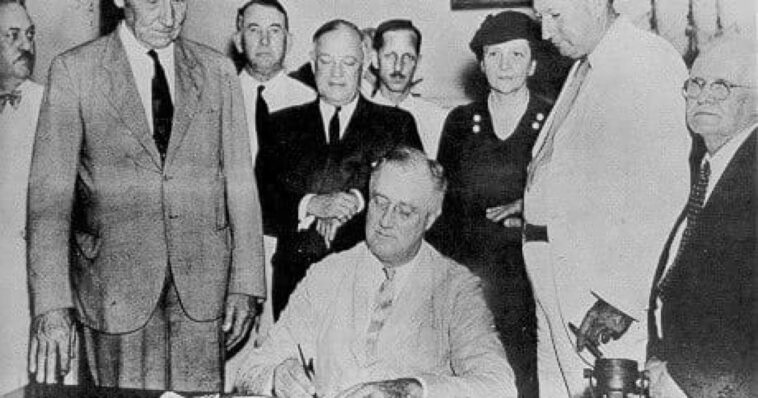

The insolvency of Social Security has been discussed for years. Is the solution Australia’s Superannuation program?
The nightmare arrives.
In 2014, in the book Falling Eagle – Rising Tigers, the massive spending of the Obama/Biden regime was discussed, and solutions that were working overseas from the Asia Pacific were presented.
The biggest problem on the table at that time and still today is the massive amount of unfunded liabilities that were increased under the Biden regime. Below is what I wrote in 2014 (pp. 23-24).
Even more alarming than the US’s annual deficits or federal debt burden is the amount of its unfunded liabilities. Unfunded liabilities are financial promises made with no money held in reserve to support these promises. For-profit organizations (e.g., companies or corporations) or not-for profit organizations (e.g., charities) must report the amount of liabilities or promises they have made that are outstanding. For example, if you have promised your employees that they will receive a pension upon their retirement, then you must report this in your financial statements.
In addition to reporting, a prudent company will set aside funds to pay for these promises when they become due. Companies may be legally prevented from taking money from the assets set aside for some of these obligations, and if a company or organization does not set aside adequate assets to support their liabilities, the organization could go bankrupt and face litigation as a result. Unfunded liabilities are a cause for concern in a company or corporation and a severe red light for anyone reviewing a company’s balance sheet to determine its financial solvency and business practices.
The US government does not have to abide by these reporting and reserving measures. The government does not have to provide in its basic set of financial statements the amount of its total liabilities, the bulk of which are currently unfunded. Also, it does not have to set aside assets to fund the obligations it has promised.
As of the end of 2012, the actual liabilities of the US federal government— including Social Security, Medicare, and federal employees’ future retirement benefits—were estimated to exceed $86.8 trillion, or 550% of annual GDP. In addition, for the year ending December 31, 2011, the annual accrued expense of Medicare and Social Security was $7 trillion. This means that these programs are adding $7 trillion annually to the US debt load but this $7 trillion is not counted in the amount of growing US debt or accounted for in its annual deficits. At the current rate, the US will have almost $100 trillion in financial debt and promises due at the end of 2014, but the public will only know about the small portion of this amount, the already massive $17 trillion in debt outstanding.
In late 2012, over 80 CEOs from some of America’s largest corporations encouraged Congress to reduce the amount of US debt. While the US currently borrows at record low interest rates, the concern is that this will change. This was the main concern of the individuals who attended the “Tea Party” rallies beginning in 2009. Many Americans were alarmed at the increases in federal government spending.
This was a warning. There are great ideas that other countries have in place that are much better than the programs in place in America. Instead of listening, the can got kicked down the road.
In early 2025 after President Trump’s inauguration Social Security was one topic being discussed. Senator Mike Lee shared a thread on this subject.
Social Security was advertised as a program to save YOUR MONEY.
2. In 1935, the American people were sold a bill of goods. They were told, “Pay into this system, and it’ll be YOUR money for retirement.” Sounds great, right? pic.twitter.com/vornmRyOY1
— Mike Lee (@BasedMikeLee) December 3, 2024
Two years later, the Washington crooks changed their narrative and labeled Social Security a tax.
4. The government—through Assistant Attorney General Robert Jackson—argued in essence, “Oh no, this isn’t YOUR money at all. This is a TAX, and we can do whatever we want with it.” Classic bait and switch. pic.twitter.com/NCNFJOs0lz
— Mike Lee (@BasedMikeLee) December 3, 2024
It started as your money and ended as their money.
6. So, to summarize: the proponents of the Social Security Act told American workers that what they paid into the system would remain *their* money, not the government’s—to get Congress to pass it—and then told the courts the exact opposite when defending the Act’s… pic.twitter.com/V0ygmHSkvL
— Mike Lee (@BasedMikeLee) December 3, 2024
This money goes into a huge account – the Social Security Trust Fund.
8. First of all, this money doesn’t sit in a nice, individual account with your name on it. No, it goes into a huge account called the “Social Security Trust Fund.”
— Mike Lee (@BasedMikeLee) December 3, 2024
The government can’t keep its hands off this money.
10. Every few years, there’s talk in Congress about “saving Social Security.” I’ve introduced and cosponsored a number of measures over the years that would fix it. But most in Congress show little desire to fix it, and are instead constantly looking for ways to “borrow” from…
— Mike Lee (@BasedMikeLee) December 3, 2024
The returns on Social Security are a joke.
12. If you had put the same amount into literally ANYTHING else—a mutual fund, real estate, even a savings account—you’d be better off by the time you reached retirement age, even if the government kept some of it!
— Mike Lee (@BasedMikeLee) December 3, 2024
This is the world’s greatest Ponzi scheme – (I shared this in 2012).
14. And let’s talk about how this system is set up to fail. The demographic shift? More retirees, fewer workers. It’s almost fair to compare it to a Ponzi scheme that’s running out of new investors.
— Mike Lee (@BasedMikeLee) December 3, 2024
This money is taken from you and you can’t invest it yourself for better returns.
16. Remember, this isn’t just about retirement. It’s about independence, about controlling your own destiny. With Social Security, you control nothing.
— Mike Lee (@BasedMikeLee) December 3, 2024
Of course, the management of Social Security is a joke, too.
18. And don’t get me started on the management. The Social Security Administration is a bureaucratic behemoth, not exactly known for its efficiency or innovation.
— Mike Lee (@BasedMikeLee) December 3, 2024
We need real reform.
20. So, what’s the solution? We need real, genuine reform. Within the Social Security system, Americans should be able to invest in their own future, and not be shackled by the worst parts of this outdated, mismanaged system.
— Mike Lee (@BasedMikeLee) December 3, 2024
We were sold a dream that became a nightmare.
22. We were sold a dream, but received a nightmare. It’s time for a wake-up call. We need real reform.
— Mike Lee (@BasedMikeLee) December 3, 2024
Social Security was a lie.
24. The history of the Social Security Act—which sadly must include the deceptive manner in which it was sold to the American people—is yet another reason why America’s century-long era of progressive government must be brought to a close.
— Mike Lee (@BasedMikeLee) December 3, 2024
In a recent article in Fortune, one top fiscal economist says that the US Deficit is not the reported $39 trillion, the real number is closer to $100 trillion — and that Washington’s own accounting rules are designed to hide it.
According to Kent Smetters, faculty director of the Penn Wharton Budget Model and one of the country’s most respected fiscal economists, that $39 trillion number is a polite fiction. The real tab, he argues, is closer to $100 trillion.
It has to do with the accounting distinction between explicit obligations — legally binding debts the government must repay — and implicit “pay-as-you-go” obligations — expected future spending commitments that carry moral or political, but not legal, force. “What we call implicit obligations are twice the size of explicit obligations,” Smetters told Fortune in a recent interview, referring to the unfunded liabilities buried inside programs like Social Security and Medicare.
If the U.S. government were required to report its finances under the same accounting rules as a publicly traded corporation, Smetters pointed out, the debt-to-GDP ratio wouldn’t be the current level of 100%, which is bad enough. “We’d be reporting a debt-to-GDP ratio closer to 300%.” The gap between those two numbers, he warned, is not a rounding error — it is the deliberate product of federal accounting standards designed to keep the full picture hidden from the public…
…The United States is not, Smetters insisted, on the verge of imminent collapse. The debt is manageable — in theory. But the window for a managed solution is closing.
What’s the answer? As noted a decade ago – the answer is a program like Australia’s Superannuation program.
This was shared at The Gateway Pundit in October of 2014 – It still is the answer.
Australia’s superannuation program may be the answer to the US’s Social Security quagmire. Australia implemented an innovative retirement system based primarily on mandatory private savings in plans called ‘superannuation funds’. This system became known as the ‘Superannuation Guarantee’ and has since been modified and expanded over time.
Australia’s superannuation is a mandatory retirement savings scheme for employees. It mandates that employers contribute 9% of eligible employee earnings, similar to FICA taxes in the US Social Security program, into a fund owned by the employee. The worker cannot generally access the superannuation funds until retirement or disability. There are very few governmental restrictions on the funds as well as governmental investment asset requirements and the beneficiary selects who will oversee their funds and what investments will make up their own portfolios.
In addition to fund performance, the superannuation funds may add disability or life cover to the plans they manage. These benefits provide the individual additional coverage should an unfortunate event occur and have created a very large market for these types of insurance products for not just insurance companies but reinsurers as well. The incentive for individuals to obtain insurance coverage also benefits the country by having fewer individuals to care for under its welfare and disability programs. The Australia Superannuation Guarantee is an example of how a sensible and smart social program in a country can have a positive impact on other social programs in that country.
Overall the results of the Australia superannuation program to the Australian economy are positively staggering. The Australian markets are liquid and growing. Results from a global pension assets study produced by Towers Watson & Company in early 2013 noted that the Australia pension fund assets are the fourth largest in the world – not so bad for a country of a little over 20 million people. It is clear that the Australian superannuation scheme ‘works effectively’ while the US Social Security system does not.
For more information on how the US would greatly benefit by replacing Social Security with a superannuation scheme get my book Falling Eagle – Rising Tigers.