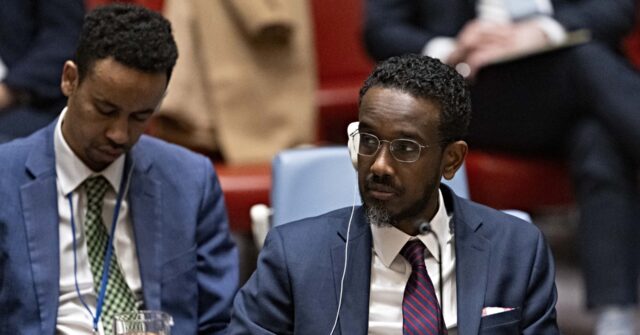
The rotating presidency of the United Nations Security Council (UNSC) will be assumed on January 1 by Somalia – a barely functional state that has exported thousands of “refugees” to the rest of the world, accompanied by crime waves and social distortions.
U.N. Watch executive director Hillel Neuer highlighted the absurdity of handing over the presidency of the Security Council to “the #1 Worst Country in the World on the failed state index last year.”
“Al-Qaeda militia controls large parts of the country. Ninety-five percent of girls aged 4 to 11 in Somalia face genital mutilation,” Neuer noted.
“Somalia is a failed state that under 12 indicators was ranked the world’s worst on terrorism, corruption, inability to collect taxes, mass displacement, economic collapse, group grievance, brain drain, and chronic insecurity,” he continued.
“Somalia is a failed state controlled in large parts by al-Qaeda, and never should have been elected to the UN Security Council. By virtue of its absurd election – by a 93% majority of the U.N. vote – Somalia gets to hold the rotating monthly presidency,” he concluded.
Apologists for Somalia and/or the United Nations pointed out that the Security Council presidential rotation is a fairly automated bureaucratic process without any stringent requirements for the job, which is meant to be a simple functionary position that only lasts for one month.
As Neuer mentioned, Somalia was elected to a non-permanent seat on UNSC in June 2024, for the first time since its previous stint as a non-permanent member in the 1970s.
UNSC has five permanent members – the United States, United Kingdom, France, China, and Russia – plus ten rotating non-permanent members who are granted two-year terms by the vote of the U.N. General Assembly. The terms are staggered so that five non-permanent seats are up for a vote each year, and the seats are farmed out to different regions of the world. Somalia won the East African seat previously held by Mozambique in 2024, alongside new temporary members Denmark, Greece, Pakistan, and Panama.
Somalia received. 179 out of 193 votes in the General Assembly to confirm its seat, which was supposed to represent an important landmark on the country’s long, slow climb out of brutal military despotism, terrorist conquest, and bloody tribal feuds.
Critics of the decision to award Somalia a seat argued that it had not made very much progress toward becoming a stable and reliable nation-state. The al-Shabaab terrorist gang arguably controls more of Somalia than the government in Mogadishu does.
Nevertheless, Somalia’s boosters – including James Swan, then the acting special representative to Somalia from U.N. Secretary-General Antonio Guterres – contended that Somalia’s progress since the overthrow of dictator Mohamed Siad Barre in 1991 deserved to be recognized, and Somalia could offer valuable insights to UNSC about fighting terrorism.
Once a temporary seat on UNSC was granted to Somalia, it was only a matter of time before it would take a one-month stint as president. The timing turned out to be awkward, with the recent revelations of Somali fraud rings stealing billions of dollars from American taxpayers, and Somalia becoming embroiled in a heated debate over independence for its northwestern region of Somaliland.
Much of the U.N. membership joined Somalia in condemning Israel’s unilateral recognition of Somaliland last week, although mostly in less hyperbolic terms than the government in Mogadishu, which accused Israel of “aggression aimed at encouraging fragmentation of the territory of Somalia.”
Of the five permanent members of UNSC, only the United States spoke favorably of recognizing the Republic of Somaliland, although it did not immediately join Israel in doing so. All ten of the temporary members rejected Israel’s recognition of the breakaway republic.
Two other states in the federation of Somalia, Puntland and more recently Jubaland, have suspended all relations with the government in Mogadishu, which greatly complicates the argument that Somalia has made tremendous progress towards achieving rational measures of statehood. To hear the Puntlanders tell it, Mogadishu is the breakaway state that is close to seceding from the rest of Somalia.
The Horn Review think tank, which takes an optimistic view of the Mogadishu government, argued last week that Somalia’s presidency of UNSC was not purely ceremonial and formulaic.
“Strategically, the role grants Somalia direct agenda setting power. For Somalia, the presidency is a critical conduit to address two paramount regional issues,” the Horn Review said, those issues being more U.N. financing for the African Union’s peacekeeping mission in Somalia, and international efforts to control the al-Shabaab terrorist organization.
“In this sense, the presidency transforms Somalia from a perennial subject of Security Council deliberations into an active shaper of its responses. However, Somalia’s capacity to fully capitalize on this opportunity is inherently limited by its own on going challenges,” the think tank said – perhaps unintentionally buttressing Neuer’s critique that the rotating presidency of UNSC is about more than just rapping a gavel, so there should be higher standards for holding it.